
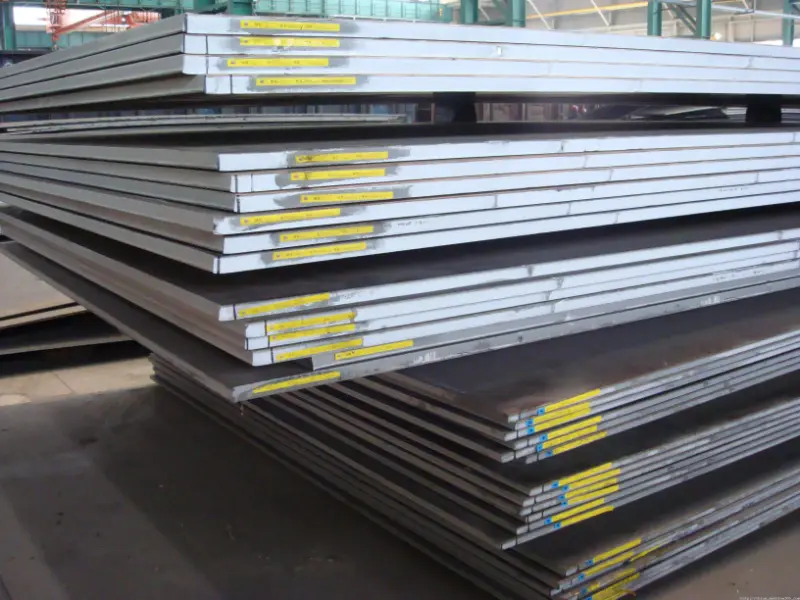
KR A63 Shipbuilding Steel
KR A63 Shipbuilding Steel: High-Strength Coil for Marine Construction
Explore the properties, equivalences, and applications of KR A63 steel coil, a 620 MPa yield strength shipbuilding plate approved by Korean Register. Detailed data on chemistry, mechanical and physical properties.
Cutting, bending, cold forming, welding (SAW, SMAW, GMAW), blasting, painting
- Phone : +8618037372205
- Email : [email protected]
- WhatsApp: Contact via Whtsapp
- WeChat: +8618037372205
KR A63 Shipbuilding Steel Introduction
KR A63 is a high-strength hull structural steel defined by the Korean Register (KR) Rules for the Classification of Steel Ships. It belongs to the A series of toughness grades, requiring Charpy V-notch impact testing at 0°C. With a minimum yield strength of 620 MPa (for thickness ≤100 mm) and tensile strength in the range 720–890 MPa, it is designed for demanding structural applications where high strength-to-weight ratio is critical. The steel is typically produced via thermo-mechanically controlled processing (TMCP) to achieve a fine-grained microstructure, ensuring good weldability and resistance to brittle fracture. It is primarily used in large container ships, bulk carriers, and offshore structures. International equivalents include ABS AH63, DNV NV A63, BV A63, LR AH63.
KR A63 Shipbuilding Steel Chemical Composition
The chemical composition conforms to KR Rules and IACS UR W11 for Grade Y63. Carbon equivalent (Ceq) values are strictly controlled to avoid weldability issues. Microalloying elements (Nb, V, Ti) are used singly or in combination to refine the grain structure. Residual elements such as Cu, Cr, Ni, Mo are limited but may be adjusted within standard limits.
| Element | Requirement (wt%) | Notes |
|---|---|---|
| C | ≤ 0.20 | Ladle analysis |
| Mn | 0.90 – 1.60 | For thickness ≤100 mm |
| Si | ≤ 0.55 | |
| P | ≤ 0.025 | |
| S | ≤ 0.025 | |
| Al (acid soluble) | ≥ 0.015 | Minimum when no other grain refining element added |
| Nb | ≤ 0.05 | Optional grain refiner, alone or combined |
| V | ≤ 0.10 | Optional grain refiner |
| Ti | ≤ 0.02 | Optional grain refiner |
| Cu | ≤ 0.35 | Residual / intentional addition possible |
| Cr | ≤ 0.20 | Residual element |
| Ni | ≤ 0.40 | Residual element |
| Mo | ≤ 0.08 | Residual element |
| Carbon Equivalent (Ceq) | ≤ 0.42 (t≤50mm); ≤ 0.44 (50< t ≤70mm); ≤ 0.46 (70< t ≤100mm) | Ceq = C+Mn/6+(Cr+Mo+V)/5+(Ni+Cu)/15 |
KR A63 Shipbuilding Steel Thermal and Electrical Physical Properties
The following data are typical reference values for high-strength low-alloy shipbuilding steel at room temperature, unless stated otherwise. Actual properties may vary slightly with composition and processing route. These values are not mandatory in the material standard but assist in design and simulation.
| Property | Typical Value | Unit | Conditions |
|---|---|---|---|
| Density (ρ) | 7.85 | g/cm³ | At 20°C |
| Elastic Modulus (E) | 205 | GPa | At 20°C |
| Shear Modulus (G) | ~80 | GPa | Estimated from E and ν |
| Poisson's Ratio (ν) | 0.30 | - | At 20°C |
| Thermal Expansion Coeff. (α) | 12.0 ×10⁻⁶ | /K | 20–100°C |
| Thermal Conductivity (λ) | ~50 | W/(m·K) | At 20°C |
| Specific Heat Capacity | ~460 | J/(kg·K) | At 20°C |
| Electrical Resistivity (ρ_e) | ~0.2 ×10⁻⁶ | Ω·m | At 20°C |
KR A63 Shipbuilding Steel Mechanical Properties
Mechanical testing is performed on standard transverse or longitudinal test pieces. Yield strength and tensile strength values are applicable for all thicknesses up to 100 mm. Charpy impact energy values are minimum average of three specimens, at 0°C for A grade. Bend test is conducted over 180° without cracking. These values are in accordance with KR Rules.
| Property | Required Value | Unit | Test Condition / Thickness |
|---|---|---|---|
| Yield Strength (ReH) | ≥ 620 | MPa | Transverse sample, thickness ≤100 mm |
| Tensile Strength (Rm) | 720 – 890 | MPa | Transverse sample |
| Elongation (A5) | ≥ 15 | % | Gauge L=5.65√S0, thickness ≤50 mm |
| Elongation (A5) | ≥ 14 | % | Thickness 50–70 mm |
| Elongation (A5) | ≥ 13 | % | Thickness 70–100 mm |
| Charpy V-notch Impact Energy (KV2) | ≥ 31 (longitudinal) | J | At 0°C, thickness ≤50 mm |
| Charpy V-notch Impact Energy (KV2) | ≥ 27 (longitudinal) | J | At 0°C, thickness 50–70 mm |
| Charpy V-notch Impact Energy (KV2) | ≥ 24 (longitudinal) | J | At 0°C, thickness 70–100 mm |
| Bend Test (180°) | No cracks or defects | - | Mandrel diameter 2t (t≤25 mm), 3t (t>25 mm) |
KR A63 Shipbuilding Steel Full Equivalent Standards and Replaceable Grades
| Country / Region | Standard / Rule | Grade | Remarks |
|---|---|---|---|
| International | IACS UR W11 | Y63 (A toughness level) | Unified requirement for ship steel, identical to KR A63 |
| Norway/Germany | DNV GL Rules | NV A63 | Identical technical requirements |
| USA | ABS Rules | AH63 | A-level toughness, 620 MPa YS |
| France | BV Rules | A63 | Same as IACS UR W11 |
| United Kingdom | LR Rules | AH63 | Identical |
| Japan | NK Rules | KA63 | Identical, K for Kaisen (ship) |
| China | CCS Rules | A63 | Adopted from IACS |
| Italy | RINA Rules | A63 | Direct equivalent |
KR A63 Shipbuilding Steel Application Introduction
The high strength of KR A63 enables reduction of plate thickness in ship structural members, resulting in lower hull weight and increased deadweight capacity. It is especially suitable for large container ships and bulk carriers where high longitudinal bending moments demand high-strength steel in the upper flange region. Good weldability permits conventional shipyard welding processes, though strict heat input control and low-hydrogen practices are recommended to avoid cold cracking.
Product Applications: Large container ships (deck plating, stringer plates, hatch coamings), Bulk carriers (topside strakes, sheer strakes), Naval vessels (hull and superstructure), Jack-up rig legs and spudcans, Offshore platform decks and modules
Processed into products: Hatch coaming plates and stiffeners, Longitudinal girders, Deck stringer angles, Keel plates and bilge strakes, Web frames and brackets, Heavy-duty structural supports
Application industries: Shipbuilding, Offshore and marine engineering, Oil and gas platform construction, Heavy machinery fabrication
KR A63 Shipbuilding Steel Similar / Alternative Materials with Comparable Performance
| Country / Region | Standard | Grade | Remarks |
|---|---|---|---|
| International (Ship) | IACS UR W11 | A70 / AH70 | Next higher strength class (min YS 690 MPa), similar toughness, higher strength for weight savings but may require preheating during welding. |
| International (Ship) | IACS UR W11 | A56 / AH56 | Lower strength class (min YS 550 MPa), slightly lower C equivalent, easier fabrication, suitable for less critical areas. |
| Europe | EN 10025-6 | S690QL | Quenched & tempered structural steel, min YS 690 MPa, higher alloy content, used in offshore structures but not typically for ship hulls. Higher carbon equivalent may limit weldability without preheat. |
| Japan | JIS G 3106 | SM570 or SM570TMC | High tensile strength steel for welded structures, min YS 460 MPa (SM570), lower strength but common in some shipbuilding applications, not a direct substitute for A63 but sometimes used for similar purposes where 620 MPa is not essential. |
Notes:
This steel is often supplied with additional requirements such as Z-direction through-thickness tensile testing (Z35 or Z25), ultrasonic examination (e.g., according to EN 10160 or ASTM A578), or stricter dimensional tolerances. When ordering, the exact thickness range and desired delivery condition must be specified. For welded structures, a welding procedure qualification test is recommended to optimize parameters and ensure Charpy impact properties in the heat-affected zone.
- Share



