
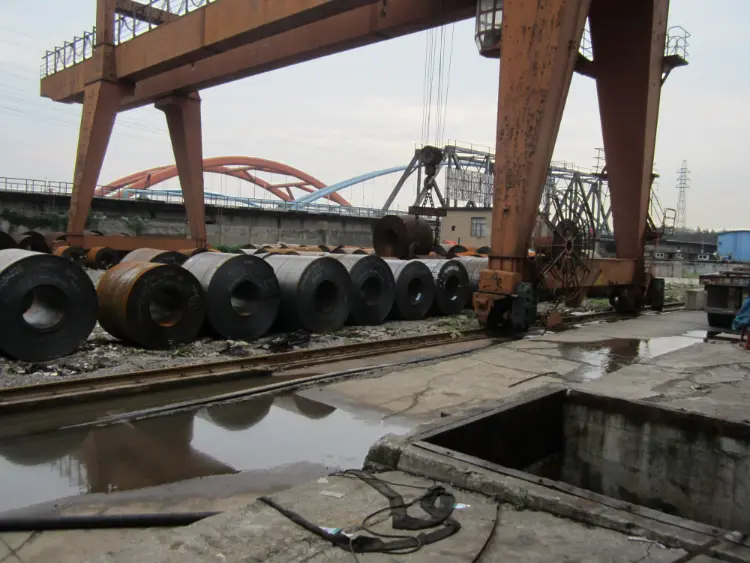
KR D63 Shipbuilding Steel Coil
KR D63 Shipbuilding Steel Coil Expert Data Sheet | Chemical & Mechanical Properties
Comprehensive technical profile of KR D63 shipbuilding steel coil covering chemical composition, mechanical properties, thermal & electrical physical data, international equivalents and application guide.
Thermo-mechanical controlled processing (TMCP), normalized rolling, or quenched and tempered (QT); machining, cold bending, gas/plasma cutting, submerged-arc welding (SAW), shielded metal arc welding (SMAW), and MIG/MAG welding
- Phone : +8618037372205
- Email : [email protected]
- WhatsApp: Contact via Whtsapp
- WeChat: +8618037372205
KR D63 Shipbuilding Steel Coil Introduction
KR D63 is a high-strength shipbuilding structural steel coil certified under the Korean Register (KR) rules. It belongs to the high-strength hull structural steel category with a minimum specified yield strength of 460 MPa and excellent low-temperature impact toughness tested at -20°C. The material is primarily produced via thermo-mechanical controlled processing (TMCP) or normalizing rolling routes. Typical characteristics include:
- Minimum yield strength ≥ 460 MPa, tensile strength 570–720 MPa
- Good weldability with low carbon equivalent (CEV) values, suitable for heavy-section welding without excessive preheating
- Superior crack-arrest toughness for critical ship structures such as decks, hull shells, and longitudinal strength members
- Compliant with major international classification society requirements and used interchangeably with EH40 grades
KR D63 Shipbuilding Steel Coil Chemical Composition
The chemical composition of KR D63 is carefully controlled to achieve high strength, good weldability, and excellent low-temperature toughness. Micro-alloying elements such as niobium (Nb), vanadium (V), and titanium (Ti) are added singly or in combination to refine the grain structure and provide precipitation strengthening. Carbon equivalent (CEV) is typically maintained ≤ 0.40 % to ensure cold-cracking resistance during welding. Residual elements (Cr, Ni, Mo, Cu) are limited to avoid excessive hardenability.
| Element | Standard Value (max, %) | Remarks |
|---|---|---|
| Carbon (C) | ≤ 0.20 | Ladle analysis; CEV control required for weldability |
| Silicon (Si) | ≤ 0.55 | Deoxidation element |
| Manganese (Mn) | 0.90 – 1.60 | Strength and toughness enhancement |
| Phosphorus (P) | ≤ 0.025 | Strict control for low-temperature service |
| Sulfur (S) | ≤ 0.025 | Strict control for lamellar tearing resistance |
| Chromium (Cr) | ≤ 0.25 | Residual element |
| Nickel (Ni) | ≤ 0.40 | Residual element (optional for low-temperature toughness improvement) |
| Molybdenum (Mo) | ≤ 0.08 | Residual element |
| Copper (Cu) | ≤ 0.35 | Residual element |
| Aluminum (Al) total | ≥ 0.015 | Grain-refining, acid-soluble aluminum |
| Niobium (Nb) | ≤ 0.05 | Grain refinement; combined addition ≤ specified limit |
| Vanadium (V) | ≤ 0.10 | Precipitation strengthening; combined addition ≤ specified limit |
| Titanium (Ti) | ≤ 0.02 | Deoxidation and grain refinement |
| Nitrogen (N) | ≤ 0.012 | Controlled for aging resistance |
| Carbon Equivalent (CEV) | ≤ 0.40 (typical) | CEV = C + Mn/6 + (Cr+Mo+V)/5 + (Ni+Cu)/15 ; guideline value for weldability |
KR D63 Shipbuilding Steel Coil Thermal & Electrical Physical Properties
The physical property data presented below are typical values for low-alloy high-strength structural steels in the density range of KR D63 and are not mandatory per the KR standard. Actual values can vary slightly depending on exact chemical composition and heat treatment condition. These values are critical for ship structural analysis, thermal distortion calculations, and induction-heating-based forming processes.
| Property | Typical Value | Unit | Test Conditions / Temperature |
|---|---|---|---|
| Density (ρ) | 7.85 | g/cm³ | 20 °C |
| Elastic Modulus (E) | 210 | GPa | 20 °C |
| Shear Modulus (G) | 81 | GPa | 20 °C |
| Poisson's Ratio (ν) | 0.3 | – | 20 °C |
| Thermal Expansion Coefficient (α) | 12.0 | 10⁻⁶/K | Ambient to 100 °C |
| Thermal Expansion Coefficient (α) | 12.5 | 10⁻⁶/K | Ambient to 200 °C |
| Thermal Expansion Coefficient (α) | 13.0 | 10⁻⁶/K | Ambient to 300 °C |
| Thermal Conductivity (λ) | 50 | W/(m·K) | 20 °C |
| Thermal Conductivity (λ) | 45 | W/(m·K) | 200 °C |
| Specific Heat Capacity (c) | 480 | J/(kg·K) | 20 °C |
| Specific Heat Capacity (c) | 520 | J/(kg·K) | 200 °C |
| Electrical Resistivity (ρ_e) | 0.22 | μΩ·m | 20 °C |
KR D63 Shipbuilding Steel Coil Mechanical Properties
The mechanical properties below are specified per KR Rules for D63 grade and are verified by tensile and Charpy V-notch impact testing. Properties may vary slightly depending on delivery condition (TMCP vs. normalized) and product thickness. For plates and coils above 50 mm thickness, the minimum yield and tensile requirements may be marginally adjusted as per the standard. The impact test temperature for grade D63 is -20°C. Bending tests at 180° are required for plates ≥ 12 mm.
| Property | Required Value | Unit | Test Conditions |
|---|---|---|---|
| ReH (Yield Strength) | ≥ 460 | MPa | t ≤ 50 mm |
| ReH (Yield Strength) | ≥ 440 | MPa | 50 mm < t ≤ 100 mm |
| Rm (Tensile Strength) | 570 – 720 | MPa | t ≤ 100 mm |
| A (Elongation) | ≥ 17 | % | Gauge length L0 = 5.65√So; longitudinal specimen |
| Bend Test (Mandrel Diameter) | d = 3a (180°) | – | t ≤ 25 mm, width ≥ 50 mm; d=mandrel dia., a=specimen thickness |
| Bend Test (Mandrel Diameter) | d = 4a (180°) | – | 25 mm < t ≤ 50 mm |
| KV (Charpy Impact Energy) longitudinal | ≥ 31 | J | t ≤ 50 mm; test temperature -20 °C |
| KV (Charpy Impact Energy) transverse | ≥ 24 | J | t ≤ 50 mm; test temperature -20 °C |
| KV (Charpy Impact Energy) longitudinal | ≥ 34 | J | 50 mm < t ≤ 100 mm; test temperature -20 °C |
| KV (Charpy Impact Energy) transverse | ≥ 27 | J | 50 mm < t ≤ 100 mm; test temperature -20 °C |
KR D63 Shipbuilding Steel Coil Fully Equivalent Material Standards & Substitutable Grades
| Country/Region | Standard/Society | Equivalent Grade | Remarks |
|---|---|---|---|
| Korea | KR (Korean Register) | D63 | Base designation |
| USA | ASTM A131 / A131M | EH40 | Same yield class, same impact test temperature (-20 °C) |
| Europe | EN 10025-4 | S460ML | TMCP delivery; longitudinal impact guaranteed at -50 °C (more severe) |
| Japan | JIS G 3106 | KE490 | Shipbuilding rolled steel; matching tensile class |
| China | GB 712 | DH40 | Equivalent yield and impact temperature; widely used in Asian shipbuilding |
| USA (ABS) | ABS Rules | EH40 | American Bureau of Shipping |
| Norway (DNV) | DNV Rules | E40 | Det Norske Veritas |
| UK (LR) | Lloyd's Register Rules | EH40 | Lloyd's Register |
| France (BV) | Bureau Veritas Rules | EH40 | Bureau Veritas |
| China (CCS) | CCS Rules | EH40 | China Classification Society |
| Japan (NK) | ClassNK Rules | KE490 | Nippon Kaiji Kyokai |
| Italy (RINA) | RINA Rules | EH40 | Registro Italiano Navale |
KR D63 Shipbuilding Steel Coil Application Introduction
KR D63 steel coil is engineered for critical ship and offshore structural applications where high strength-to-weight ratio, resistance to brittle fracture at sub-zero temperatures, and excellent weldability under shipyard conditions are mandatory. Its controlled chemistry and TMCP processing ensure uniform through-thickness properties and good fatigue resistance. Key application sectors include:
Product Applications: Container vessel longitudinal strength decks (ultra-large container ships), Bottom shell plating and hopper plates, Shear strakes and bilge strakes, Hatch coaming and upper deck girders, Transverse watertight bulkheads, Offshore platform module main support beams, Foundation nodes for offshore wind transition pieces, Pontoon and semi-submersible deck structures
Processed into products: Welded built-up H/I/T-section primary stiffeners, Flame-cut gusset plates and bracket plates, Notch-sensitive connections in high-stress zones (e.g., hatch corners), Bent hull plates using multi-roll pyramid bending, Laser-welded sandwich panels, Cold-formed long profiles and stringers
Application industries: Commercial Shipbuilding (tankers, bulk carriers, container vessels, LNG carriers), Naval Shipbuilding (auxiliary vessels), Offshore Oil & Gas (platform topsides, jacket structures, living quarters), Marine Renewable Energy (offshore wind turbine substructures, floating foundations), Heavy Lifting & Transport (ship-mounted cranes, heavy-lift vessel booms), Arctic & Ice-class Shipbuilding (when supplied with special Z-quality and low-temperature notch toughness approval)
KR D63 Shipbuilding Steel Coil Similar / Alternative Material Recommendations
| Country/Region | Standard/Grade | Designation | Remarks |
|---|---|---|---|
| Korea | KR Rules | D60 / E63 | D60 (lower tensile strength 520–670 MPa); E63 (same strength, impact at -40 °C) |
| Japan | JIS G 3106 | KE500 | Higher tensile class (610–770 MPa), suitable for weight reduction designs |
| Europe | EN 10025-6 | S500QL/S500QL1 | Quenched & tempered offshore steel with YS ≥ 500 MPa; check CEN/TR for marine application |
| USA | ASTM A131 | EH36 | Lower strength alternative (YS ≥ 355 MPa); higher availability and lower cost |
| China | GB 712 | FH40 | Similar strength with superior low-temperature impact (-60 °C); used for arctic vessels |
| Norway | DNV Rules | E420 / E460 | Direct higher-strength replacement in offshore standards |
Notes:
Supplementary requirements may be specified for Z-quality (through-thickness tensile testing per EN 10164 or ASTM A770) to guarantee lamellar tearing resistance in critically loaded joints. For arctic applications, users should consider FK or EK grade designations (impact tests at -40 °C or below) from the same material family. Additional testing such as CTOD (Crack Tip Opening Displacement), welding procedure qualification records (WPQR), and ultrasonic testing (UT) to class A or S1/E1 per EN 10160 are routinely applied to KR D63 plates above 12 mm thickness. Always confirm the latest KR Rules edition and the specific mill's CEV/CEN values to ensure compliance with the shipyard's welding standard.
- Share



