
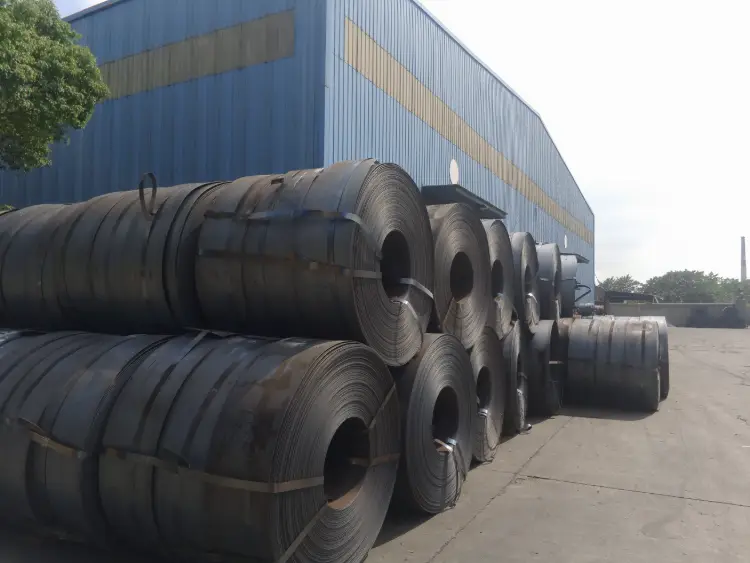
KR D70 Shipbuilding Steel Coil
KR D70 Shipbuilding Steel Coil - High Strength Structural Grade for Marine & Offshore Engineering
KR D70 is a DH70-grade high-strength shipbuilding steel coil certified by the Korean Register, offering a minimum yield strength of 690 MPa and excellent low-temperature toughness for marine structural applications such as hulls and offshore platforms.
Welding, bending, laser/plasma cutting, hot forming, cold forming
- Phone : +8618037372205
- Email : [email protected]
- WhatsApp: Contact via Whtsapp
- WeChat: +8618037372205
KR D70 Shipbuilding Steel Coil Introduction
KR D70 shipbuilding steel is a premium high‑strength structural steel grade certified by the Korean Register of Shipping (KR) in accordance with the KR Rules for the Classification of Steel Ships. The designation 'D70' follows the IACS UR W11 system: 'D' indicates a toughness class suitable for service temperatures down to ‑20 °C, and '70' corresponds to a nominal minimum yield strength of 70 kgf/mm² (690 MPa).
This thermomechanically rolled or quenched‑and‑tempered steel combines ultra‑high strength with good weldability and reliable low‑temperature impact toughness, making it ideal for weight‑critical and safety‑critical marine structures. Typical applications include deck plating, side shells, bottom longitudinals, and structural members in large container vessels, bulk carriers, and offshore platforms. The steel is supplied as hot‑rolled coil (further processed into cut‑to‑length sheets or plates) and is strictly produced under classification society survey to guarantee full compliance with all specified chemical and mechanical property requirements.
KR D70 Shipbuilding Steel Coil Chemical Composition – Ladle Analysis
The chemical composition of KR D70 shipbuilding steel is precisely controlled to achieve the required combination of high strength, excellent low‑temperature toughness, and good weldability. Carbon equivalent (Ceq) is limited to ≤ 0.42 % (for thickness ≤ 50 mm) to ensure satisfactory field welding without excessive preheat. Microalloying elements (Nb, V, Ti) are added for grain refinement and precipitation strengthening.
| Chemical Element | Standard Value (max., unless range) | Remarks |
|---|---|---|
| Carbon (C) | ≤ 0.20 | Typical for high‑strength TMCP/QT steels |
| Silicon (Si) | ≤ 0.55 | |
| Manganese (Mn) | 1.00 – 1.70 | Higher Mn for strength and toughness |
| Phosphorus (P) | ≤ 0.025 | |
| Sulfur (S) | ≤ 0.025 | |
| Aluminium (Als or total Al) | ≥ 0.015 | Grain refinement, deoxidation |
| Niobium (Nb) | ≤ 0.05 | Microalloying for precipitation hardening |
| Vanadium (V) | ≤ 0.10 | Microalloying |
| Titanium (Ti) | ≤ 0.02 | Grain refinement, fix nitrogen |
| Copper (Cu) | ≤ 0.35 | |
| Chromium (Cr) | ≤ 0.25 | |
| Nickel (Ni) | ≤ 0.40 | Improves toughness |
| Molybdenum (Mo) | ≤ 0.08 | |
| Nitrogen (N) | ≤ 0.012 | |
| Carbon Equivalent (Ceq) | ≤ 0.42 (for t ≤ 50 mm) | Ceq = C+Mn/6+(Cr+Mo+V)/5+(Ni+Cu)/15 |
KR D70 Shipbuilding Steel Coil Thermo‑Physical and Electrical Properties
The physical properties below are typical for quenched‑and‑tempered or thermomechanically rolled high‑strength steels with a minimum yield strength of 690 MPa. Slight variations may occur depending on exact chemical composition and heat treatment. These values are non‑mandatory but useful for design calculations and processing simulations.
| Property | Typical Value | Unit | Test Condition / Remarks |
|---|---|---|---|
| Density (ρ) | 7850 | kg/m³ | Room temperature |
| Elastic Modulus (E) | 210 | GPa | Room temperature |
| Shear Modulus (G) | 81 | GPa | Room temperature |
| Poisson's Ratio (ν) | 0.3 | – | Room temperature |
| Thermal Expansion Coefficient (α) | 11.7 | 10⁻⁶/K | 20–100 °C |
| Thermal Conductivity (λ) | 45 | W/(m·K) | 20 °C |
| Specific Heat Capacity (c) | 460 | J/(kg·K) | Room temperature |
| Electrical Resistivity (ρₑ) | 0.22 | μΩ·m | 20 °C |
KR D70 Shipbuilding Steel Coil Mechanical Properties
Mechanical testing is performed in accordance with KR Rules and IACS UR W11. The values below apply to transverse specimens taken from the coil/plate in the as‑delivered condition (TMCP or Q&T). Charpy V‑notch impact tests are conducted at ‑20 °C to verify D‑grade toughness. Bending tests are also required to confirm ductility without cracking.
| Property | Standard Requirement Value | Unit | Test Condition / Remarks |
|---|---|---|---|
| Yield Strength (ReH) | ≥ 690 | MPa | Room temperature, thickness ≤ 50 mm |
| Tensile Strength (Rm) | 770 – 940 | MPa | Room temperature, thickness ≤ 50 mm |
| Elongation (A) | ≥ 14 | % | L₀ = 5.65√S₀, transverse specimen |
| Charpy Impact Energy (KV₂) | ≥ 41 (mean), ≥ 27 (single) | J | ‑20 °C, V‑notch, longitudinal direction |
| Bend Test (180°) | d = 4t | – | No cracks or defects, t = specimen thickness |
KR D70 Shipbuilding Steel Coil Fully Equivalent Material Standards and Replaceable Grades
| Country / Region | Standard / Classification Society | Grade Designation | Remarks |
|---|---|---|---|
| International | IACS UR W11 | DH70 | Unified requirement for high‑strength hull structural steel |
| South Korea | KR | D70 / DH70 | Korean Register – identical specification |
| USA | ABS | DH70 | American Bureau of Shipping |
| France | BV | DH70 | Bureau Veritas |
| China | CCS | DH70 | China Classification Society |
| Norway | DNV | DH70 | Det Norske Veritas (now DNV GL) |
| UK | LR | DH70 | Lloyd's Register |
| Japan | NK | DH70 | Nippon Kaiji Kyokai (ClassNK) |
| Italy | RINA | DH70 | Registro Italiano Navale |
| Russia | RS | DH70 | Russian Maritime Register of Shipping |
KR D70 Shipbuilding Steel Coil Application Introduction
KR D70 steel coil is engineered for the most demanding marine and offshore environments where weight savings, high payload capacity, and reliable fracture toughness are critical. Its excellent combination of ultra‑high strength and good formability allows designers to reduce plate thickness while maintaining structural integrity. Typical usage follows classification society rules for hull construction and offshore structures.
Fabrication advice: Welding must be carried out with low‑hydrogen consumables matching the base metal strength; preheat and interpass temperatures should be controlled as per the steelmaker's recommendations. Cold forming can be performed, but the minimum bending radius should be at least 4 times plate thickness to avoid strain‑age cracking.
Product Applications: Hull plates and side shell panels, Deck plates and stringer plates, Bottom and bilge plates, Longitudinal stiffeners and frames, Bulkhead and superstructure components, Offshore platform decks, legs, and braces
Processed into products: Cut‑to‑shape ship building parts (brackets, gussets, flanges), Welded girders and beams, Reinforcement pads and doubler plates, Hatch coaming stays, Ice belt plates for polar‑class vessels, Fatigue‑critical connections in offshore structures
Application industries: Shipbuilding (commercial and naval vessels), Offshore engineering (platforms, jack‑up rigs, FPSO modules), Marine transportation (container ships, LNG carriers), Heavy machinery and structural engineering (where high‑strength plates are required)
KR D70 Shipbuilding Steel Coil Comparable / Alternative Materials with Similar Performance
| Country / Region | Standard | Grade | Remarks |
|---|---|---|---|
| International | IACS UR W11 | AH70, EH70, FH70 | Same strength level, different toughness classes (0 °C, ‑40 °C, ‑60 °C impact). Not fully interchangeable without re‑approval. |
| Europe | EN 10025‑6 | S690QL (S690QL1) | Quenched & tempered structural steel with min. 690 MPa yield. Not ship‑specific; requires additional welding/corrosion assessment for marine use. |
| USA | ASTM A514 / A517 | Grade S | High‑yield‑strength quenched & tempered alloy steel plate (min. 690 MPa). Suitable for general structural applications; not classified for ship hulls. |
| Japan | JIS G 3128 | SHY685 | High strength steel plate for pressure vessels (min. 685 MPa). Similar strength, but different certification scope. |
Notes:
Important considerations:
- Thickness limitations may apply; for sections exceeding 50 mm, special approval and through‑thickness (Z‑grade) properties (e.g., Z25, Z35) may be required as per KR Rules.
- All material must be surveyed during production and stamped with the classification society's mark. Test certificates (3.1 or 3.2 according to EN 10204) are mandatory.
- The steel shall be free from injurious surface defects; ultrasonic testing can be specified for internal soundness.
- When welding this grade, use of TMCP‑specific welding consumables and strict heat input control is essential to avoid softening in the heat‑affected zone.
- Storage and handling: The coil should be kept dry and protected from salt‑laden atmospheres to prevent pitting corrosion before fabrication.
- Share



