
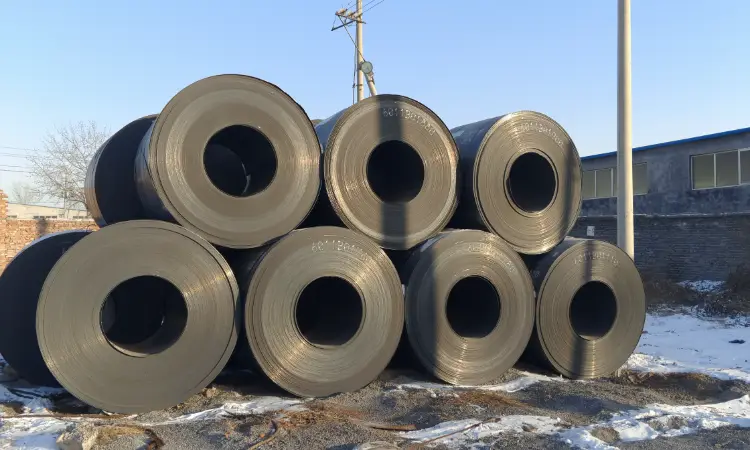
KR A70 Shipbuilding Steel Coil
KR A70 Shipbuilding Steel Coil - High Strength AH36 Equivalent for Marine Structures
Detailed material data for KR A70 shipbuilding steel coil, an AH36-equivalent high-strength grade under Korean Register rules, with chemical, mechanical, thermal, and electrical properties, recommended equivalents, and application guidance.
Hot rolling, normalizing, thermo-mechanical controlled processing (TMCP), cutting, bending, welding, cold forming
- Phone : +8618037372205
- Email : [email protected]
- WhatsApp: Contact via Whtsapp
- WeChat: +8618037372205
KR A70 Shipbuilding Steel Coil Introduction
KR A70 is a high-strength shipbuilding structural steel grade certified by the Korean Register (KR), widely considered equivalent to the internationally recognized AH36 grade under IACS UR W11. This hot-rolled steel is supplied primarily in coil form, with a minimum yield strength of 355 MPa and tensile strength between 490 and 620 MPa. It is designed for use in ship hulls, offshore platforms, and marine engineering structures where a combination of high strength, good weldability, and adequate toughness is required.
The steel is typically produced using controlled rolling or thermo-mechanical control processing (TMCP) and can be delivered in normalized or as-rolled condition. Its chemical composition features controlled carbon and manganese levels with grain-refining elements like aluminum, niobium, vanadium, or titanium to ensure fine austenite grain size. Impact toughness is verified at 0 °C (longitudinal average ≥ 34 J), making it suitable for ambient and moderately cold service conditions.
KR A70 coils can be further processed by cutting, bending, welding, and forming to fabricate various structural components, including stiffeners, bulkheads, deck plates, and web frames. The material conforms to the KR Rules for the Classification of Steel Ships, Part 2, Chapter 1, complying with stringent maritime classification society requirements.
KR A70 Shipbuilding Steel Coil Chemical Composition
The chemical composition of KR A70 steel, consistent with AH36 requirements, is designed to provide a balance of strength, toughness, and weldability. The following limits are according to KR Rules Part 2, Chapter 1, Section 3. Grain-refining elements, such as Al, Nb, V, or Ti, are added in sufficient quantities to achieve fine austenite grain size. If Al is used, the acid-soluble aluminum content must be at least 0.015%; otherwise, alternative grain refiners are used at levels documented in the ladle analysis. Elements not listed are at residual levels unless specifically agreed.
| Element | Standard Value (max, unless range) | Unit | Remarks |
|---|---|---|---|
| Carbon, C | 0.18 | % | Maximum; lower for improved weldability |
| Silicon, Si | 0.10 – 0.50 | % | Deoxidizer and strength contributor |
| Manganese, Mn | 0.90 – 1.60 | % | Enhances strength and hardenability |
| Phosphorus, P | 0.035 | % | Maximum; higher values impair toughness |
| Sulfur, S | 0.035 | % | Maximum; kept low for cleanliness |
| Aluminum, Altot | ≥ 0.015 | % | Acid-soluble, if used as grain refiner |
| Niobium, Nb | ≤ 0.05 | % | Optional grain refiner (typical 0.02–0.05) |
| Vanadium, V | ≤ 0.10 | % | Optional grain refiner |
| Titanium, Ti | ≤ 0.02 | % | Optional grain refiner |
| Nitrogen, N | ≤ 0.012 | % | If not bound by Ti or Al, may influence toughness |
| Copper, Cu | ≤ 0.35 | % | Residual; may be specified for corrosion resistance |
| Chromium, Cr | ≤ 0.20 | % | Residual |
| Nickel, Ni | ≤ 0.40 | % | Residual |
| Molybdenum, Mo | ≤ 0.08 | % | Residual |
KR A70 Shipbuilding Steel Coil Thermal and Electrical Physical Properties
The following physical properties are typical for low-carbon structural steel and are not mandatory specification values. They are provided for engineering design calculations. Variation may occur depending on exact composition, heat treatment, and temperature. Data are derived from published literature for similar HSLA steels and are suitable for preliminary modeling and analysis.
| Property | Typical Value | Unit | Test Condition / Remarks |
|---|---|---|---|
| Density, ρ | 7850 | kg/m³ | At 20 °C |
| Modulus of elasticity, E | 210 | GPa | Ambient temperature, static tensile loading |
| Shear modulus, G | 80 | GPa | Calculated from E and Poisson's ratio |
| Poisson's ratio, ν | 0.30 | - | In elastic range |
| Mean coefficient of thermal expansion, α | 12.0 × 10⁻⁶ | /K | 20 °C to 100 °C |
| Mean coefficient of thermal expansion, α | 12.5 × 10⁻⁶ | /K | 20 °C to 200 °C |
| Mean coefficient of thermal expansion, α | 13.5 × 10⁻⁶ | /K | 20 °C to 400 °C |
| Thermal conductivity, λ | 52 | W/(m·K) | At 20 °C |
| Thermal conductivity, λ | 49 | W/(m·K) | At 100 °C |
| Specific heat capacity, cp | 480 | J/(kg·K) | At 20–100 °C range |
| Electrical resistivity, ρe | 0.20 × 10⁻⁶ | Ω·m | At 20 °C |
KR A70 Shipbuilding Steel Coil Mechanical Properties
Mechanical properties are determined on specimens taken from flat products in the delivery condition, in accordance with KR Rules. The specified values apply to thicknesses up to 100 mm. Tensile testing is performed in the transverse direction; impact testing is performed on longitudinal Charpy V-notch specimens at the indicated temperature. Bending test requirements refer to a mandrel diameter of 3a for thicknesses ≤ 25 mm, where 'a' is the specimen thickness. For thicker products, the mandrel diameter may increase.
| Property | Standard Requirement | Unit | Test Condition / Remarks |
|---|---|---|---|
| Minimum yield strength, ReH | 355 | MPa | Transverse, t ≤ 100 mm (t = thickness) |
| Tensile strength, Rm | 490 – 620 | MPa | Transverse, t ≤ 100 mm |
| Minimum elongation, A5 | 21 | % | L0 = 5.65√S0, longitudinal, t ≤ 100 mm |
| Charpy impact energy, KV2 | ≥ 34 (average of 3) | J | Longitudinal, at 0 °C; one individual value ≥ 24 J allowed |
| Charpy impact energy, KV2 | ≥ 24 (average of 3) | J | Transverse, at 0 °C (if agreed) |
| Bend test, mandrel diameter | 3a (t ≤ 25 mm) | - | Bend angle 180°; no cracking on outer surface |
| Bend test, mandrel diameter | d = 3a + (t-25) (t > 25 mm) | - | d = mandrel diameter, a = thickness |
KR A70 Shipbuilding Steel Coil Full Equivalent Material Standards and Replaceable Grades
| Country / Region | Standard / Classification Society | Grade | Remarks |
|---|---|---|---|
| International (IACS) | IACS UR W11 | AH36 | Direct equivalent for all IACS members |
| USA | ASTM A131/A131M | AH36 | American Bureau of Shipping recognized |
| United Kingdom | Lloyd's Register (LR) | AH36 | Equivalent high strength grade |
| Norway/Germany | DNV GL (now DNV) | AH36 | Identical requirements |
| France | Bureau Veritas (BV) | AH36 | Same mechanical and chemical limits |
| China | CCS (China Classification Society) | AH36 | Same as IACS UR W11 |
| Japan | ClassNK (Nippon Kaiji Kyokai) | AH36 | Follows IACS UR W11 |
| Russia | RMRS (Russian Maritime Register of Shipping) | AH36 | Matches IACS specification |
| Italy | RINA | AH36 | Equivalent high strength steel |
| Poland | PRS | AH36 | Equivalent |
| Croatia | CRS | AH36 | Equivalent |
KR A70 Shipbuilding Steel Coil Application Introduction
KR A70 (AH36) steel coil is primarily used in shipbuilding and offshore engineering for structural components that require a reliable combination of medium-to-high strength, weldability, and toughness. It is suitable for all conventional shipbuilding processes, including plasma cutting, welding with common consumables (SMAW, SAW, FCAW, GMAW), and cold or hot forming. Because of its through-thickness property standard, it can be employed in moderately loaded stiffened panels, decks, and shell structures. The following lists typical industries, products, and specific components where this material is applied.
Product Applications: Ship hull structures (bulk carriers, tankers, container ships, naval vessels), Deck plates and hatch coamings, Longitudinal and transverse bulkheads, Web frames and floors, Jack-up rig legs and spudcans, Transition pieces and monopiles for offshore wind turbines, Box girders and crane pedestals
Processed into products: Longitudinal stiffeners (flat bars, bulb flats, angles), Transverse frames and floor plates, Bracket plates and collar plates, Stringer plates and sheer strakes, Bilge keels, Tank top plates, Reinforcement pads and backing plates, Hatch side coamings and end coamings
Application industries: Marine & Shipbuilding, Offshore Oil & Gas Platforms, Renewable Energy – Offshore Wind Foundations, Bridge Construction (where class-approved steel is required), Heavy Machinery & Structural Engineering
KR A70 Shipbuilding Steel Coil Similar / Close Substitute Materials Recommendation
| Country / Region | Standard | Grade | Remarks |
|---|---|---|---|
| International (IACS) | IACS UR W11 | AH32 | Lower yield strength (min 315 MPa), similar composition and toughness, usable when strength demand is relaxed |
| International (IACS) | IACS UR W11 | DH36 | Similar strength but impact test at -20°C; better low-temperature toughness, otherwise interchange possible |
| International (IACS) | IACS UR W11 | AH40 | Higher strength (min 390 MPa yield); slightly higher CEV, may be substituted when higher strength is needed |
| Europe | EN 10025-4 | S355MLO (-20°C impact) | Offshore structural steel with comparable strength; marine application requires re-certification |
| Europe | EN 10025-2 | S355J2 (+N/AR) | Structural steel (non-marine) with similar strength but without class society approval; not for ship hull |
| Japan | JIS G 3106 | SM490A | Welded structural steel with similar strength; requires additional impact testing and class approval for marine use |
Notes:
Supplementary Requirements: For thickness beyond 100 mm, the mechanical properties must be separately agreed upon with the classification society. Additional tests, such as ultrasonic examination of internal soundness (e.g., in accordance with EN 10160 or equivalent), drop-weight tear test (DWTT) for crack arrest, and through-thickness tensile testing (Z35) may be specified for critical applications. The carbon equivalent (CEV) is typically controlled to a maximum of approximately 0.38–0.40% to ensure adequate weldability without preheating in moderate thicknesses. Surface conditions are usually as-rolled, but shot blasting and primer shop coating can be applied as per customer requirements.
Marking: Each coil or plate is stamped with the manufacturer's name, steel grade (AH36), heat number, and classification society stamp. Certificates of 3.1 or 3.2 according to EN 10204 are provided, including chemical composition, tensile, and impact test results.
- Share



