
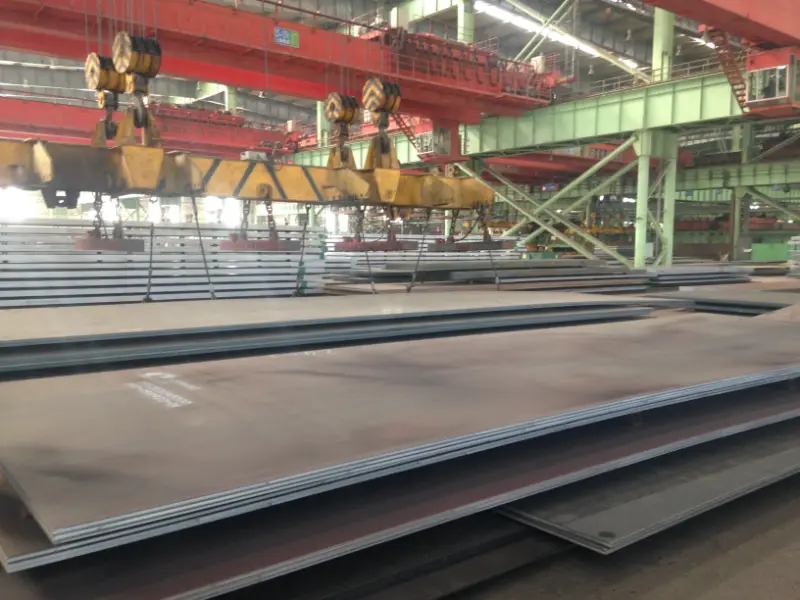
JIS SUS304J1 Austenitic Stainless Steel
JIS SUS304J1 Austenitic Stainless Steel: Deep Drawing & Forming Grade with Added Copper
Comprehensive data sheet for SUS304J1 stainless steel plate/coil per JIS G4304 and JIS G4305, including chemical composition, mechanical properties, thermal and electrical properties, and equivalent grades.
Deep drawing, stretch forming, bending, stamping, welding, machining (with appropriate lubricants)
- Phone : +8618037372205
- Email : [email protected]
- WhatsApp: Contact via Whtsapp
- WeChat: +8618037372205
JIS SUS304J1 Austenitic Stainless Steel Introduction
SUS304J1 is a copper-containing austenitic stainless steel standardized under JIS G4304 (hot-rolled) and JIS G4305 (cold-rolled). Compared with conventional SUS304, the addition of 1.00–3.00% Cu significantly enhances deep drawability, formability, and resistance to delayed cracking, while maintaining good corrosion resistance. The alloy exhibits an austenitic microstructure in the solution-annealed condition, non-magnetic or slightly magnetic after cold working. It is typically supplied in the form of hot-rolled or cold-rolled plates, sheets, and coils.
- Excellent deep drawing and stretch forming capabilities
- Good corrosion resistance in a wide range of environments
- Non-hardening by heat treatment, only by cold working
- Suitable for severe forming operations such as deep drawn sinks and hollowware
JIS SUS304J1 Austenitic Stainless Steel Chemical Composition
The chemical composition of SUS304J1 as specified in JIS G4304:2012 and JIS G4305:2012. The controlled addition of copper improves formability without significantly compromising corrosion resistance. The chemistry is analyzed on ladle samples.
| Element | Standard Value | Remarks |
|---|---|---|
| Carbon (C) | ≤ 0.08 | Maximum |
| Silicon (Si) | ≤ 1.00 | Maximum |
| Manganese (Mn) | ≤ 2.00 | Maximum |
| Phosphorus (P) | ≤ 0.045 | Maximum |
| Sulfur (S) | ≤ 0.030 | Maximum |
| Nickel (Ni) | 6.00 – 9.00 | Range |
| Chromium (Cr) | 17.00 – 19.00 | Range |
| Molybdenum (Mo) | ≤ 0.50 | Maximum, not intentionally added |
| Copper (Cu) | 1.00 – 3.00 | Range – characteristic addition |
JIS SUS304J1 Austenitic Stainless Steel Thermal and Electrical Physical Properties
Typical physical properties of SUS304J1 in the annealed condition. These values are based on standard data for similar austenitic stainless steels and may vary slightly depending on exact composition and processing. Property variation with temperature is shown where applicable.
| Property | Standard Value | Unit | Test Condition |
|---|---|---|---|
| Density (ρ) | 7.93 | g/cm³ | At 20°C |
| Elastic Modulus (E) | 193 | GPa | At 20°C |
| Shear Modulus (G) | 74 | GPa | At 20°C |
| Poisson's Ratio (ν) | 0.30 | - | At 20°C |
| Thermal Expansion Coefficient (α) | 16.0 | 10⁻⁶/K | 20–100°C |
| Thermal Expansion Coefficient (α) | 17.3 | 10⁻⁶/K | 20–300°C |
| Thermal Expansion Coefficient (α) | 18.0 | 10⁻⁶/K | 20–500°C |
| Thermal Conductivity (λ) | 16.2 | W/(m·K) | At 100°C |
| Thermal Conductivity (λ) | 17.5 | W/(m·K) | At 200°C |
| Thermal Conductivity (λ) | 21.5 | W/(m·K) | At 500°C |
| Specific Heat Capacity | 500 | J/(kg·K) | At 20°C |
| Electrical Resistivity (ρₑ) | 0.73 | μΩ·m | At 20°C |
JIS SUS304J1 Austenitic Stainless Steel Mechanical Properties
Minimum mechanical properties of SUS304J1 in solution-annealed condition at room temperature as per JIS G4304 and JIS G4305. Values apply to plate/sheet thicknesses ≤ 8 mm. For cold-rolled products, elongation varies with thickness; typical minimum values are shown. Hardness is given as maximum.
| Property | Standard Requirement | Unit | Test Condition |
|---|---|---|---|
| Yield Strength (0.2% offset, ReH) | ≥ 205 | MPa | Room temperature, solution annealed |
| Tensile Strength (Rm) | ≥ 520 | MPa | Room temperature, solution annealed |
| Elongation (A) | ≥ 40 | % | Thickness ≤ 8 mm (hot-rolled) |
| Elongation (A) | ≥ 40 | % | Thickness < 3 mm (cold-rolled) |
| Elongation (A) | ≥ 30 | % | Thickness ≥ 3 mm to ≤ 8 mm (cold-rolled) |
| Hardness (HBW) | ≤ 187 | - | Or equivalent Rockwell |
| Hardness (HRB) | ≤ 90 | - | As alternative to HBW |
| Bend Test (180° bend) | No cracks | - | Bend diameter = thickness |
JIS SUS304J1 Austenitic Stainless Steel Completely Equivalent Material Standards and Replaceable Grade Recommendations
| Country/Region | Standard | Grade | Remarks |
|---|---|---|---|
| Japan | JIS G4304 / JIS G4305 | SUS304J1 | Original specification – hot-rolled plate and cold-rolled sheet/coil |
| Japan | JIS G4303 (bars) | SUS304J1 | Same grade for bars and rods |
| International | ISO 15510 | X5CrNiCu17-8-3 | Closely matching composition but not widely adopted |
| USA | ASTM A240 | S30430 (UNS S30430) | Similar Cu-bearing grade, but Cu 3.0–4.0% and Ni 8.5–10.5%; slightly higher strength before forming |
JIS SUS304J1 Austenitic Stainless Steel Application Introduction
SUS304J1 is specifically designed for severe cold forming operations where standard 304 may suffer from cracking or excessive work hardening. Its superior drawability reduces intermediate annealing steps, making it cost-effective for deep-drawn components. The grade also offers good weldability by common fusion methods (TIG, MIG, resistance welding) and can be polished to attractive surface finishes.
- Often used in the kitchen and sanitary industry for deep sinks, bowls, and countertops.
- Preferred for drinking water systems and food processing equipment due to cleanliness and corrosion resistance.
- Suitable for architectural panels requiring complex shapes.
Product Applications: Deep-drawn kitchen sinks and washbasins, Cookware (pots, pans), Dishwasher tubs and drums, Drinking water tanks and water heaters, Elevator interior panels, Automotive decorative trims, Holloware and catering equipment
Processed into products: Sink bowls, Drawn cylindrical containers, Stamped brackets and brackets, Welded assemblies with deep forming, Exhaust system end caps, Deep-drawn motor housings, Sanitary fittings and taps
Application industries: Kitchenware and household appliances, Architecture and construction (façades, interior panels), Food and beverage processing, Automotive (trim, exhaust components), Medical equipment (non-implant, housings), General engineering and industrial containers
JIS SUS304J1 Austenitic Stainless Steel Similar/Near Equivalent Material Recommendations
| Country/Region | Standard | Grade | Remarks |
|---|---|---|---|
| Japan | JIS | SUS304 | Base composition without intentional Cu addition; lower formability |
| Japan | JIS | SUS XM7 | Higher Cu (3.0–4.0%) and Ni (8.5–10.5%); even better formability than SUS304J1 |
| Europe | EN 10088-2 | 1.4301 (X5CrNi18-10) | Standard 304; good formability but not as enhanced as SUS304J1 for deep drawing |
| Europe | EN 10088-2 | 1.4541 (X6CrNiTi18-10) | Ti-stabilized 304; comparable forming but higher cost |
| USA | ASTM A240 | 304 (UNS S30400) | Standard 304; no Cu, hence lower ductility during severe forming |
Notes:
SUS304J1 is non-magnetic in the annealed condition but may become slightly magnetic after heavy cold working. It is not recommended for applications requiring high pitting resistance (chloride environments) – consider 316L in such cases. Solution annealing temperature: 1010–1150°C followed by rapid cooling (water or air). Post-weld annealing is usually not necessary for thin sections, but stress relief may be needed to avoid stress corrosion cracking. For optimal deep drawing, use high-quality tooling and adequate lubrication.
- Share



