
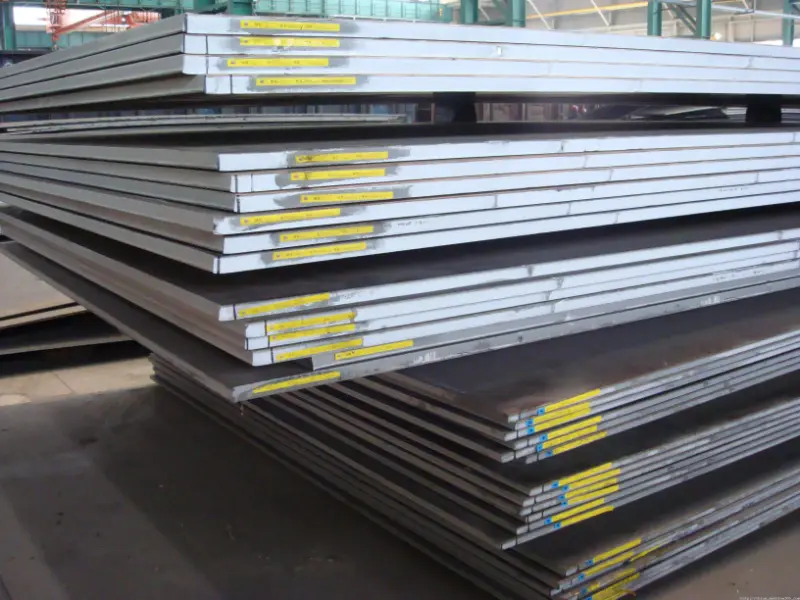
JIS G3132 SPHT4 Steel
JIS G3132 SPHT4 Steel: Hot-Rolled Pipe Coil Properties & Equivalents Guide
Detailed material data for JIS G3132 SPHT4 hot-rolled pipeline steel coil including chemical composition, mechanical, thermal, and electrical properties, international equivalents, and application guide.
Cold forming, welding (ERW/HFIW), bending, cutting
- Phone : +8618037372205
- Email : [email protected]
- WhatsApp: Contact via Whtsapp
- WeChat: +8618037372205
JIS G3132 SPHT4 Steel Introduction
JIS G3132 SPHT4 is a Japanese Industrial Standard grade of hot-rolled steel strip primarily intended for welded pipes and tubes. It is designed for structural and general pressure applications where higher strength than SPHT2/SPHT3 is required, combined with excellent weldability and formability. The controlled chemistry ensures reliable mechanical properties after pipe forming without subsequent heat treatment. SPHT4 provides a good balance between tensile strength and ductility, making it suitable for cold forming operations involved in tube manufacturing. The 'as-rolled' microstructure (typically ferritic-pearlitic) contributes to its consistent performance in automated pipe mills.
JIS G3132 SPHT4 Steel Chemical Composition
The chemical composition of SPHT4 is strictly controlled according to JIS G3132 to ensure good weldability and mechanical performance. Carbon is limited to maintain ductility and toughness. Manganese provides solid solution strengthening to meet strength requirements. Phosphorus and Sulfur are controlled as residual elements. Note that JIS G3132 specifies that SPHT4 can be supplied as aluminum-killed steel. The standard maximum values allow for variability in modern steelmaking practice while guaranteeing performance.
| Chemical Element | Standard Value (max) | Remarks |
|---|---|---|
| Carbon (C) | ≤ 0.25 | Heat analysis |
| Manganese (Mn) | 0.30 - 1.40 | Range required for strength |
| Phosphorus (P) | ≤ 0.040 | Residual element limit |
| Sulfur (S) | ≤ 0.040 | Residual element limit |
| Silicon (Si) | — | Not specified (usually ≤ 0.35 for killed steel) |
JIS G3132 SPHT4 Steel Thermal and Electrical Physical Properties
Physical properties for non-alloy structural steel similar to SPHT4. These values are typical for low-carbon steel grades used in pipe applications and are influenced primarily by density and composition. Properties such as thermal conductivity decrease while specific heat capacity increases with rising temperature. These reference values are essential for welding heat input calculations, thermal expansion compensation in pipelines, and electrical resistance considerations (e.g., induction welding).
| Property | Typical Value | Unit | Test Condition / Temperature |
|---|---|---|---|
| Density (ρ) | 7.85 | g/cm³ | At 20 °C |
| Elastic Modulus (E) | 200 | GPa | At 20 °C |
| Shear Modulus (G) | 80 | GPa | At 20 °C (typical for steel) |
| Poisson's Ratio (ν) | 0.29 | — | At 20 °C (typical for steel) |
| Thermal Expansion Coefficient (α) | 12.0 | 10⁻⁶/K | At 20~100 °C |
| Thermal Expansion Coefficient (α) | 12.5 | 10⁻⁶/K | At 20~200 °C |
| Thermal Expansion Coefficient (α) | 13.0 | 10⁻⁶/K | At 20~300 °C |
| Thermal Conductivity (λ) | 52 | W/(m·K) | At 20 °C |
| Thermal Conductivity (λ) | 48 | W/(m·K) | At 200 °C |
| Thermal Conductivity (λ) | 44 | W/(m·K) | At 400 °C |
| Specific Heat Capacity (Cp) | 460 | J/(kg·K) | At 20~100 °C |
| Electrical Resistivity (ρ_e) | 0.18 | Ω·mm²/m | At 20 °C |
JIS G3132 SPHT4 Steel Mechanical Properties
Mechanical properties for SPHT4 steel strip according to JIS G3132. The testing is performed on the base material strip before pipe forming, unless otherwise agreed. Yield strength and tensile strength are the primary design parameters. Elongation requirements are specified for different thickness ranges to verify adequate ductility for cold forming and pipe welding processes. The bend test ensures the steel can withstand severe deformation without cracking.
| Property | Standard Requirement | Unit | Test Condition |
|---|---|---|---|
| Yield Strength (ReH) | ≥ 325 | MPa | Upper yield point or 0.2% proof stress, at room temperature |
| Tensile Strength (Rm) | ≥ 490 | MPa | At room temperature |
| Elongation (A) | ≥ 23 | % | Test piece No. 5, thickness ≤ 5 mm |
| Elongation (A) | ≥ 26 | % | Test piece No. 5, thickness 5~16 mm |
| Elongation (A) | ≥ 24 | % | Test piece No. 5, thickness 16~25 mm |
| Elongation (A) | ≥ 27 | % | Test piece No. 1A, thickness > 25 mm |
| Bend Test (Bend Angle) | 180 | degrees | Bend radius = 1.5 × thickness (for thickness ≤ 16 mm) |
JIS G3132 SPHT4 Steel Completely Matching Material Standards & Substitutable Grades
| Country/Region | Standard | Grade/Designation | Remarks |
|---|---|---|---|
| Japan | JIS G3132-2011 | SPHT4 | Original base standard and grade |
| International | ISO 4951-1:2001 | E355 | Equivalent hot-rolled steel strip for cold forming of pipes and tubes |
| Europe | EN 10249-1:1995 | S355MC | Steel sheet piling sections; substitute for cold-formed sections |
| USA | ASTM A1011/A1011M | SS Grade 55 / HSLAS Grade 55 | Class 1 or 2; structural steel for pipe/tube applications |
| China | GB/T 1591-2018 | Q355B | Steel for structural application; similar strength level |
JIS G3132 SPHT4 Steel Application Introduction
SPHT4 is specifically engineered for the manufacture of welded pipes and tubes. Its controlled chemistry and mechanical properties ensure excellent formability in pipe mills, especially in ERW (Electric Resistance Welded) and HFIW (High Frequency Induction Welding) processes. The material is widely used across construction, automotive, and general mechanical engineering sectors primarily for structural and fluid transport applications where strength and weld integrity are critical. The relatively high strength-to-ductility ratio also allows for weight savings in final products.
Product Applications: Structural Hollow Sections (Square & Rectangular Tubes), Scaffolding Tubes, Plumbing Pipes (Firefighting, Water supply), Gas Cylinder Tubes, Automotive Drive Shafts, Fence Posts and Handrail systems, Roller Conveyor Tubes
Processed into products: Welded Steel Pipes (Round, Square, Rectangular), Tube End Forming components (Swaged or flared ends), Bicycle Frame Tubes (Lower grade models), Boiler Tubes (Non-critical applications), Heat Exchanger Shells (Non-corrosive service), Bus Body Structures
Application industries: Construction & Civil Engineering (Structural Steel Pipes), Automotive Industry (Seat frames, cross members, shock absorber cylinders), Agricultural Equipment, Furniture Manufacturing, Pipeline Transport (Low/Medium Pressure Water & Gas), Mechanical Engineering
JIS G3132 SPHT4 Steel Similar / Comparable Alternative Material Recommendations
| Country/Region | Standard | Grade/Designation | Remarks |
|---|---|---|---|
| Japan | JIS G3106 | SM490A | Welded structural steel; higher tensile strength range; widely available |
| Japan | JIS G3132 | SPHT3 | Same standard, lower strength requirement (TS ≥ 410 MPa) |
| China | GB/T 14164 | S355 | Steel for oil and gas pipeline transportation systems |
| India | IS 11513 | E355 | Hot-rolled steel strip for welded pipes; similar to ISO E355 |
| Germany | DIN 1614-2 | StW24 | Obsolete standard; historically used for tubes |
Notes:
Attention:
- The mechanical properties apply to the strip material. Properties in the weld zone may vary.
- For thicknesses lower than standard reference, elongation values are subject to agreement between customer and supplier.
- The values in 'Thermal and Electrical Physical Properties' are typical reference data for generic non-alloy carbon steel and are not explicitly defined as mandatory in JIS G3132; actual values may vary depending on specific heat composition within the defined limits.
- SPHT4 is generally supplied as a rimmed, capped, or semi-killed steel unless fully killed (aluminum-killed) is specified for severe forming requirements.
- Share



