
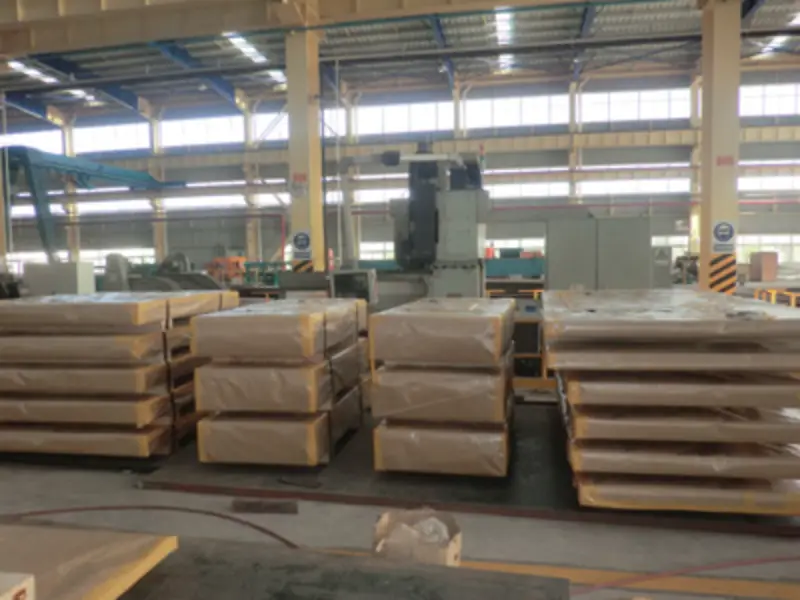
Austenitic 301L (S30103) Stainless Steel Plate/Coil
Austenitic 301L (S30103) Stainless Steel Plate/Coil: Low-Carbon High-Strength Solution
Comprehensive material data of 301L (S30103) stainless steel plate/coil per ASTM A240, including chemistry, mechanical and physical properties, international equivalents, and application guidance.
Cold forming, bending, deep drawing, stamping, welding, machining
- Phone : +8618037372205
- Email : [email protected]
- WhatsApp: Contact via Whtsapp
- WeChat: +8618037372205
Austenitic 301L Stainless Steel Plate/Coil Introduction
Austenitic 301L (UNS S30103) is a low-carbon modification of Type 301 stainless steel, designed to minimize carbide precipitation during welding and provide improved intergranular corrosion resistance in the as-welded condition. It retains the work-hardening characteristics of 301, enabling high strength through cold working while maintaining good ductility and formability in the annealed state.
Key features include:
- Excellent combination of strength and ductility
- Superior weldability with reduced sensitization risk
- High fatigue strength, especially in cold-worked tempers
- Good oxidation resistance up to 840°C intermittent and 900°C continuous service
Austenitic 301L Stainless Steel Plate/Coil Chemical Composition
Chemical composition according to ASTM A240/A240M for grade 301L (S30103). Nitrogen is intentionally added in many productions to stabilize the austenitic structure and enhance strength, though the standard treats it as a residual element (max 0.20%). Low carbon content ensures improved resistance to sensitization during welding.
| Element | Standard Value (%) | Remarks |
|---|---|---|
| Carbon (C) | ≤ 0.030 | Low carbon for weldability |
| Manganese (Mn) | ≤ 2.00 | - |
| Phosphorus (P) | ≤ 0.045 | - |
| Sulfur (S) | ≤ 0.030 | - |
| Silicon (Si) | ≤ 1.00 | - |
| Chromium (Cr) | 16.0 – 18.0 | Key for corrosion resistance |
| Nickel (Ni) | 6.0 – 8.0 | Austenite stabilizer |
| Nitrogen (N) | ≤ 0.20 | Optional strengthening element |
Austenitic 301L Stainless Steel Plate/Coil Thermal and Electrical Physical Properties
Physical properties at room temperature unless otherwise noted. Values are typical for annealed 301L stainless steel. Thermal conductivity and expansion data are essential for fabrication and design involving temperature changes. Electrical resistivity is higher than carbon steel, typical of austenitic grades.
| Property | Typical Value | Unit | Test Condition |
|---|---|---|---|
| Density (ρ) | 7.93 | g/cm³ | 20°C |
| Modulus of Elasticity (E) | 193 | GPa | Tension, 20°C |
| Shear Modulus (G) | 74 | GPa | Typical, 20°C |
| Poisson's Ratio (ν) | 0.30 | - | Elastic range, 20°C |
| Thermal Expansion Coefficient (α) | 16.6 | 10⁻⁶/°C | 20 – 100°C |
| Thermal Expansion Coefficient (α) | 17.6 | 10⁻⁶/°C | 20 – 500°C |
| Thermal Conductivity (λ) | 15.0 | W/m·K | 20°C |
| Thermal Conductivity (λ) | 21.5 | W/m·K | 500°C |
| Specific Heat Capacity (cp) | 500 | J/kg·K | 0 – 100°C |
| Electrical Resistivity (ρe) | 0.72 | μΩ·m | 20°C |
Austenitic 301L Stainless Steel Plate/Coil Mechanical Properties
Mechanical properties for annealed condition (Condition A) per ASTM A240/A240M, valid for plate, sheet, and strip up to specified thicknesses. Tensile test is performed at room temperature; elongation measured in 2 in. (50 mm) gage length. Hardness values are maximum limits. For cold-worked tempers, strength increases significantly (e.g., Full Hard: UTS up to 1850 MPa) but elongation decreases.
| Property | Standard Requirement | Unit | Test Condition |
|---|---|---|---|
| Tensile Strength (Rm) | ≥ 550 | MPa | Room temperature, annealed |
| Yield Strength (Rp0.2) | ≥ 240 | MPa | Room temperature, annealed |
| Elongation (A) | ≥ 40 | % | In 2 in. (50 mm), annealed |
| Hardness | ≤ 95 HRB / ≤ 219 HBW | - | Annealed condition |
| Bend Test | 180° bend, diameter = 1T | - | Annealed, thickness ≤ 19 mm (bend factor may vary by thickness) |
Austenitic 301L Stainless Steel Plate/Coil Completely Equivalent Material Standards and Replaceable Grades
| Region/Country | Standard | Grade | Remarks |
|---|---|---|---|
| Europe | EN 10088-2 | X2CrNiN18-7 (1.4318) | Nitrogen-controlled variant; identical application |
| Japan | JIS G4304 | SUS301L | Same chemistry and properties; widely used in rail industry |
| China | GB/T 3280 | 022Cr17Ni7 (S30103) | UNS S30103 equivalent; adopted from ASTM |
| International | ISO 15510 | X2CrNiN18-7 | ISO designation aligns with EN |
Austenitic 301L Stainless Steel Plate/Coil Application Introduction
301L is ideal for applications requiring high strength, good formability, and reliable weldability. Its low carbon content minimizes sensitization, making it suitable for welded structures without post-weld annealing. The material also exhibits excellent fatigue resistance, making it a first choice for dynamic loading conditions in transportation and industrial equipment.
Product Applications: Train car bodies and underframe components, Automotive chassis reinforcements, Metal springs and hose clamps, Architectural panels and curtain walls, Welded pipes and tubes for structural use, Domestic sinks and cookware
Processed into products: Railway car side panels, roof panels, and crossbeams, Automotive door beams, bumper reinforcements, and seat frames, Constant-force springs and wave springs, Fasteners (bolts, nuts, screws) requiring high strength and corrosion resistance, Welded structures in corrosive environments, such as chemical processing equipment, Pressure vessel shells and internal components
Application industries: Railway and mass transit (light rail, high-speed trains), Automotive (structural frames, exhaust components, clamps), Architecture and construction (roofing, facades, structural elements), Industrial equipment (springs, fasteners, conveyor belts), Food processing and kitchenware, Pressure vessels and heat exchangers
Austenitic 301L Stainless Steel Plate/Coil Similar or Near-Equivalent Substitute Materials
| Region/Country | Standard | Grade | Remarks |
|---|---|---|---|
| USA | ASTM A240 | 301 (S30100) | Higher carbon (≤0.15%); lower weldability; higher strength when cold worked |
| USA | ASTM A240 | 304 (S30400) | Higher Cr (18-20%) and Ni (8-10.5%); better corrosion resistance; slightly lower attainable cold-worked strength |
| Europe | EN 10088-2 | 1.4310 (X10CrNi18-8) | Standard 301; higher carbon, similar work-hardening |
| Japan | JIS G4304 | SUS301 | Standard 301; not low-carbon |
Notes:
Important Considerations:
- 301L is non-magnetic in the annealed condition but can become slightly magnetic after cold working due to martensite transformation.
- For applications requiring full non-magnetic properties, use stabilized or low-interstitial austenitic grades.
- Maximum service temperature in oxidizing atmospheres is approximately 900°C for intermittent use; avoid continuous operation in the 425-860°C range to prevent embrittlement.
- Corrosion resistance is generally equivalent to Type 301, but slightly lower than Type 304 in some aggressive media.
- Welding can be performed by all common methods; filler metal typically ER308L or similar low-carbon austenitic electrode.
- Share



