
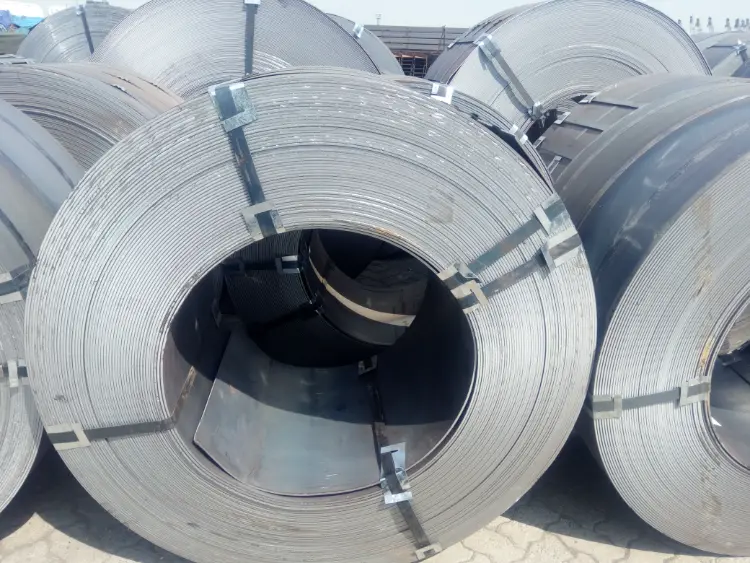
JIS G3132 SPHT3 Hot-Rolled Pipeline Steel Coil
SPHT3 Hot-Rolled Steel Coil for Pipe & Tube per JIS G3132: Chemical, Mechanical & Physical Data
Complete material datasheet for JIS G3132 SPHT3 hot-rolled carbon steel strip used for welded pipes and tubes. Includes chemical composition, mechanical properties, thermal and electrical physical properties, equivalent grades, and application guide.
Hot rolling, pickling, oiling, slitting, cutting, cold forming, welding, tube making
- Phone : +8618037372205
- Email : [email protected]
- WhatsApp: Contact via Whtsapp
- WeChat: +8618037372205
JIS G3132 SPHT3 Hot-Rolled Pipeline Steel Coil Introduction
JIS G3132 SPHT3 is a hot-rolled carbon steel strip specifically designed for the manufacture of welded pipes and tubes. It is classified under the Japanese Industrial Standard for hot-rolled carbon steel strip for pipes and tubes. This grade provides a minimum tensile strength of 410 MPa, ensuring reliable structural performance in welded tubular products. SPHT3 exhibits good weldability, formability, and uniform mechanical characteristics, making it suitable for cold forming and high-speed tube welding processes. Typical applications include general structural pipes, scaffolding tubes, mechanical tubing, and furniture tubing. The material is supplied in the as-rolled condition, often with a lightly pickled and oiled surface to enhance corrosion resistance during storage and processing.
JIS G3132 SPHT3 Hot-Rolled Pipeline Steel Coil Chemical Composition
The chemical composition of JIS G3132 SPHT3 is controlled to ensure good weldability and consistent mechanical properties. Only the elements specified in the standard are shown. Other residual elements are kept to levels that do not impair the intended application.
| Element | Standard Value (max, unless range given) | Remarks |
|---|---|---|
| Carbon (C) | 0.25 | max |
| Silicon (Si) | 0.35 | max |
| Manganese (Mn) | 0.30 – 0.90 | |
| Phosphorus (P) | 0.040 | max |
| Sulfur (S) | 0.040 | max |
JIS G3132 SPHT3 Hot-Rolled Pipeline Steel Coil Thermal and Electrical Physical Properties
The physical properties listed below are typical values for low-carbon steel and are applicable to SPHT3. These values are not specified in JIS G3132 but serve as engineering references for design and processing.
| Property | Typical Value | Unit | Test Condition / Remarks |
|---|---|---|---|
| Density (ρ) | 7.85 | g/cm³ | Room temperature |
| Modulus of Elasticity (E) | 210 | GPa | Room temperature |
| Shear Modulus (G) | 80 | GPa | Room temperature |
| Poisson's Ratio (ν) | 0.3 | — | Room temperature |
| Thermal Expansion Coefficient (α) | 12.0 × 10⁻⁶ | 1/K | 20–100 °C |
| Thermal Conductivity (λ) | 50 | W/(m·K) | Room temperature |
| Specific Heat Capacity (c) | 460 | J/(kg·K) | Room temperature |
| Electrical Resistivity (ρ_e) | 0.15 × 10⁻⁶ | Ω·m | Room temperature |
JIS G3132 SPHT3 Hot-Rolled Pipeline Steel Coil Mechanical Properties
Mechanical properties of SPHT3 are guaranteed by the standard for the as-rolled condition. Tensile strength is the primary requirement; yield strength is not specified but is typically around 245–300 MPa depending on thickness and processing. Elongation values vary with strip thickness. Bending test requirements are also thickness dependent.
| Property | Standard Required Value | Unit | Test Condition / Remarks |
|---|---|---|---|
| Tensile Strength (Rm) | ≥ 410 | N/mm² (MPa) | |
| Elongation (A) | ≥ 20 | % | Thickness ≤ 1.6 mm, JIS No.5 test piece, rolling direction |
| Elongation (A) | ≥ 25 | % | Thickness 1.6 < t ≤ 3.2 mm |
| Elongation (A) | ≥ 30 | % | Thickness 3.2 < t ≤ 6.0 mm |
| Elongation (A) | ≥ 28 | % | Thickness > 6.0 mm (JIS No.1A test piece) |
| Bend Test (180°) | d = 1.0t | — | Thickness ≤ 3.2 mm, inside radius = 1.0 × thickness |
| Bend Test (180°) | d = 1.5t | — | Thickness 3.2 < t ≤ 6.0 mm |
| Bend Test (180°) | d = 2.0t | — | Thickness > 6.0 mm |
JIS G3132 SPHT3 Hot-Rolled Pipeline Steel Coil Fully Equivalent Material Standards and Replaceable Grades
| Country/Region | Standard | Grade | Remarks |
|---|---|---|---|
| Japan | JIS G3132 | SPHT3 | Original standard grade |
| South Korea | KS D 3515 | SPHT3 | Technically equivalent, identical chemical and mechanical requirements |
| China (Baosteel) | Q/BQB 302 | SPHT3 | Enterprise standard based on JIS, fully interchangeable |
JIS G3132 SPHT3 Hot-Rolled Pipeline Steel Coil Application Introduction
JIS G3132 SPHT3 is primarily used as a feedstock for the production of electric-resistance-welded (ERW) steel pipes and tubes. It is also suitable for forming into cold-bent sections and structural hollow profiles. Its consistent mechanical properties and good weldability make it a cost-effective choice for a wide range of general-purpose steel tubular products.
Product Applications: General structural welded steel pipes (round, square, rectangular), Scaffolding tubes and props, Furniture tubes and frames, Greenhouse frames, Conveyor rollers and mechanical tubing, Fence posts and handrails
Processed into products: Scaffold couplers and accessories, Tube chassis for agricultural implements, Exhaust and muffler tubing (after coating), Hydraulic line pipes (low/medium pressure), Hollow sections for light structural frames, Roll cage tubes for recreational vehicles
Application industries: Construction and infrastructure, Agricultural machinery and equipment, Automotive (structural and fluid tubes), Furniture manufacturing, General engineering and mechanical fabrication, Fencing and scaffolding
JIS G3132 SPHT3 Hot-Rolled Pipeline Steel Coil Similar / Comparable Alternative Materials
| Country/Region | Standard | Grade | Remarks |
|---|---|---|---|
| China | GB/T 3274 | Q345B | Hot-rolled structural steel with similar tensile strength (470–630 MPa) and good weldability; higher yield strength (≥345 MPa). Suitable for structural pipes. |
| European Union | EN 10025-2 | S275JR | Tensile strength 410–560 MPa, yield ≥275 MPa. Comparable formability and weldability; can substitute SPHT3 for non-critical pipe applications. |
| USA | ASTM A1011 | SS Grade 50 (Type 1/2) | Hot-rolled carbon steel strip with tensile strength ≥410 MPa (Grade 50, 340 min yield); used for similar tube making. Slightly different chemical composition. |
Notes:
- For thicknesses outside the standard range (typically 1.2–13 mm), mechanical property requirements may be subject to agreement between the purchaser and the manufacturer.
- SPHT3 can be supplied with a lightly oiled surface to prevent rust. When pickled and oiled, it is often designated as SPHT3-P or SPHT3-PO.
- Welding of SPHT3 components is normally performed using standard fusion welding methods (ERW, TIG, MIG) without special preheating, but for thick sections or critical applications, a low-hydrogen process is recommended.
- Although not specified in the standard, normalizing after forming may improve structural uniformity for demanding applications.
- Share



