
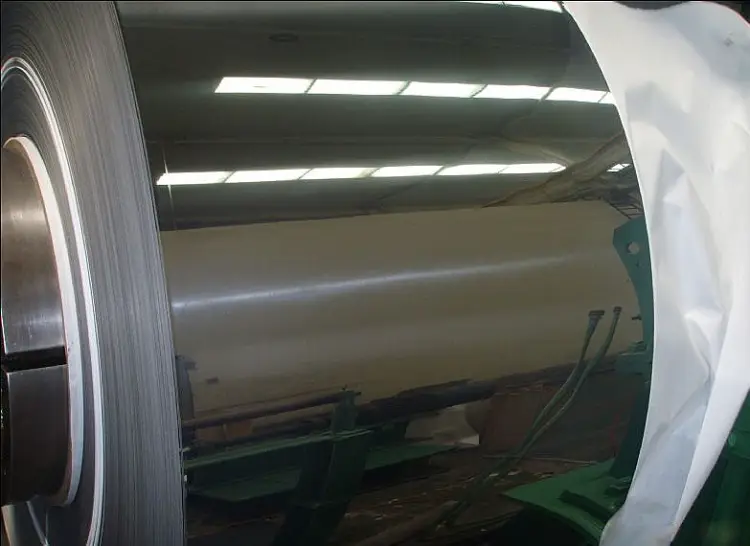
ASTM A131 Grade A Shipbuilding Steel Coil
ASTM A131 Grade A Shipbuilding Steel Coil - Ordinary Strength for Reliable Marine Structures
Explore ASTM A131 Grade A shipbuilding steel coil: chemical composition, mechanical properties, physical data, international equivalents, and application guidelines for hull construction and offshore engineering.
Hot rolling, normalizing, thermo-mechanical controlled processing (TMCP), pickling and oiling, slitting
- Phone : +8618037372205
- Email : [email protected]
- WhatsApp: Contact via Whtsapp
- WeChat: +8618037372205
ASTM A131 Grade A Shipbuilding Steel Coil Introduction
ASTM A131 Grade A is an ordinary strength hull structural steel widely used in shipbuilding and marine construction. Supplied primarily as hot-rolled coil, plate, and shapes, it offers a minimum yield strength of 235 MPa and tensile strength between 400–520 MPa. The grade is characterized by good weldability, moderate formability, and reliable performance in ambient temperature applications.
- Key attributes: Good notch toughness (when specified), excellent surface quality, and consistent mechanical properties.
- Typical supply condition: As-rolled or normalized, with optional impact testing for higher assurance.
The balanced chemistry (C ≤ 0.21%, Mn 0.80–1.10%) ensures easy fabrication without compromising structural integrity, making it a cost-effective choice for merchant ships, barges, and offshore structures where ordinary strength is sufficient.
ASTM A131 Grade A Shipbuilding Steel Coil Chemical Composition
The chemical composition conforms to ASTM A131 Grade A requirements for ordinary strength shipbuilding steel. Carbon equivalent (CE) restrictions may apply for improved weldability when specified. Aluminum is added only if the steel is ordered as killed (fully deoxidized). Residual elements such as copper, nickel, chromium, and molybdenum are controlled when supplementary requirement S1 is invoked.
| Chemical Element | Standard Value (wt%) | Remarks |
|---|---|---|
| Carbon (C) | ≤ 0.21 | Ladle analysis; product analysis tolerance +0.02 |
| Manganese (Mn) | 0.80–1.10 | Minimum can be 2.5 × C, but not required to exceed 1.10 |
| Silicon (Si) | 0.10–0.35 | For plates, shapes, and bars; for coils same range applies |
| Phosphorus (P) | ≤ 0.035 | Product analysis tolerance +0.005 |
| Sulfur (S) | ≤ 0.035 | Product analysis tolerance +0.005 |
| Aluminum (Al) | 0.015–0.06 (acid soluble) | Required only when killed steel is specified; otherwise optional |
| Copper (Cu) | ≤ 0.35 (if S1 specified) | Residual element; not routinely required |
| Nickel (Ni) | ≤ 0.40 (if S1 specified) | Residual element |
| Chromium (Cr) | ≤ 0.20 (if S1 specified) | Residual element |
| Molybdenum (Mo) | ≤ 0.08 (if S1 specified) | Residual element |
| Sum of Cu+Ni+Cr+Mo | ≤ 0.70 (if S1 specified) | Applicable only when supplementary requirement is invoked |
ASTM A131 Grade A Shipbuilding Steel Coil Physical Properties
These values are not specified in ASTM A131 but are representative for ordinary carbon‑manganese structural steels. They may vary slightly with processing conditions and temperature.
| Property | Typical Value | Unit | Test Condition / Temperature |
|---|---|---|---|
| Density (ρ) | 7850 | kg/m³ | Room temperature |
| Elastic Modulus (E) | 200 | GPa | Room temperature |
| Shear Modulus (G) | 80 | GPa | Room temperature |
| Poisson's Ratio (ν) | 0.30 | – | Room temperature |
| Thermal Expansion Coefficient (α) | 12.0 | 10⁻⁶/K | 20–100 °C |
| Thermal Expansion Coefficient (α) | 12.5 | 10⁻⁶/K | 20–200 °C |
| Thermal Conductivity (λ) | 52 | W/(m·K) | 100 °C |
| Specific Heat Capacity (cp) | 480 | J/(kg·K) | 20–100 °C |
| Electrical Resistivity (ρe) | 0.20 | μΩ·m | Room temperature |
ASTM A131 Grade A Shipbuilding Steel Coil Mechanical Properties
Tensile and bend properties are mandatory per ASTM A131. Impact testing is not normally required for Grade A, but can be performed by agreement (e.g., 34 J at 20 °C). All tests are conducted at room temperature unless otherwise stated. The bend test ensures sufficient ductility for cold forming without cracking.
| Property | Standard Value | Unit | Test Condition |
|---|---|---|---|
| Yield Strength (ReH) | ≥ 235 | MPa | Room temperature, transverse specimen for coil/plate |
| Tensile Strength (Rm) | 400–520 | MPa | Room temperature, transverse specimen |
| Elongation (A) in 50 mm (2 in) | ≥ 24 | % | Gauge length 50 mm, thickness ≤ 20 mm |
| Elongation (A) in 200 mm (8 in) | ≥ 21 | % | Gauge length 200 mm, thickness ≤ 20 mm |
| Bend Test (180°) | Bend diameter = 2 × thickness | – | Thickness ≤ 20 mm, no cracks on outside surface |
| Charpy V‑notch Impact | Not specified (or 34 J at 20 °C if agreed) | J | Optional, longitudinal specimen, 10×10 mm |
ASTM A131 Grade A Shipbuilding Steel Coil Full Equivalent Material Standards and Designations
| Country / Region | Standard | Grade | Remarks |
|---|---|---|---|
| USA | ASTM A131 | Grade A | Base standard |
| International (IACS) | IACS UR W11 | Grade A | Uniform requirement for ordinary strength hull structural steel |
| American Bureau of Shipping | ABS Rules | Grade A | Identical chemistry and properties |
| Lloyd's Register | LR Rules | Grade A | Identical requirements |
| DNV | DNV Rules | Grade A (NV A) | Same strength level |
| Bureau Veritas | BV Rules | Grade A | Same as ASTM A131 Gr.A |
| China Classification Society | CCS Rules | Grade A | Equivalent to ASTM A131 Gr.A |
| Registro Italiano Navale | RINA Rules | Grade A | Matching specifications |
| Nippon Kaiji Kyokai | NK Rules | Grade A | Equivalent ordinary strength |
| Korean Register | KR Rules | Grade A | Equivalent ordinary strength |
ASTM A131 Grade A Shipbuilding Steel Coil Application Introduction
ASTM A131 Grade A coil is designed for primary and secondary structures in marine environments where ordinary strength is adequate and service temperatures are not extremely low. The material's excellent weldability and moderate toughness make it suitable for a wide range of ship components.
Product Applications: Hull shells and side plates, Deck plating and bulkheads, Superstructures and deckhouses, Stiffeners and girders, Brackets and web frames, Hatches and coamings, Light marine cranes and pedestals
Processed into products: Ship shell plates (longitudinal and transverse), Stiffeners (flat bar, angle, bulb profiles), Deck stringer plates, Bulkhead panels and corrugated sheets, Floor plates and girder webs, Bracket plates and knees, Cargo hold linings (non‑abrasive)
Application industries: Commercial shipbuilding (cargo vessels, tankers, bulk carriers), Offshore and marine engineering, Barge and pontoon construction, Port and harbor equipment, Dredging machinery
ASTM A131 Grade A Shipbuilding Steel Coil Similar / Alternative Material Recommendations
| Country / Region | Standard | Grade | Remarks |
|---|---|---|---|
| USA | ASTM A36 | A36 | General structural steel; similar yield (250 MPa) but not shipbuilding‑specific; lacks marine certification |
| EU | EN 10025-2 | S235JR | Structural steel with comparable strength; impact properties at +20 °C; not certified for shipbuilding |
| Japan | JIS G3106 | SM400A | Welded structural steel; similar tensile range but not fully equivalent for marine use |
| China | GB/T 700 | Q235B | Carbon structural steel; close strength but different quality requirements; not for ship classification |
| International | ASTM A131 | Grade B | Higher manganese (0.80–1.20) and optional impact test at 0 °C; otherwise similar properties |
Notes:
Grade A coil is typically available in thicknesses up to 12.5 mm and widths up to 2000 mm. For welded structures exposed to low temperatures or dynamic loading, consider Grades D or E which offer guaranteed impact toughness. When ordering, supplementary requirement S3 (normalizing) or S5 (controlled rolling/TMCP) can be specified for improved grain refinement. Coils may be supplied with mill edge or trimmed edge, and surface condition can be hot‑rolled, pickled and oiled, or blasted and primed.
- Share



