
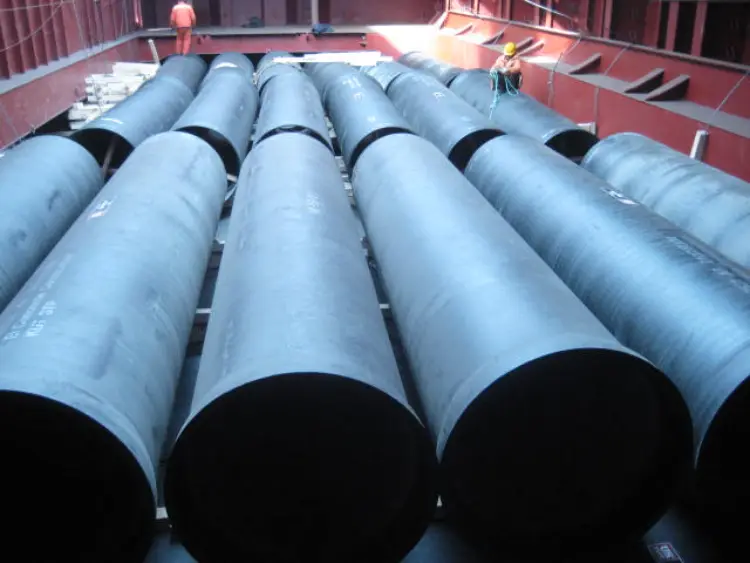
JIS G3106 SM490YB ERW Pipe
JIS G3106 SM490YB ERW Pipe: High-Strength Welded Structural Steel Tube
Complete material data for SM490YB electric-resistance-welded steel pipe according to JIS G3106. Includes chemical composition, mechanical properties, physical constants, international equivalents, and application guide.
Hot rolling, cold forming, bending, welding, machining, ERW pipe manufacturing
- Phone : +8618037372205
- Email : [email protected]
- WhatsApp: Contact via Whtsapp
- WeChat: +8618037372205
JIS G3106 SM490YB ERW Pipe Introduction
SM490YB is a hot-rolled structural steel grade specified in JIS G3106 for welded structures. It is widely used to manufacture ERW (Electric Resistance Welded) pipes for building frames, bridges, offshore platforms and heavy machinery. The material provides a minimum yield strength of 365 MPa for thicknesses up to 16 mm and guarantees a Charpy impact energy of 27 J at 0 °C. Its well-balanced chemical composition (C ≤ 0.20 %, Mn ≤ 1.60 %) ensures good weldability and formability while maintaining high strength. SM490YB is often delivered in the as-rolled or normalized condition and can be further processed by cold bending, cutting and welding. With reliable toughness and excellent structural performance, SM490YB ERW pipe meets demanding requirements for dynamic and static loads in civil engineering and industrial applications.
JIS G3106 SM490YB ERW Pipe Chemical Composition
Chemical limits for SM490YB according to JIS G3106. The steel is a low-carbon, high-manganese structural grade with restricted phosphorus and sulfur to improve weldability and toughness. No intentional additions of Cr, Ni, Mo or Cu are specified; residual elements shall not degrade the steel properties. Carbon equivalent is typically controlled for good weldability.
| Element | Required Value (max, %) | Remarks |
|---|---|---|
| Carbon (C) | 0.20 | max |
| Silicon (Si) | 0.55 | max |
| Manganese (Mn) | 1.60 | max |
| Phosphorus (P) | 0.035 | max |
| Sulfur (S) | 0.035 | max |
| Carbon equivalent (CE) | Reported | Customer agreement if required |
JIS G3106 SM490YB ERW Pipe Thermal & Electrical Physical Properties
Representative physical properties for low-carbon structural steel similar to SM490YB. These values are not mandatory in JIS G3106; they are provided for design calculations and FEA modelling. Actual properties may vary slightly depending on exact composition, heat treatment and processing history. Electrical resistivity is given at room temperature.
| Property | Typical Value | Unit | Test Condition |
|---|---|---|---|
| Density (ρ) | 7850 | kg/m³ | Room temperature |
| Modulus of elasticity (E) | 210 | GPa | Room temperature |
| Shear modulus (G) | 80 | GPa | Room temperature |
| Poisson's ratio (ν) | 0.3 | — | Room temperature |
| Coefficient of thermal expansion (α) | 11.7 × 10⁻⁶ | 1/K | 20 – 100 °C |
| Coefficient of thermal expansion (α) | 12.5 × 10⁻⁶ | 1/K | 20 – 200 °C |
| Thermal conductivity (λ) | 51 | W/(m·K) | Room temperature |
| Specific heat capacity | 460 | J/(kg·K) | Room temperature |
| Electrical resistivity (ρₑ) | 0.19 × 10⁻⁶ | Ω·m | Room temperature |
JIS G3106 SM490YB ERW Pipe Mechanical Properties
Mechanical requirements for SM490YB as per JIS G3106. Values are derived from test pieces taken from the base material before or after pipe forming, depending on the agreement. Charpy impact test is performed at 0 °C on full-size 10×10 mm V-notch specimens; for thinner material sub-size specimens are used with adjusted minimum energy. Bending test is specified for material up to 25 mm thickness.
| Property | Required Value | Unit | Test Condition / Thickness (t) |
|---|---|---|---|
| Yield point / Yield strength (ReH) | ≥ 365 | MPa | t ≤ 16 mm |
| Yield point / Yield strength (ReH) | ≥ 355 | MPa | 16 < t ≤ 40 mm |
| Yield point / Yield strength (ReH) | ≥ 335 | MPa | 40 < t ≤ 75 mm |
| Yield point / Yield strength (ReH) | ≥ 325 | MPa | 75 < t ≤ 100 mm |
| Tensile strength (Rm) | 490 – 610 | MPa | All thicknesses |
| Elongation (A) | ≥ 17 | % | t ≤ 16 mm, No. 5 test piece, gauge length 200 mm |
| Elongation (A) | ≥ 21 | % | 16 < t ≤ 50 mm, No. 5 test piece, gauge length 200 mm |
| Elongation (A) | ≥ 23 | % | t > 40 mm, No. 4 test piece, gauge length 50 mm |
| Bending test (mandrel diameter) | 1.5 × t | — | 180° bend, t ≤ 16 mm |
| Bending test (mandrel diameter) | 2.0 × t | — | 180° bend, 16 < t ≤ 25 mm |
| Charpy impact energy (KV₂) | ≥ 27 | J | 0 °C, 10×10 mm V-notch specimen |
JIS G3106 SM490YB ERW Pipe Full Equivalent Material Standards and Substitutable Grades
| Country / Region | Standard | Grade | Remarks |
|---|---|---|---|
| Europe | EN 10025-2 | S355J0 (1.0553) | Same yield strength class (355 MPa vs 365 MPa for t ≤ 16 mm), 0 °C impact 27 J. Chemical composition and mechanical properties are harmonized. |
| International | ISO 630-2 | S355J0 | Identical to EN grade. Applicable for structural plates and wide flats. |
| China | GB/T 1591 | Q355D | Yield ≥ 355 MPa (t ≤ 16 mm), impact energy at -20 °C ≥ 47 J. Slightly higher toughness, but can replace SM490YB in most welded structures. |
| Japan | JIS G3106 | SM490B | Same base specification but with relaxed impact requirement (0 °C, 27 J) for thicknesses 500 N/mm², without 'Y' designation. For less demanding applications. |
JIS G3106 SM490YB ERW Pipe Application Introduction
SM490YB ERW pipe is designed for welded, bolted and riveted structures where high strength, good weldability and notch toughness at 0 °C are essential. The material is suitable for both primary and secondary structural members. Typical fabrications include building columns, bridge girders, pipe trusses, piling, crane booms and heavy machinery frames. The ERW pipe form provides excellent dimensional accuracy and surface finish, allowing it to be used directly for structural hollow sections or further processed into complex assemblies.
- Hot-dip galvanizing can be applied for corrosion protection.
- Cold bending radii should follow standards (e.g., 2.5t for t ≤ 16 mm).
- Low-temperature service conditions down to -10 °C are acceptable due to the guaranteed impact energy at 0 °C.
Product Applications: ERW structural hollow sections (circular, square, rectangular), Spiral-welded and straight-seam pipe piles, Prefabricated building frames and modules, Bridge box girders and stiffening ribs, Crane booms and lattice structures, Piping systems for low-pressure mechanical applications
Processed into products: Building columns and beam-to-column connections, Truss chords and web members, Pipe pile splices and end rings, Bearing stiffeners and base plates (cut from pipe), Track beams and runway girders, Machinery frames and support legs, Scaffolding tubes and couplers
Application industries: Building and civil engineering (structural frames, columns, beams), Bridge engineering (trusses, arches, piers), Offshore and marine (platform legs, deck structures, piling), Industrial machinery (loader arms, excavator booms, conveyor galleries), Transmission line towers and telecommunication masts, Agricultural and construction equipment (trailers, scaffolding)
JIS G3106 SM490YB ERW Pipe Similar and Alternative Material Recommendations
| Country / Region | Standard | Grade | Remarks |
|---|---|---|---|
| United States | ASTM A572/A572M | Grade 50 (345 MPa) | Yield strength 345 MPa, tensile 450 MPa min. Impact test optional. Not a full equivalent but widely used in similar applications. Consider higher section modulus for strength. |
| United States | ASTM A36 | — | Lower strength (250 MPa yield). Suitable only for non-critical replacements. |
| Europe | EN 10025-2 | S355JR | Lacks assured 0 °C toughness (27 J at +20 °C). Use only if impact requirement is not mandated. |
| China | GB/T 1591 | Q355C | Impact at 0 °C (34 J min). Can substitute with prior approval. Chemical composition is close to SM490YB. |
| Japan | JIS G3106 | SM490A | No Charpy requirement. Use only for statically loaded structures without toughness demand. |
Notes:
Note: The above data are compiled from JIS G3106:2015 and typical physical property references. Actual product properties may be subject to specific manufacturing tolerances and should be verified with the mill certificate. Welding procedures should consider the carbon equivalent value (typically Ceq ≤ 0.42) and may require preheat for thick sections. For cyclic loading or seismic applications, further toughness specifications may be agreed upon. Chemical composition for product analysis may be slightly wider than ladle analysis.
- Share



