
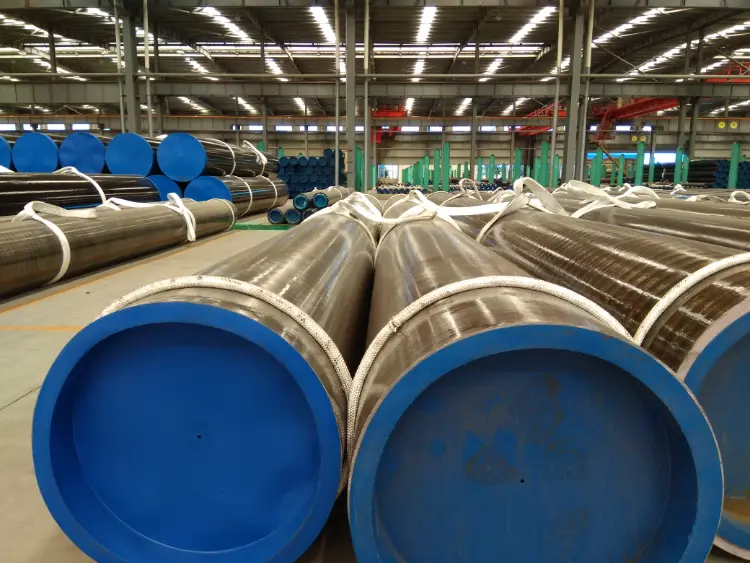
JIS G3101 SS400 LSAW Pipe
JIS G3101 SS400 LSAW Pipe: Comprehensive Material Data, Properties & Equivalents
In-depth analysis of JIS G3101 SS400 LSAW pipe covering chemical composition, mechanical and physical properties, equivalent grades, and application guide.
Hot rolling, cold forming, welding (LSAW, ERW, etc.), cutting, bending, machining
- Phone : +8618037372205
- Email : [email protected]
- WhatsApp: Contact via Whtsapp
- WeChat: +8618037372205
JIS G3101 SS400 LSAW Pipe Introduction
JIS G3101 SS400 is a Japanese industrial standard rolled steel for general structure, widely used in welded structural applications such as LSAW (Longitudinally Submerged Arc Welded) pipes. As a typical carbon structural steel, SS400 offers good weldability, moderate strength, and excellent formability, making it suitable for a broad range of engineering and construction projects.
The material is characterized by:
- Tensile strength in the range of 400–510 MPa with yield strength dependent on thickness.
- No mandatory impact toughness requirements in base standard, but can be supplied with specific agreements.
- Good bending and welding performance, commonly delivered in hot-rolled or normalized condition.
JIS G3101 SS400 LSAW Pipe Chemical Composition
According to JIS G3101:2015, the chemical composition of SS400 is only restricted for phosphorus and sulfur. Elements such as carbon, silicon, and manganese are not specified and are left to the manufacturer's discretion to achieve the required mechanical properties. The typical values below are provided for reference and may vary among producers.
| Element | Standard Value (max, % by mass) | Remarks |
|---|---|---|
| C (Carbon) | Not specified | Typical ≤0.20%, controlled by manufacturer |
| Si (Silicon) | Not specified | Typical ≤0.40%, controlled by manufacturer |
| Mn (Manganese) | Not specified | Typical ≤1.40%, controlled by manufacturer |
| P (Phosphorus) | 0.050 | Mandatory maximum |
| S (Sulfur) | 0.050 | Mandatory maximum |
JIS G3101 SS400 LSAW Pipe Thermal and Electrical Physical Properties
Physical properties are not specified in JIS G3101. The data below are typical room-temperature values for plain carbon structural steels similar to SS400 and are intended for general engineering use. Actual values may vary slightly depending on exact composition and microstructure.
| Property | Typical value | Unit | Condition / Remarks |
|---|---|---|---|
| Density (ρ) | 7.85 | g/cm³ | At 20 °C |
| Modulus of elasticity (E) | 200 | GPa | Tensile modulus, room temperature |
| Shear modulus (G) | 79.3 | GPa | Calculated, room temperature |
| Poisson's ratio (ν) | 0.29 | — | Within elastic range |
| Thermal expansion coefficient (α) | 12.0 | 10⁻⁶/K | Between 20 °C and 100 °C |
| Thermal conductivity (λ) | 50 | W/(m·K) | At 20 °C |
| Specific heat capacity | 460 | J/(kg·K) | At 20 °C |
| Electrical resistivity (ρ_e) | 0.15 | μΩ·m | At 20 °C |
JIS G3101 SS400 LSAW Pipe Mechanical Properties
Mechanical properties of SS400 are specified in JIS G3101 and depend on product thickness. The standard defines yield point or proof strength, tensile strength, elongation, and bendability. Impact energy is not required unless specially agreed. The table below lists the guaranteed values for as-rolled or equivalent condition.
| Property | Requirement | Unit | Test Condition / Remarks |
|---|---|---|---|
| Yield strength (ReH) | ≥245 | MPa | For thickness ≤16 mm |
| Yield strength (ReH) | ≥235 | MPa | For thickness >16 mm to ≤40 mm |
| Yield strength (ReH) | ≥215 | MPa | For thickness >40 mm to ≤100 mm |
| Yield strength (ReH) | ≥205 | MPa | For thickness >100 mm |
| Tensile strength (Rm) | 400 ~ 510 | MPa | All thicknesses |
| Elongation (A) | ≥21 | % | Thickness ≤5 mm, test piece No.5, longitudinal |
| Elongation (A) | ≥17 | % | Thickness >5 to ≤16 mm, test piece No.1A, longitudinal |
| Elongation (A) | ≥21 | % | Thickness >5 to ≤16 mm, test piece No.1A, transverse |
| Elongation (A) | ≥21 | % | Thickness >16 to ≤50 mm, test piece No.1A, longitudinal |
| Elongation (A) | ≥17 | % | Thickness >16 to ≤50 mm, test piece No.1A, transverse |
| Elongation (A) | ≥23 | % | Thickness >40 mm, test piece No.10, longitudinal |
| Bend test (mandrel diameter) | 1.5 × thickness | — | 180° bending, thickness ≤16 mm, outer side crack-free |
| Bend test (mandrel diameter) | 2.0 × thickness | — | 180° bending, thickness >16 to ≤100 mm, outer side crack-free |
| Impact energy (KV) | Not specified | J | Optional; may be agreed upon at time of order |
JIS G3101 SS400 LSAW Pipe Exact Equivalent Material Standards and Replaceable Grades
| Country/Region | Standard | Grade | Remarks |
|---|---|---|---|
| Japan | JIS G3101 | SS400 | Original specification |
| United States | ASTM A36/A36M | Grade 36 | Common structural carbon steel, very similar properties |
| Europe | EN 10025-2 | S275JR | Closest match; yield 275 MPa typically higher, tensile 410-560 MPa |
| China | GB/T 700 | Q235B | Equivalent carbon structural steel; Q235C/D for better toughness |
| International | ISO 630-2 | S275B | Structural steel - Part 2; comparable strength and chemistry |
| India | IS 2062 | E250 A/B/C | Fe 410 WA/WB/WC older designation; E250 corresponds to yield 250 MPa min |
JIS G3101 SS400 LSAW Pipe Application Introduction
JIS G3101 SS400 is one of the most widely used structural carbon steels, suitable for a variety of general engineering applications where moderate strength and outstanding weldability are required. The LSAW pipe form extends its usage to fluid transportation and structural columns.
Key application sectors include:
Product Applications: LSAW steel pipes for structural and line pipe applications, Hot-rolled plates, coils, and sections for welded fabrications, Storage tanks and silos for liquids and solids, Piling pipes and casing for foundation works, Machine frames and support structures, Prefabricated steel buildings and modular structures
Processed into products: Flanges, gussets, and brackets, Beam-to-column connections, Pipe supports and hangers, Base plates and anchorages, Guide rails and protective barriers, Simple forged parts (after appropriate forming)
Application industries: Construction and civil engineering (building frames, columns, trusses), Bridge engineering (girders, piers, handrails), Shipbuilding (hulls, decks, superstructures), Transportation (trailers, railway wagons, vehicle chassis), Energy infrastructure (storage tanks, pressure vessels, pipe racks), Water and sewage (penstocks, water mains, piling)
JIS G3101 SS400 LSAW Pipe Similar / Alternative Material Recommendations
| Country/Region | Standard | Grade | Remarks |
|---|---|---|---|
| Japan | JIS G3101 | SS330 | Lower strength (tensile 330-430 MPa); easier forming, not direct substitute for structural loads |
| Japan | JIS G3101 | SS490 | Higher strength (tensile 490-610 MPa); for more demanding structural applications |
| Japan | JIS G3106 | SM400A/B/C | Welded structural steel with guaranteed impact toughness; suitable for low-temp service |
| Europe | EN 10025-2 | S235JR | Lower yield strength (235 MPa min); may replace non-critical SS400 parts |
| United States | ASTM A283/A283M | Grade C | Low and intermediate tensile strength carbon steel plates; less common for structural pipe |
| China | GB/T 700 | Q195 | Lower carbon steel, tensile 315-430 MPa; only for light-duty components |
Notes:
Special considerations for LSAW pipes: The pipe manufacturing process (longitudinal submerged arc welding) may introduce heat-affected zone properties that differ slightly from the base material. Weld procedure qualification and adequate normalizing or stress relieving may be required for critical services. For sour service or low-temperature applications, consider SS400 with additional impact toughness agreements, or switch to higher-grade steels such as JIS G3106 SM400B or equivalent ASTM/EN grades.
Availability: SS400 LSAW pipes are generally available in diameters from 16″ (406.4 mm) up to 100″ (2540 mm) with wall thicknesses up to 50 mm, subject to mill capabilities.
Coating and protection: The material does not contain corrosion-resistant alloying elements; external coatings (3LPE, FBE, coal tar enamel) or internal linings (cement mortar, epoxy) are commonly applied for buried or submerged pipe applications.
- Share



