
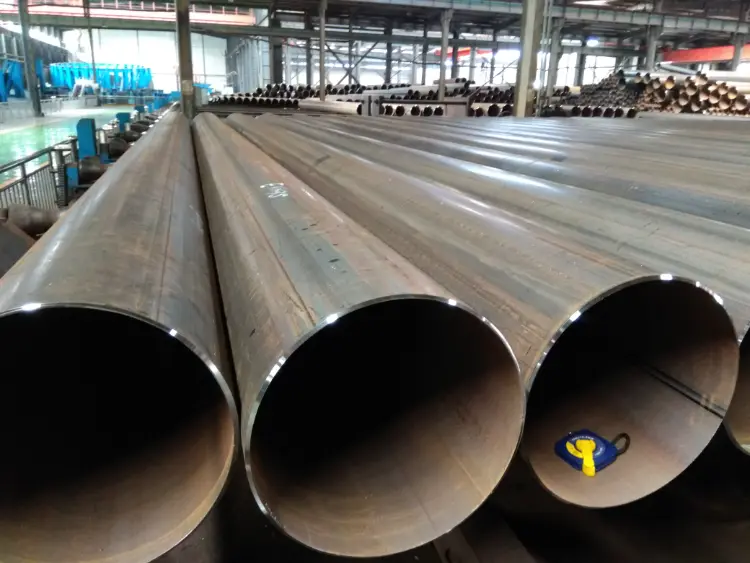
St52-3 LSAW Pipe
St52-3 LSAW Pipe: Composition, Properties, Equivalents & Uses
Comprehensive technical data for St52-3 structural steel LSAW pipe per DIN 17100, with chemical, mechanical, thermal properties, global equivalents, and application guidance.
Submerged arc welding (SAW), hot rolling, cold forming, machining
- Phone : +8618037372205
- Email : [email protected]
- WhatsApp: Contact via Whtsapp
- WeChat: +8618037372205
St52-3 LSAW Pipe Introduction
St52-3 is a structural carbon steel originally specified in the German standard DIN 17100, now superseded by EN 10025 grades. It is widely used for welded steel pipes, particularly LSAW (Longitudinal Submerged Arc Welded) pipes, due to its excellent weldability, high strength, and good toughness. The steel offers a minimum yield strength of 355 MPa for thicknesses up to 16 mm, making it suitable for load-bearing structures. Typical applications include oil and gas transmission pipelines, structural frameworks, and machinery components. The LSAW pipe manufacturing process employs submerged arc welding to produce large-diameter pipes with high dimensional accuracy.
St52-3 LSAW Pipe Chemical Composition
The chemical composition of St52-3 steel is defined by DIN 17100, ensuring consistent weldability and mechanical properties. Main elements include carbon and manganese, with low sulfur and phosphorus for improved cleanliness. No intentional addition of alloying elements such as chromium or nickel is required, making it a non-alloy structural steel.
| Chemical Element | Standard Value | Remarks |
|---|---|---|
| Carbon (C) | ≤0.20% | Max. limit for weldability |
| Silicon (Si) | ≤0.55% | Deoxidizing element |
| Manganese (Mn) | ≤1.60% | Increases strength and toughness |
| Phosphorus (P) | ≤0.045% | Max. for steel cleanliness |
| Sulfur (S) | ≤0.045% | Max. for steel cleanliness |
St52-3 LSAW Pipe Thermal and Electrical Physical Properties
Typical physical properties for St52-3 steel at room temperature, applicable for general engineering calculations. These values are not specified in DIN 17100 but are characteristic of low-carbon structural steels.
| Property | Typical Value | Unit | Condition |
|---|---|---|---|
| Density (ρ) | 7.85 | g/cm³ | 20°C |
| Elastic Modulus (E) | 210 | GPa | 20°C |
| Shear Modulus (G) | 81 | GPa | 20°C |
| Poisson's Ratio (ν) | 0.3 | – | 20°C |
| Thermal Expansion (α) | 11.1 × 10⁻⁶ | 1/K | 20–100°C |
| Thermal Conductivity (λ) | 52 | W/(m·K) | 20°C |
| Specific Heat Capacity | 460 | J/(kg·K) | 20°C |
| Electrical Resistivity (ρ_e) | 0.20 | µΩ·m | 20°C |
St52-3 LSAW Pipe Mechanical Properties
Mechanical properties are for plates and strips used in LSAW pipe production, typically in the as-rolled or normalized condition. The values below represent the minimum requirements per DIN 17100 for thicknesses ≤ 16 mm. Actual pipe properties may vary depending on welding and forming.
| Property | Standard Requirement | Unit | Test Condition |
|---|---|---|---|
| Yield Strength (ReH) | ≥ 355 | MPa | t ≤ 16 mm, room temperature |
| Tensile Strength (Rm) | 490 – 630 | MPa | t ≤ 16 mm, room temperature |
| Elongation (A) | ≥ 22 | % | l0 = 5.65√S0, longitudinal |
| Bend Test | d = 2a (180°) | – | Bending mandrel diameter d, specimen thickness a |
St52-3 LSAW Pipe Exact Equivalent Grades and Substitute Recommendations
| Country/Region | Standard | Grade | Remarks |
|---|---|---|---|
| Europe | EN 10025-2 | S355J2 | Direct successor; improved impact properties at -20°C |
| USA | ASTM A572 | Grade 50 | Similar yield strength, structural use |
| Japan | JIS G3106 | SM490A | Comparable strength, weldable structural steel |
| China | GB/T 1591 | Q345D | Equivalent to S355J2, impact tested at -20°C |
St52-3 LSAW Pipe Application Introduction
St52-3 LSAW pipes are employed in a wide range of industries due to their balanced strength and weldability. They are suitable for large-diameter piping systems, structural components, and pressure-containing applications. Proper coating and cathodic protection are recommended for underground or subsea service.
Product Applications: LSAW (Longitudinal Submerged Arc Welded) pipes, Spiral submerged arc welded pipes, Structural steel tubes, Flanges and fittings, Pipeline expansion joints
Processed into products: Pipe sections for oil/gas transmission, Structural columns and beams, Pressure vessel shells, Piling pipes, Machine bases and supports
Application industries: Oil and Gas (pipeline transmission), Construction and Infrastructure (steel structures, bridges), Mechanical Engineering (machinery frames, supports), Shipbuilding (hull structures, piping), Water and Sewage (penstocks, pipelines)
St52-3 LSAW Pipe Similar/Alternative Materials
| Country/Region | Standard | Grade | Remarks |
|---|---|---|---|
| Europe | EN 10025-2 | S355J0 | Similar strength, less stringent impact (0°C) |
| Europe | EN 10025-2 | S355JR | Similar strength, room-temperature impact |
| Germany | DIN 17100 | St52-3 N | Normalized with improved toughness |
| China | GB/T 1591 | Q345C | Close alternative, impact tested at 0°C |
Notes:
St52-3 is often supplied in as-rolled or normalized condition. For LSAW pipes, longitudinal welds are made by submerged arc welding with appropriate welding consumables to match base metal strength. Where impact toughness is required, St52-3 N or equivalent S355J2 should be specified. Corrosion protection such as 3LPE or FBE coating is common for buried pipelines.
- Share



