
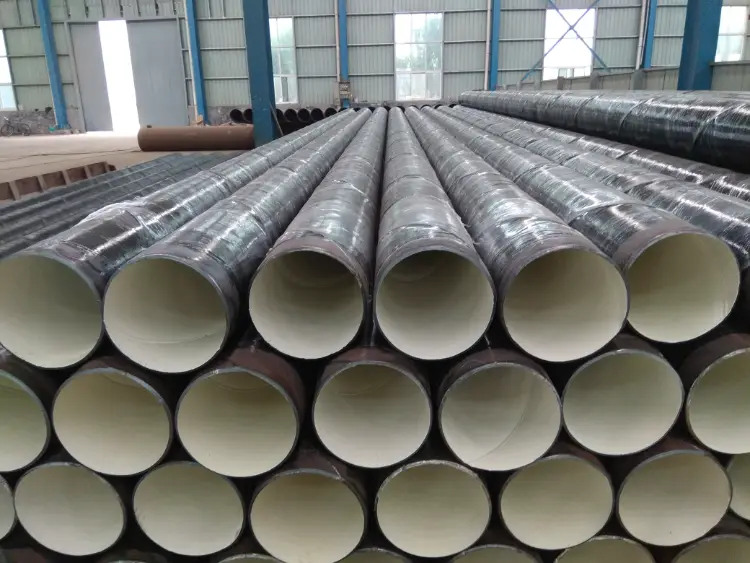
JIS G3101 SS490 LSAW Pipe
JIS G3101 SS490 LSAW Pipe: High-Strength Structural Steel for Welded Applications
Detailed material properties of JIS G3101 SS490 steel used for longitudinal submerged arc welded (LSAW) pipes, including chemical composition, mechanical and physical properties, international equivalents, and application guidance.
LSAW pipe manufacturing (forming, tack welding, submerged arc welding), gas cutting, cold bending, hot bending, machining
- Phone : +8618037372205
- Email : [email protected]
- WhatsApp: Contact via Whtsapp
- WeChat: +8618037372205
JIS G3101 SS490 LSAW Pipe Introduction
JIS G3101 SS490 is a Japanese general structural rolled steel offering a minimum tensile strength of 490 MPa. It is widely utilized for welded structures, bridges, ships, and building frameworks. As a hot-rolled carbon steel, SS490 combines good weldability with moderate strength and formability, making it suitable for LSAW (Longitudinal Submerged Arc Welded) pipes used in piling, water transmission, and structural columns.
- Good balance of strength and ductility
- Excellent weldability for LSAW pipe fabrication
- Cost-effective for large-diameter structural tubes
- Available in plates and strips for pipe forming
JIS G3101 SS490 LSAW Pipe Chemical Composition
JIS G3101 specifies maximum phosphorus and sulfur contents for SS490. Other elements are not mandated but may be adjusted by the manufacturer to achieve required mechanical properties. Typical carbon content ranges from 0.18% to 0.22%.
| Element | Specified Value (max, %) | Remarks |
|---|---|---|
| C (Carbon) | Not specified | Typical: 0.18–0.22% for thickness ≤100 mm |
| Si (Silicon) | Not specified | May be added for deoxidation |
| Mn (Manganese) | Not specified | Usually 0.50–1.20% to meet strength |
| P (Phosphorus) | ≤ 0.050 | Heat analysis |
| S (Sulfur) | ≤ 0.050 | Heat analysis |
JIS G3101 SS490 LSAW Pipe Thermal and Electrical Physical Properties
Physical properties are typical for low-carbon structural steel and are not directly certified by JIS G3101. Values are provided for design and modeling purposes.
- Density: 7,850 kg/m³
- Elastic modulus: 206 GPa at room temperature
- Poisson's ratio: 0.3
Thermal expansion and conductivity vary with temperature.
| Property | Typical Value | Unit | Test Condition / Reference |
|---|---|---|---|
| Density (ρ) | 7.85 | g/cm³ | Room temperature |
| Elastic Modulus (E) | 206 | GPa | Room temperature |
| Shear Modulus (G) | 79.3 | GPa | Calculated from E and ν |
| Poisson's Ratio (ν) | 0.3 | - | Within elastic range |
| Thermal Expansion Coefficient (α) | 11.7 | ×10⁻⁶/K | 20–100 °C |
| Thermal Expansion Coefficient (α) | 12.5 | ×10⁻⁶/K | 20–200 °C |
| Thermal Conductivity (λ) | 52 | W/(m·K) | At 20 °C |
| Specific Heat Capacity | 0.46 | J/(g·K) | Around 20 °C |
| Electrical Resistivity (ρ_e) | 0.16 | Ω·mm²/m | At 20 °C |
JIS G3101 SS490 LSAW Pipe Mechanical Properties
Mechanical properties of SS490 steel are thickness-dependent. For LSAW pipes, the wall thickness typically ranges from 6 mm to 40 mm. The values below are the minimum requirements according to JIS G3101, unless otherwise agreed. Yield point (ReH) and tensile strength (Rm) are guaranteed; impact toughness is not a standard requirement but can be specified by supplementary agreement.
| Property | Required Value | Unit | Test Condition |
|---|---|---|---|
| Yield Point (ReH) | ≥ 285 | MPa | Thickness ≤ 16 mm |
| Yield Point (ReH) | ≥ 275 | MPa | 16 mm < thickness ≤ 40 mm |
| Yield Point (ReH) | ≥ 255 | MPa | 40 mm < thickness ≤ 100 mm |
| Tensile Strength (Rm) | 490 – 610 | MPa | All thicknesses |
| Elongation (A) | ≥ 19 | % | Thickness ≤ 5 mm (No.5 test piece) |
| Elongation (A) | ≥ 17 | % | 5 mm < thickness ≤ 16 mm (No.1A test piece) |
| Elongation (A) | ≥ 19 | % | 16 mm < thickness ≤ 50 mm (No.1A test piece) |
| Elongation (A) | ≥ 21 | % | Thickness > 50 mm (No.10 test piece) |
| Bend Test (Bend Angle 180°) | d = 2.0t | - | Thickness ≤ 16 mm |
| Bend Test (Bend Angle 180°) | d = 2.5t | - | 16 mm < thickness ≤ 100 mm |
JIS G3101 SS490 LSAW Pipe Directly Equivalent Material Standards and Substitutable Grades
| Country/Region | Standard | Grade | Remarks |
|---|---|---|---|
| Japan | JIS G3101 | SS490 | Original specification |
| South Korea | KS D 3503 | SS490 | Identical technical requirements |
| China | GB/T 700 | Q275 | Comparable strength; verify weldability for LSAW |
| International | ISO 630-2 | E490 | Structural steel with minimum Rm 490 MPa, not directly identical |
JIS G3101 SS490 LSAW Pipe Application Introduction
SS490 LSAW pipes are employed where a balance of moderate strength, good weldability, and cost-efficiency is required. They can be produced with a variety of wall thicknesses and diameters, often used for structural columns, marine piles, and conveyance of non-corrosive fluids.
- Compatible with standard welding procedures (SMAW, SAW, GMAW)
- Suitable for galvanizing or coating for enhanced corrosion protection
- Can be cold-formed or hot-bent to specific requirements
Product Applications: Longitudinal submerged arc welded steel pipes, Spiral submerged arc welded steel pipes (from SS490 strips), Structural hollow sections and tubular columns, Bridge piling and foundation pipes, Transmission line poles and telecom towers
Processed into products: LSAW pipe segments for water mains, Pipe piles for deep foundations, Jacket legs and bracing for offshore platforms, Welded tubular trusses for long-span roofs, Flanged connection spools in pump stations
Application industries: Construction and civil engineering (building frames, bridges), Marine and offshore engineering (piles, jackets), Water transmission and infrastructure (penstocks, culverts), Machinery and equipment manufacturing, Renewable energy (wind turbine towers, solar support structures)
JIS G3101 SS490 LSAW Pipe Similar / Closely Matching Alternative Materials
| Country/Region | Standard | Grade | Remarks |
|---|---|---|---|
| European Union | EN 10025-2 | S275JR | Lower yield strength (275 MPa), but similar tensile range; check design |
| European Union | EN 10025-2 | S355JR | Higher yield (355 MPa), often used as upgrade substitute for SS490 |
| United States | ASTM A572 | Grade 42 | Yield 290 MPa, tensile 415–550 MPa, close match |
| United States | ASTM A36 | Grade 36 | Lower strength (min 250 MPa yield), may be used for less demanding applications |
| Australia/New Zealand | AS/NZS 3678 | G300 | Slightly higher yield (300 MPa), tensile 440–560 MPa |
Notes:
Additional considerations for SS490 LSAW pipes:
- Impact test requirements (e.g., Charpy V-notch) are not mandatory in JIS G3101; they must be separately agreed if needed for low-temperature service.
- For pipes operating under pressure, relevant pipe standards (e.g., JIS G3456) should be consulted for supplementary requirements.
- Post-weld heat treatment (PWHT) may be required for thick walls or to relieve residual stresses – consult project specifications.
- At thicknesses above 100 mm, chemical composition and properties should be confirmed with the manufacturer; limited data are provided in JIS G3101.
- Welding consumables should be matched to the strength level (e.g., E49XX series) for optimum joint performance.
- Share



