
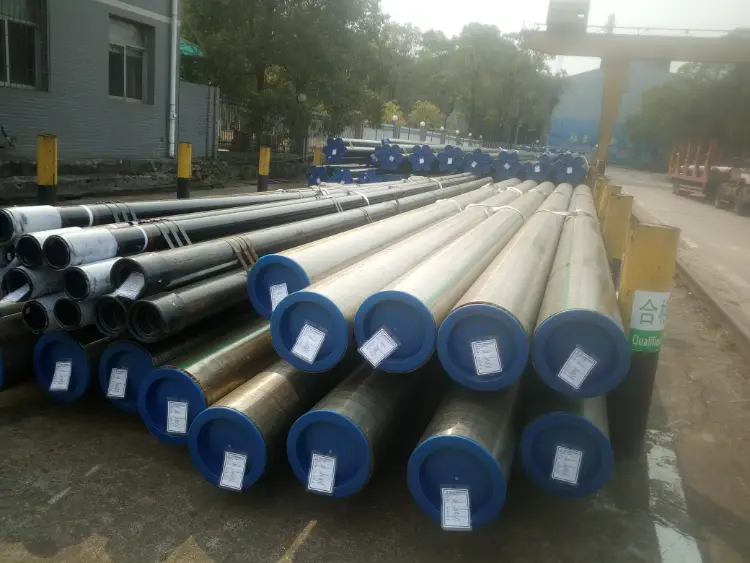
JIS G3101 SS330 ERW Pipe
JIS G3101 SS330 ERW Pipe: Composition, Mechanical & Physical Properties, Equivalents
In-depth data sheet for JIS G3101 SS330 electric resistance welded (ERW) pipe including chemical composition, mechanical properties, physical data, international equivalents, and application guide.
Electric resistance welding (ERW), cold forming, hot-rolling, bending, cutting, mild machining, galvanizing
- Phone : +8618037372205
- Email : [email protected]
- WhatsApp: Contact via Whtsapp
- WeChat: +8618037372205
JIS G3101 SS330 ERW Pipe Introduction
JIS G3101 SS330 is a carbon steel for general structural purposes as per Japanese Industrial Standard. When manufactured into electric resistance welded (ERW) pipe, it provides a cost-effective solution for structural frameworks, piping, and light mechanical components. SS330 exhibits good weldability, moderate strength, and excellent formability. Typical delivery condition is hot-rolled strip formed into pipe and ERW, with no specific heat treatment required. The material is widely used in construction, infrastructure, and machinery where strict strength requirements are not the primary concern.
JIS G3101 SS330 ERW Pipe Chemical Composition
The standard JIS G3101 specifies maximum limits for phosphorus and sulfur only. Carbon, silicon, and manganese are not specified in the standard and are left to the manufacturer's discretion. The table below reflects typical commercially supplied values for SS330 intended for ERW pipe production.
| Element | Typical Value (max %) | Remarks |
|---|---|---|
| Carbon (C) | 0.15 | Not specified in standard; typical for weldability |
| Silicon (Si) | 0.05 | Not specified in standard; kept low for surface quality |
| Manganese (Mn) | 0.60 | Not specified in standard; added for strength |
| Phosphorus (P) | 0.050 | Maximum as per JIS G3101 |
| Sulfur (S) | 0.050 | Maximum as per JIS G3101 |
JIS G3101 SS330 ERW Pipe Thermal and Electrical Physical Properties
Physical properties are representative of general carbon steel grades similar to SS330. These values are not formally specified in JIS G3101 but are widely accepted for design calculations and simulation. Slight variations may occur based on exact composition and processing.
| Property | Typical Value | Unit | Test Condition / Remarks |
|---|---|---|---|
| Density (ρ) | 7.85 | g/cm³ | Room temperature |
| Modulus of Elasticity (E) | 210 | GPa | Room temperature, standard for carbon steel |
| Shear Modulus (G) | 81 | GPa | Calculated from E and Poisson's ratio |
| Poisson's Ratio (ν) | 0.3 | — | Within elastic range |
| Thermal Expansion (α) | 11.7 × 10⁻⁶ | 1/K | 20°C to 100°C |
| Thermal Conductivity (λ) | 53 | W/(m·K) | At 20°C |
| Specific Heat Capacity | 486 | J/(kg·K) | At 20°C |
| Electrical Resistivity (ρ_e) | 0.16 × 10⁻⁶ | Ω·m | At 20°C (approximate) |
JIS G3101 SS330 ERW Pipe Mechanical Properties
The following values are derived from JIS G3101 base steel requirements and common practice for ERW structural pipe (e.g., according to JIS G3444). Actual values may vary depending on wall thickness and pipe dimensions. Tensile test and bend test are standard; impact test is not normally required.
| Property | Standard Requirement (min or range) | Unit | Test Condition |
|---|---|---|---|
| Yield Point (ReH) or Yield Strength | ≥ 205 | MPa | Wall thickness ≤ 16 mm |
| Tensile Strength (Rm) | 330 – 430 | MPa | All thicknesses |
| Elongation (A) | ≥ 26 | % | Thickness ≤ 5 mm, JIS No.5 test piece |
| Elongation (A) | ≥ 21 | % | 5 mm < thickness ≤ 16 mm, JIS No.1A test piece |
| Elongation (A) | ≥ 26 (nominal for pipe) | % | Full section ERW pipe (tube) |
| Bend Test (Bend Angle 180°, D = diameter of mandrel, t = thickness) | No cracks | — | Mandrel diameter ≤ 1.5×t for thickness ≤ 8 mm; 2.0×t for thickness > 8 mm |
JIS G3101 SS330 ERW Pipe Exact Equivalent Material Standards and Replaceable Grades
| Country/Region | Standard | Grade | Remarks |
|---|---|---|---|
| International (ISO) | ISO 630-2 | HR235 | Comparable yield strength ~235 MPa minimum; replaces older Fe360 |
| European Union | EN 10025-2 | S235JR | Standard structural grade; widely equivalent |
| USA | ASTM A283/A283M | Grade D | Similar tensile range and weldable carbon steel |
| China | GB/T 700 | Q235A | Yield ≥235 MPa, tensile 375-500 MPa; close substitute for thicker sections |
| Korea | KS D 3503 | SS275 | Equivalent to JIS SS330 in Korean standard system |
JIS G3101 SS330 ERW Pipe Application Introduction
SS330 ERW pipe is designed for structural and general engineering applications where moderate strength and good weldability are essential. It is not intended for pressure-retaining parts unless additional testing is carried out. The pipe can be easily cut, bent, drilled, and coated. Common protective treatments include hot-dip galvanizing and painting.
Product Applications: Structural hollow sections for frames, Scaffolding tubes and accessories, Furniture legs and frames, Greenhouse structures, Fencing and handrails, Conveyor rollers, Light poles and signposts
Processed into products: Welded tubular joints, Brackets and supports, Spacers and axle tubes, Frame members for machinery guards, Pipe sleeves and spacers, Exhaust pipe sections (non-automotive)
Application industries: Building & Construction, Furniture Manufacturing, Agricultural Machinery, Automotive (non-critical structural parts), Infrastructure (guardrails, sign posts), Material Handling (racks, trolleys)
JIS G3101 SS330 ERW Pipe Similar / Alternative Materials with Close Properties
| Country/Region | Standard | Grade | Remarks |
|---|---|---|---|
| Japan | JIS G3101 | SS400 | Higher strength (tensile 400-510 MPa); often used interchangeably where available |
| Japan | JIS G3131 | SPHC | Hot-rolled mild steel sheet; similar chemical range, used for forming and tube |
| USA | ASTM A1011 | CS Type B | Commercial quality hot-rolled; close to SS330 in pipe application |
| Germany | DIN 17100 | St33 | Historical equivalent; now replaced by EN S185 / S235 |
Notes:
Additional remarks: SS330 ERW pipe is typically produced according to JIS G3444 (Carbon steel tubes for general structural purposes). The inside weld bead may be controlled or removed on request. Hydrostatic testing is generally not required for structural tubes unless specified. For enhanced corrosion resistance, hot-dip galvanizing to JIS H8641 is commonly applied. Supply condition: mill edge, square cut ends, oiled or dry.
- Share



