
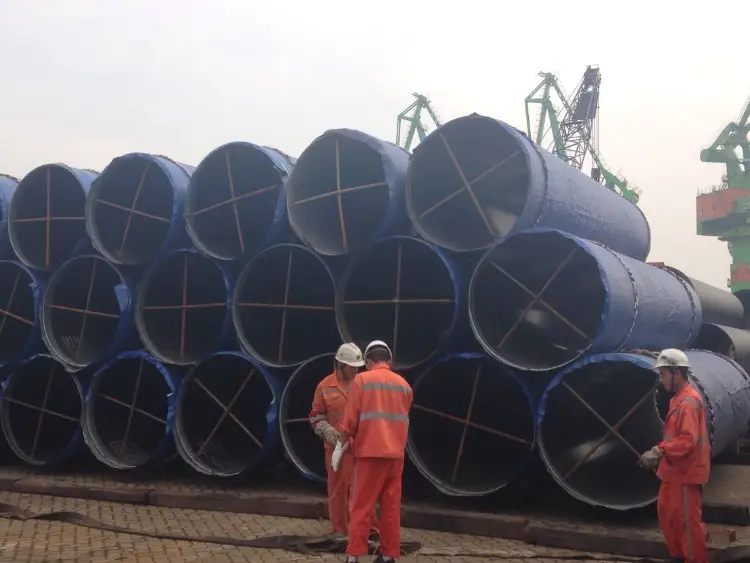
High-Strength Quenched & Tempered S460QL Steel for SSAW Pipe
High-Strength Quenched & Tempered S460QL Steel for SSAW Pipe - EN 10025-6
Comprehensive material data for S460QL high-strength quenched and tempered steel according to EN 10025-6, including chemical composition, mechanical properties, physical constants, equivalent grades and application guidance for SSAW pipes.
Hot forming, cold forming (with limitations), welding (with controlled heat input), cutting (plasma, flame, laser), machining
- Phone : +8618037372205
- Email : [email protected]
- WhatsApp: Contact via Whtsapp
- WeChat: +8618037372205
High-Strength Quenched & Tempered S460QL Steel for SSAW Pipe Introduction
S460QL is a high-strength quenched and tempered fine-grain structural steel defined in EN 10025-6. It offers a minimum yield strength of 460 MPa (for thicknesses up to 50 mm) combined with guaranteed low-temperature impact toughness down to -50 °C (longitudinal KV≥27 J). The QL designation indicates quenching and tempering treatment plus low-temperature (-50 °C) notch toughness.
This grade is widely used for welded structures requiring high strength-to-weight ratios and excellent brittle fracture resistance, such as SSAW (Spiral Submerged Arc Welded) pipes, offshore platforms, bridges, and heavy machinery. The steel is supplied in the quenched and tempered condition, offering good weldability and formability for demanding engineering applications.
High-Strength Quenched & Tempered S460QL Steel for SSAW Pipe Chemical Composition
Chemical requirements for ladle analysis according to EN 10025-6. The S460QL grade is a fine-grain steel with microalloying elements (Nb, V, Ti, Al) to ensure grain refinement and precipitation strengthening. Carbon equivalent (CEV) is typically controlled for good weldability. Elements are given as maximum values unless a range is specified.
| Element | Standard Value (max %) | Remarks |
|---|---|---|
| C | 0.20 | |
| Si | 0.80 | |
| Mn | 1.70 | |
| P | 0.025 | |
| S | 0.015 | |
| Cr | 1.50 | |
| Mo | 0.70 | |
| Ni | 2.00 | |
| Nb | 0.06 | |
| V | 0.12 | |
| Ti | 0.05 | |
| Cu | 0.50 | |
| N | 0.015 | |
| B | 0.005 | |
| Zr | 0.15 | |
| Al (total) | ≥ 0.015 | Minimum required for fine-grain practice |
| CEV | Reference only | Calculated per EN 10025-6; typical max ≤0.47–0.53 depending on thickness |
High-Strength Quenched & Tempered S460QL Steel for SSAW Pipe Thermal and Electrical Physical Properties
Typical physical constants at room temperature (20 °C) unless otherwise noted. These values are representative of quenched and tempered low-alloy structural steels and are not part of EN 10025-6 mandatory requirements. They serve as engineering reference for design calculations.
| Property | Typical Value | Unit | Test Condition / Remarks |
|---|---|---|---|
| Density (ρ) | 7850 | kg/m³ | At 20 °C |
| Modulus of elasticity (E) | 210 | GPa | Tensile modulus, room temperature |
| Shear modulus (G) | 80 | GPa | Calculated from E and ν |
| Poisson's ratio (ν) | 0.30 | Elastic deformation range | |
| Thermal expansion coefficient (α) | 12.0 | 10⁻⁶/K | 20 °C – 100 °C |
| Thermal expansion coefficient (α) | 12.5 | 10⁻⁶/K | 20 °C – 200 °C |
| Thermal expansion coefficient (α) | 13.1 | 10⁻⁶/K | 20 °C – 400 °C |
| Thermal conductivity (λ) | 50 | W/(m·K) | At 20 °C (typical for Q&T steel) |
| Specific heat capacity (cₚ) | 460 | J/(kg·K) | At 20 °C |
| Electrical resistivity (ρₑ) | 0.23 | µΩ·m | At 20 °C |
High-Strength Quenched & Tempered S460QL Steel for SSAW Pipe Mechanical Properties
Minimum mechanical property requirements according to EN 10025-6, based on thickness (t) ranges. Values refer to longitudinal test pieces unless stated otherwise. Impact testing at -50 °C confirms L-grade toughness. Bending tests are performed on transverse specimens for plate products.
| Property | Requirement | Unit | Condition / Thickness |
|---|---|---|---|
| Yield strength (ReH) | ≥ 460 | MPa | t ≤ 50 mm |
| Yield strength (ReH) | ≥ 440 | MPa | 50 mm < t ≤ 100 mm |
| Yield strength (ReH) | ≥ 400 | MPa | 100 mm < t ≤ 150 mm |
| Tensile strength (Rm) | 550 – 720 | MPa | t ≤ 100 mm |
| Tensile strength (Rm) | 500 – 670 | MPa | 100 mm < t ≤ 150 mm |
| Elongation (A) | ≥ 17 | % | t ≤ 50 mm; L₀=5.65√S₀, longitudinal |
| Elongation (A) | ≥ 16 | % | 50 mm < t ≤ 100 mm |
| Elongation (A) | ≥ 15 | % | 100 mm < t ≤ 150 mm |
| Impact energy (KV, longitudinal) | ≥ 27 | J | -50 °C; average of 3 specimens, single min 70% of average |
| Bend test (transverse) | No cracks | Mandrel diameter: 2t for t ≤ 16 mm; 3t for t > 16 mm; bending angle 180° |
High-Strength Quenched & Tempered S460QL Steel for SSAW Pipe Fully Equivalent Material Standards and Replaceable Grades
| Country/Region | Standard | Grade | Remarks |
|---|---|---|---|
| European Union | EN 10025-6:2019 | S460QL | Original specification |
| Germany | DIN EN 10025-6 | S460QL | Identical to EN version |
| United Kingdom | BS EN 10025-6 | S460QL | Identical to EN version |
| France | NF EN 10025-6 | S460QL | Identical to EN version |
| International | ISO 4950-3 | S460QL | High yield strength flat products; technically equivalent |
High-Strength Quenched & Tempered S460QL Steel for SSAW Pipe Application Introduction
S460QL in the quenched and tempered condition is especially suited for SSAW (Spiral Submerged Arc Welded) pipes used in high-pressure oil and gas transmission because it offers high strength, low-temperature toughness and excellent weldability when proper procedures are followed. It is also widely used in:
- Offshore platforms and marine structures (deck plates, node sections)
- Bridges and civil engineering (box girders, long-span structures)
- Cranes, heavy transport vehicles and material handling equipment
- Pressure vessels and storage tanks
- Heavy structural hollow sections
Product Applications: Spiral submerged arc welded (SSAW) pipes, Longitudinal welded pipes (LSAW), Structural plates and wide flats, Welded H-beams and box columns, Pressure vessel shells
Processed into products: SSAW pipe sections for long-distance pipelines, Offshore platform braces and legs, Crane boom chords and luffing jibs, Bridge main girders and cross beams, Pressure vessel cylindrical shells
Application industries: Oil & Gas (transportation pipelines, SSAW pipes), Marine & Offshore, Bridge Construction, Heavy Machinery & Mining, Energy & Pressure Equipment
High-Strength Quenched & Tempered S460QL Steel for SSAW Pipe Similar / Comparable Alternative Materials
| Country/Region | Standard | Grade | Remarks |
|---|---|---|---|
| EU | EN 10025-6 | S460Q | Same strength, minimum impact at -20 °C instead of -50 °C |
| EU | EN 10025-6 | S460QL1 | Impact temperature -60 °C, otherwise identical |
| EU | EN 10025-6 | S500Q / S500QL | Higher yield strength (500 MPa), similar Q&T concept |
| USA | ASTM A514 / A517 | Grade B | Quenched & tempered plate; similar strength and toughness range, but different chemical limits |
| Japan | JIS G 3128 | SHY685 | High-strength quenched & tempered steel; similar applications, check property alignment |
Notes:
Welding: Preheating and interpass temperature control are recommended to avoid hydrogen cracking. Use low-hydrogen consumables and follow approved welding procedures.
Forming: Cold forming may require stress relief treatment depending on deformation ratio. Hot forming must be followed by re-quenching and tempering to restore properties.
Corrosion protection: As with all structural steels, protective coatings or cathodic protection may be needed in aggressive environments.
Certification: Inspect to EN 10204 type 3.1 or 3.2 as required.
- Share



