
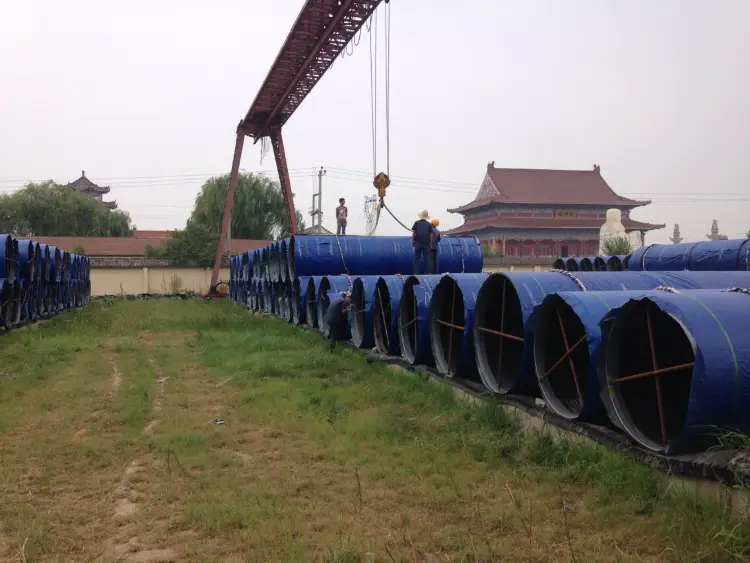
EN10025-6 S460Q SSAW Pipe
EN10025-6 S460Q Quenched & Tempered Steel for SSAW Pipe Fabrication
Comprehensive data on S460Q steel grade according to EN 10025-6, featuring chemistry, mechanical and physical properties, equivalents, and applications in spiral submerged arc welded (SSAW) pipes.
Quenching and tempering (Q+T), cold forming, welding (SAW, SMAW, GMAW), machining
- Phone : +8618037372205
- Email : [email protected]
- WhatsApp: Contact via Whtsapp
- WeChat: +8618037372205
EN10025-6 S460Q SSAW Pipe Introduction
S460Q is a quenched and tempered fine-grain structural steel grade defined in EN 10025-6:2004 + A1:2011. It offers a minimum yield strength of 460 MPa and good weldability combined with high toughness at low temperatures. The Q designation indicates a quenching and tempering heat treatment, which delivers a favorable strength-to-toughness ratio. Key characteristics include:
- Excellent strength and ductility for welded heavy structures
- Controlled chemical composition with low carbon equivalent (CEV) ensuring reliable weldability
- Specified impact energy at -20°C (S460Q) for ductile fracture resistance
- Supplied in plates and wide flats, commonly processed into SSAW (spiral submerged arc welded) pipes for high-pressure transmission
The S460Q plate is ideal for demanding applications such as offshore platforms, bridges, pressure vessels, and large-diameter linepipe produced via the spiral welding process.
EN10025-6 S460Q SSAW Pipe Chemical Composition
The chemical composition of S460Q steel strictly follows the limits of EN 10025-6. Maximum values are shown unless a range is specified. The carbon equivalent value (CEV) is calculated according to the standard using the formula: CEV = C + Mn/6 + (Cr+Mo+V)/5 + (Ni+Cu)/15. For thickness ≤70 mm the maximum CEV is 0.47, and for thickness >70 mm it is 0.50. Controlled additions of microalloying elements like Nb, V, Ti contribute to grain refinement and precipitation strengthening.
| Chemical Element | Maximum Value (%) | Remarks |
|---|---|---|
| Carbon (C) | 0.20 | CEV depends on thickness |
| Silicon (Si) | 0.80 | |
| Manganese (Mn) | 1.70 | |
| Phosphorus (P) | 0.025 | |
| Sulfur (S) | 0.015 | |
| Nitrogen (N) | 0.015 | |
| Boron (B) | 0.005 | |
| Chromium (Cr) | 1.50 | |
| Copper (Cu) | 0.50 | |
| Molybdenum (Mo) | 0.70 | Optional addition |
| Niobium (Nb) | 0.06 | |
| Nickel (Ni) | 2.0 | Allowed up to specified limit |
| Titanium (Ti) | 0.05 | |
| Vanadium (V) | 0.12 | |
| Zirconium (Zr) | 0.15 |
EN10025-6 S460Q SSAW Pipe Thermal and Electrical Physical Properties
The physical properties listed below are representative for a carbon-manganese quenched and tempered steel with a yield strength of about 460 MPa. They are not specified in EN 10025-6 but are typical engineering reference data. Thermal expansion, conductivity, and specific heat vary with temperature. Modulus of elasticity and Poisson's ratio remain nearly constant at room temperature.
| Property | Typical Value | Unit | Test Condition / Temperature |
|---|---|---|---|
| Density (ρ) | 7850 | kg/m³ | 20°C |
| Modulus of Elasticity (E) | 210 | GPa | 20°C |
| Shear Modulus (G) | 81 | GPa | 20°C |
| Poisson's Ratio (ν) | 0.3 | – | 20°C |
| Thermal Expansion Coefficient (α) | 11.1 × 10⁻⁶ | K-1 | 20–100°C |
| Thermal Expansion Coefficient (α) | 12.1 × 10⁻⁶ | K-1 | 20–200°C |
| Thermal Expansion Coefficient (α) | 12.9 × 10⁻⁶ | K-1 | 20–300°C |
| Thermal Expansion Coefficient (α) | 13.5 × 10⁻⁶ | K-1 | 20–400°C |
| Thermal Conductivity (λ) | 51.9 | W/(m·K) | 20°C |
| Thermal Conductivity (λ) | 48.6 | W/(m·K) | 200°C |
| Thermal Conductivity (λ) | 45.3 | W/(m·K) | 300°C |
| Thermal Conductivity (λ) | 42.7 | W/(m·K) | 400°C |
| Specific Heat Capacity | 490 | J/(kg·K) | 20°C |
| Specific Heat Capacity | 540 | J/(kg·K) | 200°C |
| Specific Heat Capacity | 590 | J/(kg·K) | 400°C |
| Electrical Resistivity (ρe) | 0.23 × 10⁻⁶ | Ω·m | 20°C |
EN10025-6 S460Q SSAW Pipe Mechanical Properties
Mechanical properties are valid for the quenched and tempered condition. Values depend on product thickness. Yield strength (ReH), tensile strength (Rm), and elongation (A) are determined on transverse test pieces, while impact energy (KV) is measured on longitudinal Charpy V-notch specimens at -20°C. The bend test (if required) uses a mandrel diameter of 3t for thickness ≤16 mm and 4t for thicker sections.
| Property | Specified Value | Unit | Test Condition |
|---|---|---|---|
| Yield Strength (ReH) | 460 min | MPa | Thickness ≤16 mm |
| Yield Strength (ReH) | 440 min | MPa | Thickness >16 ≤40 mm |
| Yield Strength (ReH) | 420 min | MPa | Thickness >40 ≤63 mm |
| Yield Strength (ReH) | 400 min | MPa | Thickness >63 ≤80 mm |
| Yield Strength (ReH) | 380 min | MPa | Thickness >80 ≤100 mm |
| Yield Strength (ReH) | 360 min | MPa | Thickness >100 ≤150 mm |
| Tensile Strength (Rm) | 550 - 720 | MPa | Thickness ≤40 mm |
| Tensile Strength (Rm) | 530 - 700 | MPa | Thickness >40 ≤100 mm |
| Tensile Strength (Rm) | 500 - 680 | MPa | Thickness >100 ≤150 mm |
| Elongation (A) | 17 min | % | Thickness ≤40 mm, gauge length 5.65√So (transverse) |
| Elongation (A) | 15 min | % | Thickness >40 ≤100 mm |
| Elongation (A) | 14 min | % | Thickness >100 ≤150 mm |
| Impact Energy (KV) | 27 min | J | at -20°C, longitudinal, thickness ≤70 mm |
| Bend Test (mandrel diameter) | 3t | Thickness ≤16 mm, 180° bend | |
| Bend Test (mandrel diameter) | 4t | Thickness >16 mm, 180° bend |
EN10025-6 S460Q SSAW Pipe Completely Equivalent Material Standards and Replaceable Grades
| Country / Region | Standard | Grade | Remarks |
|---|---|---|---|
| Europe | EN 10025-6 | S460Q | Base specification for quenched & tempered fine-grain steel |
| International | ISO 4951-2 | S460Q | Identical designation for high yield strength structural steel |
| Germany | DIN EN 10025-6 | S460Q | German implementation of European standard |
| France | NF EN 10025-6 | S460Q | French adoption |
| UK | BS EN 10025-6 | S460Q | British adoption, former BS 7613 S460QL/S460QL1 may also be referenced |
| Italy | UNI EN 10025-6 | S460Q | Italian version |
| Spain | UNE EN 10025-6 | S460Q | Spanish version |
EN10025-6 S460Q SSAW Pipe Application Introduction
S460Q steel, primarily delivered as quenched and tempered plates, is widely used in the production of spiral submerged arc welded (SSAW) pipes for high-pressure oil and gas transmission, water mains, and structural piling. Its high yield strength permits lighter wall thickness, reducing weight and fabrication costs. The steel's excellent low-temperature toughness guarantees reliability in arctic or offshore environments. Fabrication is straightforward by cold bending, welding, and machining. Typical welding processes include submerged arc welding (SAW) and manual metal arc welding (MMAW) with appropriate low-hydrogen consumables.
Product Applications: Spiral submerged arc welded (SSAW) pipes, Longitudinal submerged arc welded (LSAW) pipes, Structural hollow sections and box girders, Bridge components, Piling pipes and foundation elements, Flanges, elbows, and reducers for high-pressure piping systems
Processed into products: Linepipe segments and risers, Pressure vessel shells and heads, Offshore platform legs and braces, Crane booms and heavy-duty frames, Penstock liners and bifurcations, Piling connectors and end rings
Application industries: Oil and gas pipeline (onshore & offshore), Water distribution and penstock, Civil engineering and construction, Offshore platforms and marine structures, Pressure vessel and boiler manufacturing, Heavy equipment and mining machinery
EN10025-6 S460Q SSAW Pipe Near-Equivalent / Alternative Material Recommendations
| Country / Region | Standard | Grade | Remarks |
|---|---|---|---|
| Europe | EN 10025-4 | S460M | Thermomechanically rolled (TMCP), similar yield strength but different toughness and weldability |
| Europe | EN 10025-3 | S460N | Normalized fine-grain steel, lower toughness, used for non-critical structures |
| China | GB/T 1591 | Q460D | High-strength low-alloy structural steel, available in larger thickness ranges with adjusted properties |
| USA | ASTM A572/A572M | Grade 65 | Yield strength 450 MPa (65 ksi), general structural steel, may require supplementary conditions for S460Q parity |
| Japan | JIS G 3106 | SM570 | Welded structural steel with min yield 460 MPa, similar to S460M but not quenched & tempered |
Notes:
Welding recommendations: Preheat temperature usually 100–150°C depending on plate thickness and carbon equivalent. Interpass temperature should not exceed 250°C. Post-weld heat treatment (PWHT) may be avoided due to the quenched and tempered condition when correct welding procedures are applied. The CEV limits ensure good resistance to cold cracking. Certification: EN 10204 inspection certificate 3.1 or 3.2 is typically provided.
- Share



