
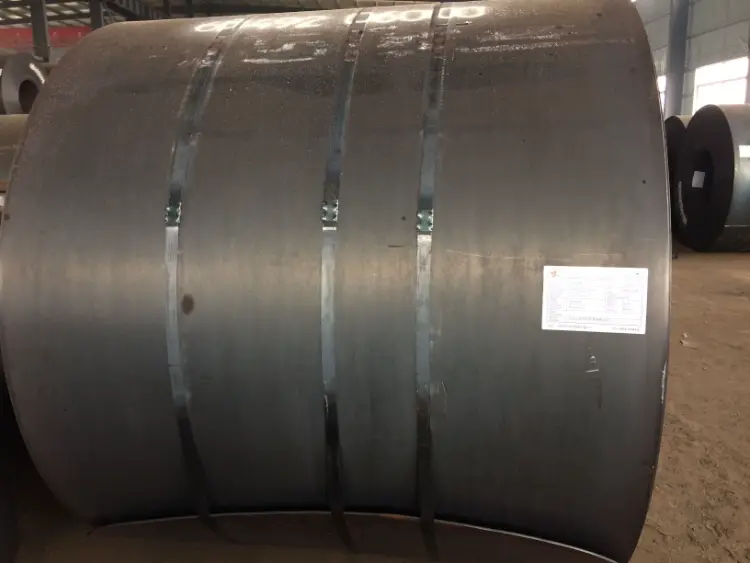
GL Grade E Shipbuilding Steel Coil
GL Grade E Shipbuilding Steel Coil - Low-Temperature Marine Structural Steel
Comprehensive material data for GL Grade E shipbuilding steel coil, covering chemical composition, mechanical and thermal properties, international equivalents, and fabrication guidance per GL and IACS rules.
Hot rolling, normalizing (N), thermo‑mechanical controlled rolling (M/TMCP)
- Phone : +8618037372205
- Email : [email protected]
- WhatsApp: Contact via Whtsapp
- WeChat: +8618037372205
GL Grade E Shipbuilding Steel Coil Introduction
GL Grade E is a normal strength hull structural steel standardized by Germanischer Lloyd (now part of DNV GL). It is a fully killed, fine‑grain steel supplied in normalized or thermo‑mechanically controlled rolled (TMCP) condition. The grade offers a minimum yield strength of 235 MPa and excellent notch toughness at -40°C, making it suitable for critical ship structures such as outer hulls, decks, and bulkheads. Its good weldability and resistance to brittle fracture ensure reliable performance in cold‑water vessels and offshore applications. The product is typically delivered as coils, plates, or cut‑to‑length sheets, ready for shipyard processing.
GL Grade E Shipbuilding Steel Coil Chemical Composition
Chemical limits according to GL Rules and IACS UR W11 for normal strength Grade E steel, thickness ≤50 mm. The steel must be fully killed and fine‑grain treated. When aluminium is used as grain refiner, a minimum acid‑soluble Al content of 0.015% is required. Residual element levels are restricted to maintain weldability and toughness.
| Element | Standard Value (wt%) | Remarks |
|---|---|---|
| Carbon (C) | ≤0.18 | max |
| Manganese (Mn) | 0.70 – 1.60 | for thickness ≤50 mm |
| Silicon (Si) | 0.10 – 0.50 | |
| Phosphorus (P) | ≤0.035 | max |
| Sulfur (S) | ≤0.035 | max |
| Aluminium (Al) acid sol. | ≥0.015 | if used for grain refining, minimum |
| Nitrogen (N) | ≤0.009 | unless bound by sufficient Al |
| Chromium (Cr) | ≤0.20 | residual |
| Nickel (Ni) | ≤0.40 | residual |
| Copper (Cu) | ≤0.35 | residual |
| Molybdenum (Mo) | ≤0.08 | residual |
| Total Cr+Ni+Cu+Mo | ≤0.70 | sum of residuals |
GL Grade E Shipbuilding Steel Coil Thermal and Electrical Physical Properties
Approximate physical properties at room temperature for carbon‑manganese structural steel. Actual values may vary slightly depending on exact chemical composition and processing route. These data are suitable for engineering calculations of heat transfer, stiffness, and electrical characteristics.
| Property | Typical Value | Unit | Conditions / Notes |
|---|---|---|---|
| Density (ρ) | 7.85 | g/cm³ | at 20°C |
| Elastic Modulus (E) | 210 | GPa | at 20°C |
| Shear Modulus (G) | 80 | GPa | at 20°C |
| Poisson's Ratio (ν) | 0.3 | — | typical |
| Thermal Expansion Coefficient (α) | 12.0 × 10⁻⁶ | K⁻¹ | between 20°C and 100°C |
| Thermal Conductivity (λ) | 52 | W/(m·K) | at 20°C |
| Specific Heat Capacity (cₚ) | 460 | J/(kg·K) | at 20°C |
| Electrical Resistivity (ρₑ) | 0.16 × 10⁻⁶ | Ω·m | at 20°C |
GL Grade E Shipbuilding Steel Coil Mechanical Properties
Tensile and impact properties per GL rules, evaluated on longitudinal test pieces unless otherwise noted. For thickness above 50 mm up to 100 mm, elongation values reduce per agreement. The Charpy impact test temperature is -40°C; minimum average absorbed energy is 27 J longitudinal and 20 J transverse for thickness ≤50 mm. Bend test is performed with a 180° mandrel diameter of 3 times the specimen thickness.
| Property | Standard Requirement | Unit | Test Condition / Thickness |
|---|---|---|---|
| Yield Strength (ReH) | ≥235 | MPa | t ≤100 mm, longitudinal |
| Tensile Strength (Rm) | 400 – 520 | MPa | t ≤100 mm, longitudinal |
| Elongation (A5) | ≥22 | % | t ≤50 mm, gauge L₀=5.65√S₀ |
| Elongation (A5) | ≥21 | % | 50 < t ≤70 mm |
| Elongation (A5) | ≥20 | % | 70 < t ≤100 mm |
| Impact Energy (KV) long. | ≥27 (average) | J | -40°C, Charpy V‑notch, t≤50 mm |
| Impact Energy (KV) transv. | ≥20 (average) | J | -40°C, Charpy V‑notch, t≤50 mm |
| Bend Test | d=3a, 180° | — | no cracks, t≤50 mm |
GL Grade E Shipbuilding Steel Coil Completely Equivalent Material Standards and Substitutable Grade Recommendations
| Country/Region | Standard | Grade | Remarks |
|---|---|---|---|
| International (IACS) | UR W11 (Rev.8) | E | Identical chemical and mechanical requirements |
| DNV GL | Rules Pt.2 Ch.1 | NV E | Unified grade from merged GL and DNV |
| Lloyd's Register (LR) | Rules for Ships | Grade E | Full equivalence, -40°C impact |
| Bureau Veritas (BV) | Rules for Steel Ships | Grade E | Same minimum yield 235 MPa |
| American Bureau of Shipping (ABS) | Rules for Materials and Welding | Grade E | Recognized by all IACS members |
| China Classification Society (CCS) | Rules for Materials | E | Directly equivalent to GL E |
| Korean Register (KR) | Rules for the Classification of Steel Ships | RE | Same technical delivery conditions |
| ClassNK (Nippon Kaiji Kyokai) | Rules for Steel Ships | KE | Widely accepted substitute |
| Registro Italiano Navale (RINA) | Rules for Ships | E | Equivalent in all respects |
GL Grade E Shipbuilding Steel Coil Application Introduction
GL Grade E steel coils are primarily employed in the shipbuilding and offshore industry. Their combination of guaranteed low‑temperature toughness and good formability makes them ideal for hull structures that must operate in cold climates. The material can be processed by flame cutting, plasma cutting, shearing, and cold forming; it is easily welded with standard shipyard procedures using low‑hydrogen electrodes or wire under appropriate preheat and interpass conditions. Typical applications include:
Product Applications: Ocean‑going merchant ships, Naval auxiliary vessels, Offshore oil & gas platform substructures, Arctic and Antarctic research vessels, Heavy‑duty port handling equipment
Processed into products: Bottom shell plating, Side shell and bilge strake plates, Main deck and strength deck plates, Longitudinal and transverse stiffeners, Bulkhead panels, Keel plates and stem bars, Hatch coaming and coaming stays, Helideck decks on offshore structures
Application industries: Shipbuilding (cargo ships, tankers, bulkers, container vessels), Offshore engineering (platforms, jackets, modules), Marine construction (docks, pontoons, floating cranes), Ice‑reinforced structures and icebreakers, Bridge fabrication (where low‑temperature toughness is required)
GL Grade E Shipbuilding Steel Coil Similar/Alternative Material Recommendations
| Country/Region | Standard | Grade | Remarks |
|---|---|---|---|
| European Union | EN 10025-2 | S235J2 | Structural steel, 235 MPa min. yield, impact -20°C; not ship‑class approved but similar strength |
| European Union | EN 10025-3 | S235N | Normalized fine‑grain steel, 235 MPa, impact -20°C, enhanced weldability |
| USA | ASTM A131 / A131M | Grade E | Shipbuilding steel, equivalent grade for marine use |
| Japan | JIS G3106 | SM400B | Welded structural steel, 235 MPa class, impact 0°C; for general structures |
| Russia | GOST 5521-93 | E32 (Rst42-2) | Shipbuilding steel, 235 MPa, impact -40°C, comparable toughness |
Notes:
Delivery and certification: Material shall be supplied with GL (or DNV GL) inspection certificate type 3.1 or 3.2 per EN 10204. For thicknesses over 50 mm, through‑thickness properties (Z‑quality) can be agreed if the design requires high resistance to lamellar tearing. Welding: Preheat is generally not required for moderate thicknesses, but follow the consumable manufacturer's guidance for low‑temperature service. Storage: Coils should be stored in dry, covered conditions to prevent corrosion before fabrication.
- Share



