
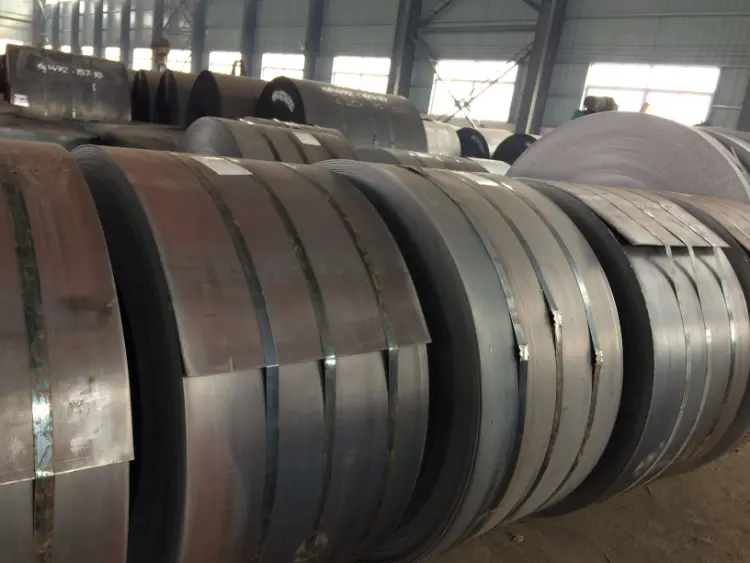
GL Grade D Shipbuilding Steel Coil
GL Grade D Shipbuilding Steel Coil - Chemical & Mechanical Properties
Detailed technical data for GL Grade D shipbuilding steel coil: chemical composition, mechanical properties, thermal and electrical physical properties, equivalent and similar materials, applications in shipbuilding and marine engineering.
Hot rolling, cold forming, welding, machining, flame cutting
- Phone : +8618037372205
- Email : [email protected]
- WhatsApp: Contact via Whtsapp
- WeChat: +8618037372205
GL Grade D Shipbuilding Steel Coil Introduction
GL Grade D is a normal-strength hull structural steel defined by the Germanischer Lloyd (GL) rules, now part of DNV GL. It belongs to the IACS UR W11 ordinary-strength shipbuilding steel category. GL Grade D is designed for use in marine environments where good weldability, reliable toughness at 0 °C, and moderate strength are required. As a carbon-manganese steel, it offers a minimum yield strength of 235 MPa and a tensile strength within 400–520 MPa. The steel is typically supplied in the normalized or as-rolled condition, with grain refinement achieved through additions of aluminium, niobium, vanadium, or titanium. Its good impact toughness ensures resistance to brittle fracture in ship hulls, decks, and structural components. The material can be formed, machined, and welded using standard shipyard procedures, making it a cost-effective choice for general ship construction.
GL Grade D Shipbuilding Steel Coil Chemical Composition
The chemical composition of GL Grade D steel is controlled to ensure good weldability and low-temperature toughness. Grain-refining elements such as aluminium, niobium, vanadium, or titanium are added as necessary. The table below lists the standard requirements according to IACS UR W11 for ordinary-strength grades.
| Element | Specified Value | Remarks |
|---|---|---|
| C | ≤ 0.21 | Ladle analysis |
| Mn | ≥ 2.5 × C | Minimum manganese based on carbon content |
| Si | ≤ 0.50 | Ladle analysis |
| P | ≤ 0.035 | Ladle analysis |
| S | ≤ 0.035 | Ladle analysis |
| Als (acid-soluble Al) | ≥ 0.015 | When used as grain-refining element |
| Nb | 0.02–0.05 | Optional; may be used singly or in combination with V or Ti |
| V | 0.05–0.10 | Optional |
| Ti | ≤ 0.02 | Optional |
| Cu | ≤ 0.35 | Residual element |
| Cr | ≤ 0.20 | Residual element |
| Ni | ≤ 0.40 | Residual element |
| Mo | ≤ 0.08 | Residual element |
| N | ≤ 0.009 | If not fixed by grain refiners |
GL Grade D Shipbuilding Steel Coil Thermal and Electrical Physical Properties
The following physical properties are typical for normalized carbon-manganese steels with a composition similar to GL Grade D. They are provided as reference values for engineering calculations and are not part of the material certification requirements.
| Property | Typical Value | Unit | Test Condition / Notes |
|---|---|---|---|
| Density (ρ) | 7.85 | g/cm³ | At 20 °C |
| Modulus of Elasticity (E) | 205 | GPa | At 20 °C |
| Shear Modulus (G) | 80 | GPa | At 20 °C |
| Poisson's Ratio (ν) | 0.3 | - | At 20 °C |
| Thermal Expansion Coeff. (α) | 11.5 × 10⁻⁶ | K⁻¹ | 20–100 °C |
| Thermal Expansion Coeff. (α) | 12.5 × 10⁻⁶ | K⁻¹ | 20–200 °C |
| Thermal Expansion Coeff. (α) | 13.5 × 10⁻⁶ | K⁻¹ | 20–400 °C |
| Thermal Conductivity (λ) | 51.9 | W/(m·K) | At 100 °C |
| Thermal Conductivity (λ) | 48.6 | W/(m·K) | At 200 °C |
| Thermal Conductivity (λ) | 42.7 | W/(m·K) | At 400 °C |
| Specific Heat Capacity (cₚ) | 486 | J/(kg·K) | At 20–100 °C |
| Electrical Resistivity (ρₑ) | 0.15 × 10⁻⁶ | Ω·m | At 20 °C |
GL Grade D Shipbuilding Steel Coil Mechanical Properties
The mechanical properties of GL Grade D are defined for thicknesses up to 100 mm. Values below comply with IACS UR W11 and GL rules. Impact toughness is verified at 0 °C with Charpy V-notch specimens. Bending tests require no cracking when bent through 180° around a former of 3 times the thickness.
| Property | Specified Value | Unit | Test Condition |
|---|---|---|---|
| Yield Strength (ReH) | ≥ 235 | MPa | Thickness ≤ 100 mm |
| Tensile Strength (Rm) | 400 – 520 | MPa | Thickness ≤ 100 mm |
| Elongation (A) | ≥ 22 | % | Gauge length 5.65√So, longitudinal |
| Bend Test | No cracking, 180° bend, d=3a | - | All thicknesses (a = specimen thickness) |
| Impact Energy (KV2), longitudinal | ≥ 27 | J | Charpy V-notch at 0 °C |
| Impact Energy (KV2), transverse | ≥ 20 | J | Charpy V-notch at 0 °C |
GL Grade D Shipbuilding Steel Coil Completely Equivalent Material Standards and Substitutable Grade Recommendations
| Country/Region | Standard | Grade | Remarks |
|---|---|---|---|
| International | IACS UR W11 | Grade D | Unified requirement for ordinary-strength hull structural steel |
| USA | ABS Rules | ABS Grade D | American Bureau of Shipping |
| France | BV Rules | BV Grade D | Bureau Veritas |
| China | CCS Rules | CCS Grade D | China Classification Society |
| Norway | DNV Rules | DNV Grade D | DNV GL (formerly Det Norske Veritas) |
| South Korea | KR Rules | KR Grade D | Korean Register of Shipping |
| UK | LR Rules | LR Grade D | Lloyd's Register |
| Japan | NK Rules | NK Grade D | Nippon Kaiji Kyokai (ClassNK) |
| Italy | RINA Rules | RINA Grade D | Registro Italiano Navale |
GL Grade D Shipbuilding Steel Coil Application Introduction
GL Grade D steel is a versatile normal‑strength hull structural steel that can be processed into a wide range of products for maritime applications. It is most commonly used where good weldability and guaranteed notch toughness at 0 °C are required. The steel is available in coil form for continuous processes and can be cut‑to‑length for plate and section fabrication.
Product Applications: Hull plating (shell, deck, and bottom plates), Bulkheads and watertight divisions, Structural stiffeners (longitudinals, frames, girders), Deckhouses and superstructures, Hatch covers and coamings, Brackets and transverse web frames, Pipe supports and foundations, Marine boiler supports and stools
Processed into products: Plasma- and flame‑cut shapes, Bent and rolled shell plates (by cold or warm forming), Welded built‑up profiles (T‑bars, L‑sections), Punched or drilled stiffeners, Machine‑fabricated cleats and brackets, Mild-steel welding consumables compatible with GL D steel
Application industries: Shipbuilding and ship repair, Offshore oil and gas platforms, Marine renewable energy (wind turbine foundations), Port and harbour construction, Barge and inland waterway vessel manufacturing, Naval architecture and marine engineering
GL Grade D Shipbuilding Steel Coil Materials with Similar Property Recommendations and Analysis
| Country/Region | Standard | Grade | Remarks |
|---|---|---|---|
| International | IACS UR W11 | AH32 | High-strength hull steel, min YS 315 MPa, suitable for structural parts requiring higher loads, impact at 0 °C |
| International | IACS UR W11 | DH32 | High-strength hull steel, min YS 315 MPa, impact tested at -20 °C, provides better low‑temperature toughness |
| International | IACS UR W11 | EH32 | High-strength hull steel, min YS 315 MPa, impact tested at -40 °C, for severe cold‑climate applications |
| China | GB 712 | CCS D (GB 712 D) | Chinese national standard for ship structural steel, mechanically equivalent to GL D but certification differs |
| Russia | GOST 5521 | St3sp | Ordinary carbon steel with comparable strength, used in shipbuilding; toughness requirements may vary |
| General | EN 10025-2 | S235JR, S235J0 | Structural steel with similar yield strength; not certified for marine use but often considered for less critical parts |
Notes:
- All chemical and mechanical properties are based on the IACS Unified Requirement W11 for ordinary-strength hull structural steels, which is adopted by GL (now DNV GL).
- For thicknesses above 100 mm, the yield and tensile strength may require separate agreement between the purchaser and the steel manufacturer.
- The steel can be supplied with additional certifications such as ultrasonic testing, through‑thickness properties (Z‑quality), or higher toughness values as per class society rules.
- When welding GL Grade D, preheat may be required for thicker sections (>30 mm) to avoid hydrogen cracking; follow approved welding procedure specifications.
- Share



