
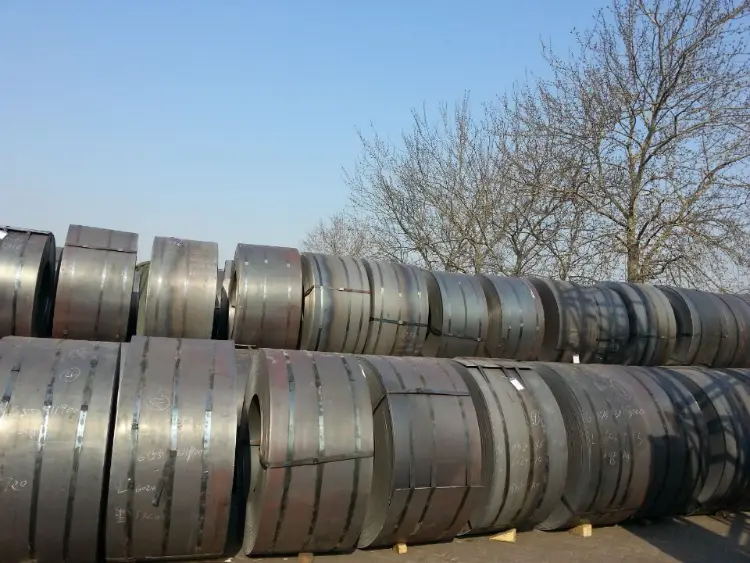
GL Grade B Shipbuilding Steel Coil
GL Grade B Shipbuilding Steel Coil: Comprehensive Material Properties & Equivalents
Explore the full technical profile of GL Grade B shipbuilding steel coil, including chemical composition, mechanical & physical properties, international equivalents, and primary applications.
Cold Forming, Welding, Cutting (Plasma/Laser/Flame), Bending, Rolling
- Phone : +8618037372205
- Email : [email protected]
- WhatsApp: Contact via Whtsapp
- WeChat: +8618037372205
GL Grade B Shipbuilding Steel Coil Introduction
GL Grade B shipbuilding steel coil is a high-quality, normalized or controlled-rolled marine structural steel governed by the Germanischer Lloyd (GL) classification society standards. It is specifically designed for the construction of ship hulls and offshore structures, offering an excellent combination of reliable strength, good weldability, and notch toughness at room temperature. This mild steel grade is a fundamental material for main structural components like hull plates, decks, and bulkheads. With a specified minimum yield strength of 235 MPa, it ensures robust structural integrity under static and dynamic loads. Its carefully controlled chemistry, low carbon equivalent, and consistent mechanical properties provide superior formability and facilitate efficient fabrication processes such as cutting, forming, and welding in shipyards globally.
GL Grade B Shipbuilding Steel Coil Chemical Composition
The chemical composition of GL Grade B steel is strictly controlled to ensure optimal weldability and structural performance. Maximum limits are set for elements like Carbon (C) and Manganese (Mn) to define strength, while residuals such as Phosphorus (P) and Sulfur (S) are minimized to enhance ductility and toughness. Micro-alloying elements like Aluminum (Al) are required for grain refinement when the steel is supplied in a fine-grain treated condition. The following values represent heat analysis data according to the GL Rules for normal strength hull structural steel.
| Element | Standard Value (Max, %) | Remarks |
|---|---|---|
| Carbon (C) | 0.21 | Ladle analysis |
| Manganese (Mn) | ≥ 0.80 | Ladle analysis; max value depends on C content, typically min 2.5×C |
| Silicon (Si) | 0.10 – 0.50 | Ladle analysis |
| Phosphorus (P) | 0.035 | Ladle analysis |
| Sulfur (S) | 0.035 | Ladle analysis |
| Aluminum (Al) | ≥ 0.015 | Acid-soluble, required for fine grain practice |
| Chromium (Cr) | ≤ 0.25 | Residual element |
| Nickel (Ni) | ≤ 0.30 | Residual element |
| Copper (Cu) | ≤ 0.35 | Residual element |
| Molybdenum (Mo) | ≤ 0.10 | Residual element |
GL Grade B Shipbuilding Steel Coil Thermal & Electrical Physical Properties
Physical properties are conventional data for low-carbon structural steel. These values are not mandatory for product certification but are essential for design calculations involving thermal loading, heat transfer analysis, and electromagnetic compatibility. Properties like density drive weight estimations, while thermal expansion and conductivity influence fire resistance design and welding procedure qualifications. The data below represents typical values at room temperature unless otherwise noted.
| Property | Typical Value | Unit | Test Condition |
|---|---|---|---|
| Density (ρ) | 7.85 | kg/dm³ | At 20°C |
| Elastic Modulus (E) | 210 | GPa | At 20°C |
| Shear Modulus (G) | 81 | GPa | At 20°C |
| Poisson's Ratio (ν) | 0.30 | – | At 20°C |
| Thermal Expansion Coefficient (α) | 11.7 | 10⁻&sup6;/K | Between 20°C and 100°C |
| Thermal Expansion Coefficient (α) | 12.5 | 10⁻&sup6;/K | Between 20°C and 200°C |
| Thermal Conductivity (λ) | 52 | W/(m·K) | At 20°C |
| Specific Heat Capacity | 460 | J/(kg·K) | At 20°C |
| Electrical Resistivity (ρ_e) | 0.22 | Ω·mm²/m | At 20°C |
GL Grade B Shipbuilding Steel Coil Mechanical Properties
The mechanical properties of GL Grade B steel are verified through tensile and impact testing to ensure compliance with classification society rules. Key properties include minimum yield strength, tensile strength range, elongation, and Charpy V-notch impact toughness at a defined temperature. The impact test requirement at 0°C is a primary differentiator from Grade A steel, ensuring adequate resistance to brittle fracture in moderately cold environments. The following data is based on the GL standard for thicknesses typically up to 50 mm.
| Property | Required Value | Unit | Test Condition |
|---|---|---|---|
| Yield Strength (ReH) | ≥ 235 | MPa | Transverse/Flat specimen, Ambient temperature, t ≤ 50mm |
| Yield Strength (ReH) | ≥ 215 | MPa | Transverse/Flat specimen, Ambient temperature, 50mm < t ≤ 100mm |
| Tensile Strength (Rm) | 400 – 520 | MPa | Transverse/Flat specimen, Ambient temperature |
| Elongation (A5) | ≥ 22 | % | Longitudinal/Round specimen, Gauge length 5.65√So, Ambient temperature |
| Charpy V-Notch Impact Energy (KV) | ≥ 27 (Average) | J | Longitudinal, Testing Temperature 0°C |
| Charpy V-Notch Impact Energy (KV) | ≥ 20 (Single) | J | Longitudinal, Testing Temperature 0°C |
| Bend Test (Dia. factor 'd') | d = 3a (t ≤ 30mm) or d = 3.5a (t > 30mm) | – | 180° bend, 'a'=specimen thickness, no cracks |
GL Grade B Shipbuilding Steel Coil Exact International Equivalent Material Standards & Grades
| Country/Region | Standard/Classification Society | Grade/Designation | Remarks |
|---|---|---|---|
| International | IACS (International Association of Classification Societies) | Normal Strength Hull Structural Steel Grade B | Unified Requirement UR W11 defines the common baseline standard for all IACS members. |
| United States | ABS (American Bureau of Shipping) | Grade B | Chemically and mechanically identical to GL Grade B. |
| France | BV (Bureau Veritas) | Grade B | Fully equivalent grade for ship construction under BV class. |
| China | CCS (China Classification Society) | Grade B | Direct equivalent for hull structural applications. |
| Norway/Germany | DNV (Det Norske Veritas) | NV B / B | DNV Grade B is a direct match after the merger with GL, now referred to as DNV rules. |
| South Korea | KR (Korean Register) | Grade B | Compliant with IACS UR W11, equivalent in all service aspects. |
| United Kingdom | LR (Lloyd's Register) | Grade B | Standard hull steel grade with identical requirements. |
| Japan | NK (Nippon Kaiji Kyokai, ClassNK) | Grade B | Fully equivalent for shipbuilding and marine structures. |
| Italy | RINA (Registro Italiano Navale) | Grade B | Equivalent normal strength hull structural steel. |
GL Grade B Shipbuilding Steel Coil Application Introduction
GL Grade B steel coil is a backbone material in marine and offshore construction, offering a balance of strength, formability, and affordability. It is ideally utilized in moderate and heavy sections of the hull where a notch toughness guarantee at 0°C is required. The material's excellent weldability allows for high-efficiency panel line fabrication, while its good formability permits cold and hot bending during frame and shell plate production. Typical delivery as flat plates cut from coil ensures consistent quality and optimal logistics for shipyards.
Product Applications: Bulk Carriers and Tanker Hulls, Container Ships and Ro-Ro Ferries, Offshore Jack-up Rig Legs (secondary members), Floating Pontoons and Docks, Barge Skids and Deep-sea Foundations
Processed into products: Main Deck Plating and Stringer Plates, Hull Bottom and Side Shell Plating, Transverse and Longitudinal Bulkheads, Inner Bottom Plating (Tank Top), Web Frames, Stiffeners, and Girders, Hatch Coamings and Cargo Hold Supports
Application industries: Shipbuilding (Merchant, Naval, Passenger), Offshore Oil & Gas Platform Construction, Marine Salvage and Heavy Lifting, Dredging and Port Infrastructure, Bridge Fabrication (with additional approvals)
GL Grade B Shipbuilding Steel Coil Similar/Comparable Material Grades for Reference
| Country/Region | Standard | Grade | Remarks |
|---|---|---|---|
| European Union | EN 10025-2 | S235JR / S235J0 | S235J0 provides similar impact toughness (27J at 0°C) but is a general structural steel, not certified by classification societies for marine use. Must verify weldability and through-thickness properties. |
| China | GB/T 700 | Q235B / Q235C | Q235B has room temperature impact requirement; Q235C has 0°C impact requirement, aligning closer to Grade B. Not a direct replacement without marine certification. |
| Russia | GOST 5521 | St3sp (normalized) | Russian shipbuilding steel with similar strength level. Exact equivalence must be verified against specific delivery conditions. |
| International | IACS | Grade A | A lower grade with identical strength but only 20°C impact requirement. May be suitable for non-critical, non-cold exposed structures, but is a downgrade from Grade B. |
Notes:
Certification: Products must be certified by the GL/DNV classification society surveyor, including stamping with the grade, heat number, and surveyor's mark. Weldability: The carbon equivalent (CEV) is typically controlled to ≤ 0.38–0.40% to ensure excellent cold-cracking resistance. A typical CEV formula for Grade B is C + Mn/6 + (Cr+Mo+V)/5 + (Ni+Cu)/15. Surface Condition: Coils are generally delivered in a pickled and oiled, or blast-cleaned and shop-primed condition to prevent corrosion during storage and fabrication.
- Share



