
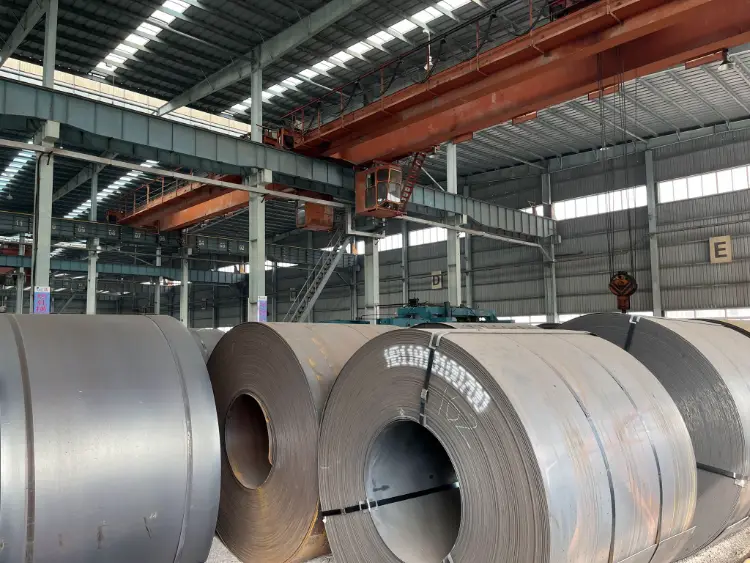
GL F620 Shipbuilding Steel Coil
GL F620 Shipbuilding Steel Coil - High-Strength Structural Plate Certified
GL F620 is a high-strength shipbuilding steel coil with minimum yield strength of 620 MPa, certified by Germanischer Lloyd (now DNV GL) for critical offshore and marine constructions.
Thermo-mechanical rolling, quenching and tempering
- Phone : +8618037372205
- Email : [email protected]
- WhatsApp: Contact via Whtsapp
- WeChat: +8618037372205
GL F620 Shipbuilding Steel Coil Introduction
GL F620 is a quenched and tempered high-strength structural steel for shipbuilding, classified under the rules of Germanischer Lloyd (GL) and now part of DNV GL. Key characteristics:
- Minimum yield strength of 620 MPa, offering excellent load-bearing capacity
- Good weldability and toughness at low temperatures
- Suitable for heavy-lift structures, jack-up rig components, and high-stress ship frames
- Supplied as coils or cut-to-length plates after thermal-mechanical processing
It is designed to meet stringent marine classification society requirements, ensuring reliable performance in harsh sea environments.
GL F620 Shipbuilding Steel Coil Chemical Composition
Typical ladle analysis as per DNV GL rules for high-strength shipbuilding steels. Elements include: carbon, manganese, silicon, phosphorus, sulfur, chromium, nickel, molybdenum, copper, niobium, vanadium, titanium, and nitrogen. Carbon equivalent (CEV) is controlled for weldability.
| Element | Standard Value (max % unless range) | Remarks |
|---|---|---|
| C | ≤0.20 | Exact max depends on thickness |
| Si | ≤0.55 | Killed steel practice |
| Mn | 1.00–1.70 | Higher Mn for strength |
| P | ≤0.025 | Low phosphorus requirement |
| S | ≤0.025 | Low sulfur requirement |
| Cr | ≤1.50 | Improves hardenability |
| Ni | ≤2.00 | Enhances toughness |
| Mo | ≤0.70 | Contributes to temper resistance |
| Cu | ≤0.50 | May be present for corrosion resistance |
| Nb | 0.02–0.05 | Grain refinement |
| V | 0.02–0.10 | Precipitation strengthening |
| Ti | 0.02–0.10 | Nitrogen fixation |
| Al (total) | ≥0.020 | Fine grain practice |
| N | ≤0.012 | Controlled for aging |
| B | ≤0.005 | Optional for hardenability |
GL F620 Shipbuilding Steel Coil Thermal and Electrical Physical Properties
Approximate physical properties for quenched & tempered structural steel at room temperature. Includes: density, elastic modulus, shear modulus, Poisson's ratio, thermal expansion, thermal conductivity, specific heat, and electrical resistivity.
| Property | Value (Typical) | Unit | Conditions |
|---|---|---|---|
| Density (ρ) | 7850 | kg/m³ | Room temperature |
| Elastic Modulus (E) | 205–210 | GPa | Room temperature |
| Shear Modulus (G) | 79–81 | GPa | Estimated from E and ν |
| Poisson's Ratio (ν) | 0.28–0.30 | — | Room temperature |
| Thermal Expansion (α) | 11.5–12.5 ×10⁻⁶ | K⁻¹ | 20–200°C |
| Thermal Expansion (α) | 13.0–14.0 ×10⁻⁶ | K⁻¹ | 20–400°C |
| Thermal Conductivity (λ) | 40–45 | W/(m·K) | At 100°C |
| Thermal Conductivity (λ) | 35–40 | W/(m·K) | At 300°C |
| Specific Heat (cp) | 460–500 | J/(kg·K) | 20–100°C |
| Electrical Resistivity (ρ_e) | 0.20–0.25 ×10⁻⁶ | Ω·m | Room temperature |
GL F620 Shipbuilding Steel Coil Mechanical Properties
Mechanical properties for quenched and tempered condition, tested on transverse specimens per GL standard. Key parameters: yield strength (ReH), tensile strength (Rm), elongation (A), Charpy impact toughness at -20°C or -40°C.
| Property | Standard Requirement | Unit | Test Condition |
|---|---|---|---|
| Yield Strength (ReH) | ≥620 | MPa | t ≤ 50 mm |
| Yield Strength (ReH) | ≥550 | MPa | 50 < t ≤ 100 mm |
| Tensile Strength (Rm) | 720–890 | MPa | Transverse specimen |
| Elongation (A5) | ≥15 | % | Gauge length 5.65√So |
| Bend Test (mandrel diameter) | D = 4t (t ≤ 25 mm) | — | 180° bend, no cracks |
| Impact Energy (KV, -40°C) | ≥27 (transverse) | J | Average of 3 tests |
| Impact Energy (KV, -40°C) | ≥18 (single min) | J | Individual minimum value |
GL F620 Shipbuilding Steel Coil Fully Equivalent Material Standards and Substitute Grades
| Country/Region | Standard | Grade | Remarks |
|---|---|---|---|
| Germany / DNV GL | GL Rules / DNV-OS-B101 | F620 | Original grade, now under DNV GL |
| American Bureau of Shipping | ABS Rules | EQ70 | Equivalent high-strength grade |
| Lloyd's Register | LR Rules | F620 | Identical name under LR |
| Bureau Veritas | BV Rules | F620 | Identical name |
| China Classification Society | CCS Rules | F620 | Identical designation |
| Korean Register | KR Rules | F620 | Identical |
| Nippon Kaiji Kyokai | NK Rules | F620 | Identical |
| Registro Italiano Navale | RINA Rules | F620 | Identical |
| EN standard reference | EN 10025-6 | S690Q/QL | Not fully identical; additional CVN requirements may apply |
GL F620 Shipbuilding Steel Coil Application Introduction
GL F620 steel coil is engineered for extreme marine and offshore structural applications where high strength and toughness are paramount. Key uses:
- Leg components of jack-up drilling rigs
- Heavy-lift crane booms and pedestals
- Reinforced ship frames, stringers, and girders
- Pressure hulls of submersibles
- Offshore platform nodes and braces
Its excellent weldability and low-temperature impact resistance make it suitable for Arctic and deep-water operations.
Product Applications: Jack-up rig legs and spud cans, Floating production storage and offloading (FPSO) modules, Self-elevating platform hulls, Crane structures for marine terminals, Subsea equipment frames
Processed into products: Welded beams and box sections for ship hull reinforcement, Flanges and web plates for I/H-beams, Brackets and stiffeners in critical areas, Structural nodes and transition pieces, Machined parts such as pins and bushings after softening post-weld
Application industries: Shipbuilding and ship repair, Offshore oil & gas, Marine engineering, Heavy lifting and transportation, Port and harbor infrastructure
GL F620 Shipbuilding Steel Coil Similar or Comparable Alternative Materials
| Country/Region | Standard | Grade | Remarks |
|---|---|---|---|
| Europe | EN 10025-6 | S690QL | Quenched & tempered structural steel with min 690 MPa yield; may need supplementary impact test for marine use |
| International | ASTM / A36 modified | ASTM A514 Grade Q | High-strength quenched and tempered alloy steel plate, yield 690 MPa; often used in offshore structures |
| Japan | JIS G 3128 | SHY 685 | High yield strength steel for welded structures; not exact marine grade but similar strength |
| USA | API | 2Y Grade 60 | Offshore steel with yield ≥414 MPa, higher grades may be available; not direct equivalent |
Notes:
Additional considerations:
- The material must be produced by a GL-approved steelmaker.
- Ultrasonic testing to class A or B in accordance with EN 10160 is often required.
- Preheating before welding and post-weld heat treatment may be needed depending on thickness and CEV.
- For thicknesses above 50 mm, property gradients are verified at quarter-thickness.
- Supplementary Charpy testing at lower temperatures (e.g., -60°C) can be negotiated.
- Share



