
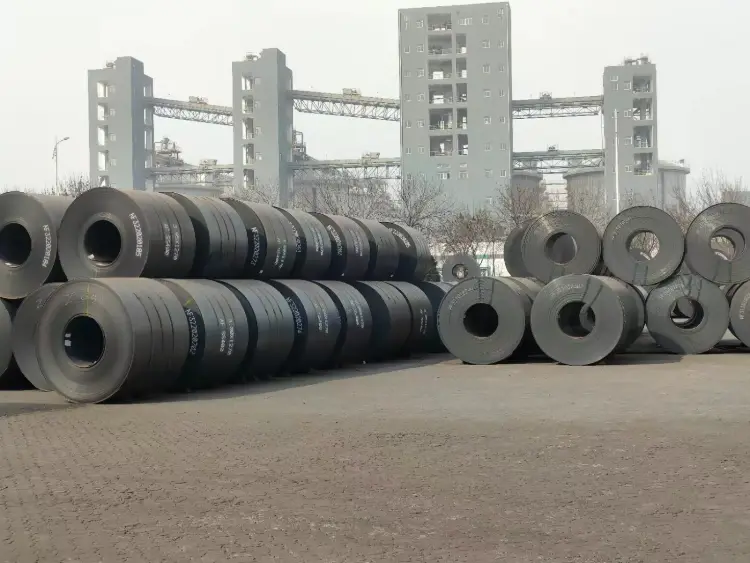
GL D690 Shipbuilding Steel Coil
GL D690 Shipbuilding Steel Coil - High-Strength Grades for Heavy Marine Structures
Complete material data for GL D690 shipbuilding steel coil, including chemical composition, mechanical properties, thermal and electrical parameters, and equivalent grades.
Hot rolling, controlled rolling, quenching and tempering (Q+T), normalising (by agreement)
- Phone : +8618037372205
- Email : [email protected]
- WhatsApp: Contact via Whtsapp
- WeChat: +8618037372205
GL D690 Shipbuilding Steel Coil Introduction
GL D690 is a high-strength structural shipbuilding steel plate/coil of not less than 690 MPa yield strength, certified under the former Germanischer Lloyd (now DNV GL) rules. It belongs to the D toughness class, indicating an impact test temperature of -20°C. This grade is widely used in the fabrication of hulls, decks, and offshore structures where high strength and good toughness are required.
- Yield strength ≥ 690 MPa for thickness ≤ 50 mm
- Excellent low-temperature toughness (KV ≥ 50 J at -20°C, longitudinal)
- Typically supplied in quenched and tempered (Q+T) condition
- Complies with IACS UR W31 unified requirements for high-strength hull structural steels
- Available in plate and coil form
GL D690 Shipbuilding Steel Coil Chemical Composition
The following table presents the specified chemical composition limits for GL D690 according to DNV GL rules. Elements not listed (Cr, Ni, Mo, Cu, Nb, V, Ti, Al, N) have their own maxima or minima as indicated. Carbon equivalent (CEV) is controlled to ensure good weldability.
| Element | Specified Value (%) | Remarks |
|---|---|---|
| Carbon (C) | ≤0.20 | Max. |
| Manganese (Mn) | 0.70 – 1.70 | |
| Silicon (Si) | ≤0.55 | Max. |
| Phosphorus (P) | ≤0.025 | Max. |
| Sulfur (S) | ≤0.025 | Max. |
| Chromium (Cr) | ≤1.50 | May be added |
| Nickel (Ni) | ≤2.00 | |
| Molybdenum (Mo) | ≤0.80 | |
| Copper (Cu) | ≤0.50 | |
| Niobium (Nb) | ≤0.06 | |
| Vanadium (V) | ≤0.10 | |
| Titanium (Ti) | ≤0.05 | |
| Aluminum (Al, total) | ≥0.020 | Minimum (acid soluble Al may be specified) |
| Nitrogen (N) | ≤0.015 | Max. (unless bound by Nb/Ti/Al) |
| Carbon Equivalent (CEV) | ≤0.52 | CEV = C + Mn/6 + (Cr+Mo+V)/5 + (Ni+Cu)/15 |
GL D690 Shipbuilding Steel Coil Thermal and Electrical Physical Properties
Typical physical properties for high-strength quenched and tempered steels like GL D690 at room temperature. Actual values may vary slightly depending on exact chemical composition and heat treatment.
| Property | Typical Value | Unit | Condition |
|---|---|---|---|
| Density (ρ) | 7.85 | g/cm³ | at 20°C |
| Modulus of Elasticity (E) | 210 | GPa | at 20°C |
| Shear Modulus (G) | 80.8 | GPa | at 20°C |
| Poisson's Ratio (ν) | 0.3 | – | |
| Thermal Expansion Coefficient (α) | 12.2 × 10⁻⁶ | 1/K | 20 – 300°C |
| Thermal Conductivity (λ) | 46 | W/(m·K) | at 20°C |
| Specific Heat Capacity | 460 | J/(kg·K) | at 20°C |
| Electrical Resistivity (ρ_e) | 0.20 × 10⁻⁶ | Ω·m | at 20°C |
GL D690 Shipbuilding Steel Coil Mechanical Properties
Mechanical properties for GL D690 are given for the quenched and tempered condition. Values refer to flat products up to 50 mm thickness. Bend test requirements depend on thickness. Impact values are shown for the D-grade (-20°C) in both longitudinal and transverse directions.
| Property | Specified Requirement | Unit | Test Condition |
|---|---|---|---|
| Yield Strength (ReH) | ≥690 | MPa | Thickness ≤ 50 mm |
| Tensile Strength (Rm) | 770 – 940 | MPa | Thickness ≤ 50 mm |
| Elongation (A) | ≥14 | % | Longitudinal, gauge length 5.65√S₀ (L₀ = 50 mm for 10 mm thickness) |
| Bend Test (180°) | d = 3t | – | Thickness ≤ 25 mm |
| Bend Test (180°) | d = 4t | – | Thickness 25 < t ≤ 50 mm |
| Impact Energy (KV, -20°C) | ≥50 | J | Longitudinal, Charpy-V, average of 3 specimens |
| Impact Energy (KV, -20°C) | ≥34 | J | Transverse, Charpy-V, average of 3 specimens |
GL D690 Shipbuilding Steel Coil Completely Equivalent Material Standards and Substitutable Grades
| Country/Region | Standard | Grade | Remarks |
|---|---|---|---|
| International (IACS) | IACS UR W31 | D690 | Unified requirement for high-strength hull structural steel |
| Norway (DNV GL) | DNV GL Rules | DNV D690 | Direct equivalent in current DNV GL classification |
| France (BV) | BV Rules | BV D690 | |
| UK (LR) | LR Rules | LR D690 | |
| USA (ABS) | ABS Rules | ABS D690 | |
| China (CCS) | CCS Rules | CCS D690 | |
| Russia (RS) | RS Rules | RS D690 | |
| Korea (KR) | KR Rules | KR D690 | |
| Italy (RINA) | RINA Rules | RINA D690 |
GL D690 Shipbuilding Steel Coil Application Introduction
GL D690 is designed for heavily loaded ship and offshore structures where weight saving and high strength are critical. It can be cold formed, machined, and welded using appropriate low-hydrogen processes. Preheating and interpass temperature control are recommended to avoid hydrogen cracking. The steel is often used in thicker sections as a replacement for lower-strength grades to reduce hull weight without compromising safety.
Product Applications: Hull plates and stiffeners, Superstructure elements, Deck plates and hatch covers, Offshore platform topsides and jackets, Jack-up rig legs and spudcans, Crane booms and heavy machinery
Processed into products: Main deck plating, Side shell frames, Bulkheads, Longitudinals and transversals, Bottom and bilge plating, Anchor handling equipment, Chute frames and wear plates
Application industries: Shipbuilding (commercial and naval), Offshore oil & gas platforms, Floating production, storage and offloading (FPSO) units, Heavy lifting and port equipment, Pressure vessels and penstocks (subject to additional approval)
GL D690 Shipbuilding Steel Coil Similar / Equivalent Substitute Materials
| Country/Region | Standard | Grade | Remarks |
|---|---|---|---|
| European Union | EN 10025-6 | S690Q / S690QL | Quenched and tempered structural steels with similar strength; lower impact test temperature may be specified (e.g. -20°C, -40°C). Not automatically certified for ship classification. |
| United States | ASTM A514 / A514M | Grade B / Grade E | High-yield-strength quenched and tempered alloy steel plates for structural applications; Charpy toughness comparable at -20°C with appropriate supplementary requirement. |
| Japan | JIS G 3128 | SHY685 | High yield strength steel plates for welded structures; similar strength level, toughness available down to -20°C. |
Notes:
- Welding: Use low-hydrogen electrodes (e.g., E11018M) and maintain preheat/interpass temperature per approved welding procedure. For thickness >30 mm, post-weld dehydrogenation treatment (PWHT) may be advisable.
- Forming: Cold forming may require stress relieving if deformation exceeds 5% or as specified by the classification society.
- Certification: All plates/coils must be stamped with the GL mark and accompanied by a material certificate (3.1 or 3.2 per EN 10204).
- Additional tests: Ultrasonic testing per GL rules is mandatory for thickness ≥30 mm.
- Share



