
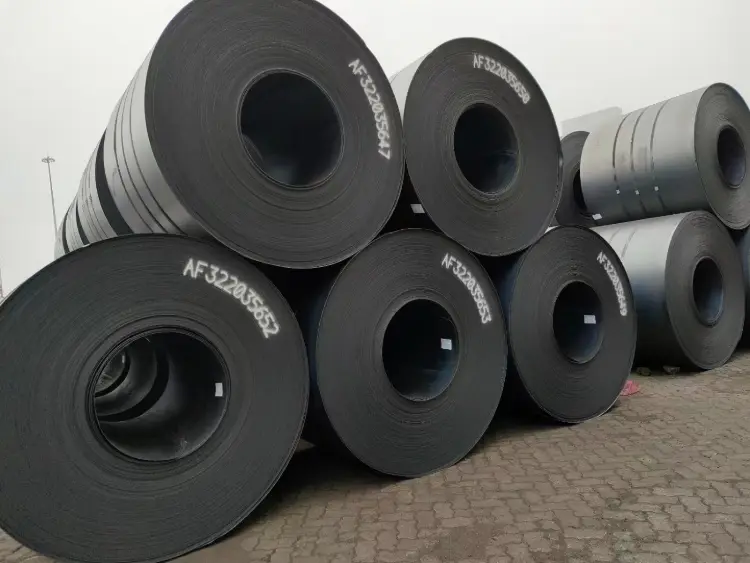
GL A690 Shipbuilding Steel Coil
GL A690 Shipbuilding Steel Coil: High-Strength Quenched & Tempered Marine Steel
Comprehensive technical data for GL A690 shipbuilding steel coil, including chemical composition, mechanical and physical properties, equivalent grades, and application guidelines.
Hot rolling, quenching and tempering, welding, cutting, cold forming, machining
- Phone : +8618037372205
- Email : [email protected]
- WhatsApp: Contact via Whtsapp
- WeChat: +8618037372205
GL A690 Shipbuilding Steel Coil Introduction
GL A690 is a high-strength quenched and tempered structural steel grade certified by DNV GL for shipbuilding and offshore applications. It offers a minimum yield strength of 690 MPa and excellent weldability, toughness, and resistance to brittle fracture. This grade is intended for use in highly stressed welded structures such as ship hulls, decks, and offshore platforms. Key features:
- High yield and tensile strength with good elongation and impact toughness
- Optimized chemistry for low-temperature toughness (Charpy test at 0 °C for grade A)
- Suitable for heavy plate and coil production, typically delivered in normalized or Q+T condition
- Compliant with DNV-OS-B101 and recognized by major classification societies
GL A690 Shipbuilding Steel Coil Chemical Composition
Chemical composition limits according to DNV-OS-B101 for grade A690 (ladle analysis). All values represent maximum limits unless a range is specified.
- Carbon equivalent (CEV) is usually controlled to ensure weldability.
- Micro-alloying elements such as V, Nb, and Ti are added for grain refinement and precipitation strengthening.
- Total aluminium content is specified to ensure fine grain practice.
| Element | Standard value (max, unless range) | Remarks |
|---|---|---|
| C | ≤ 0.20 | Carbon |
| Mn | ≤ 1.70 | Manganese |
| Si | ≤ 0.55 | Silicon |
| P | ≤ 0.025 | Phosphorus |
| S | ≤ 0.015 | Sulfur |
| Cr | ≤ 0.80 | Chromium |
| Ni | ≤ 2.0 | Nickel |
| Mo | ≤ 0.70 | Molybdenum |
| Cu | ≤ 0.50 | Copper |
| V | ≤ 0.10 | Vanadium |
| Nb | ≤ 0.06 | Niobium |
| Ti | ≤ 0.05 | Titanium |
| Al (total) | 0.015 - 0.080 | Aluminium, fine grain requirement |
| N | ≤ 0.015 | Nitrogen |
| B | ≤ 0.004 | Boron (if added) |
GL A690 Shipbuilding Steel Coil Thermal and Electrical Physical Properties
Typical physical properties for GL A690 steel (quenched and tempered condition). These values are indicative and can vary slightly with actual chemical composition and heat treatment.
- Density is essentially constant for low‑alloy steels.
- Thermal expansion and conductivity are typical for structural steels and important for design under thermal loads.
- Electrical resistivity is representative at room temperature.
| Property | Typical value | Unit | Test conditions / remarks |
|---|---|---|---|
| Density (ρ) | 7850 | kg/m³ | At 20 °C |
| Modulus of elasticity (E) | 210 | GPa | At 20 °C |
| Shear modulus (G) | 80 | GPa | Calculated from E and ν |
| Poisson's ratio (ν) | 0.3 | – | At 20 °C |
| Thermal expansion coefficient (α) | 12.0 × 10⁻⁶ | K⁻¹ | 20 – 100 °C |
| Thermal conductivity (λ) | 50 | W/(m·K) | At 20 °C |
| Specific heat capacity | 460 | J/(kg·K) | At 20 °C |
| Electrical resistivity (ρₑ) | 0.20 | μΩ·m | At 20 °C |
GL A690 Shipbuilding Steel Coil Mechanical Properties
Mechanical properties for GL A690 according to DNV-OS-B101, valid for quenched and tempered condition. Properties refer to transverse test pieces unless longitudinal is specified.
- Yield strength and tensile strength values apply to thicknesses up to 150 mm.
- Charpy V‑notch impact energy at 0 °C for grade A690.
- Bend test shall be performed with a mandrel diameter of 3t (t = specimen thickness) through 180° without cracking.
| Property | Standard requirement | Unit | Test conditions / remarks |
|---|---|---|---|
| Yield strength (ReH) | ≥ 690 | MPa | Transverse, ambient temperature |
| Tensile strength (Rm) | 770 - 940 | MPa | Transverse, ambient temperature |
| Elongation after fracture (A) | ≥ 14 | % | Gauge length 5.65√S₀, thickness ≤ 100 mm |
| Charpy impact energy (KV) | ≥ 27 (longitudinal), ≥ 20 (transverse) | J | 0 °C, V‑notch |
| Bend test | No cracks | – | Bend angle 180°, mandrel diameter 3t |
GL A690 Shipbuilding Steel Coil Fully Equivalent Material Standards and Replaceable Grades
| Country / Region | Standard / Classification Society | Grade | Remarks |
|---|---|---|---|
| International (DNV GL) | DNV-OS-B101 | VL A690 | Base grade, same yield and impact requirements (0 °C) |
| USA (ABS) | ABS Rules | ABS EQ70 | Equivalent yield strength 690 MPa, Charpy at 0 °C |
| UK (LR) | Lloyd's Register Rules | LR EH690 | High strength hull structural steel, impact at 0 °C |
| France (BV) | Bureau Veritas Rules | BV E690 | Match in mechanical and toughness requirements |
| China (CCS) | CCS Rules | CCS E690 | Same strength class and impact temperature |
| Japan (NK) | ClassNK Rules | NK KE690 | Comparable high strength grade for shipbuilding |
| Korea (KR) | Korean Register Rules | KR E690 | Equivalent in classification rules |
| Italy (RINA) | RINA Rules | RINA E690 | Same minimum yield strength and toughness class |
GL A690 Shipbuilding Steel Coil Application Introduction
GL A690 steel coil is primarily designed for welded structures in shipbuilding and offshore engineering where high strength and good toughness are essential. The material is suitable for heavy load‑bearing components exposed to dynamic forces and low ambient temperatures. Typical manufacturing processes include cutting, cold forming, and welding. Key application areas:
Product Applications: Hull plates and stiffeners, Deck plates and superstructure elements, Offshore platform legs and bracing, Crane booms and lifting frames, Heavy‑duty chassis and frames
Processed into products: Ship hull shell plates and longitudinal frames, Watertight bulkheads and tank walls, Jack‑up rig spudcans and legs, Gantry crane girders and trolley frames, Heavy excavator booms and arms
Application industries: Shipbuilding and marine engineering, Offshore oil & gas platforms, Heavy lifting and transportation equipment, Bridge and infrastructure construction, Pressure vessels and storage tanks (with additional certification)
GL A690 Shipbuilding Steel Coil Similar / Nearly Equivalent Substitute Materials
| Country / Region | Standard | Grade | Remarks |
|---|---|---|---|
| Europe | EN 10025-6 | S690Q | Quenched and tempered, YS 690 MPa, Charpy at -20 °C (better toughness), CEV limits may differ; additional qualification for marine use may be required |
| USA | ASTM A514/A514M | Grade S | Quenched and tempered alloy steel plate, YS 690 min., UTS 790-965 MPa, Charpy requirements not directly matched, often used in structural applications |
| Japan | JIS G 3128 | SHY 685 | High yield strength steel plate for welded structures, YS 685 MPa, similar chemistry, suitable for heavy construction |
| China | GB/T 16270 | Q690D | High strength structural steel, YS 690 MPa, impact at -20 °C, widely used in machinery and engineering; needs additional certification for ship classification |
Notes:
Welding and fabrication: GL A690 is produced with a carbon equivalent value typically below 0.52% to ensure good weldability. Preheating and post‑weld heat treatment should be applied according to the plate thickness and welding procedure specification. Low hydrogen welding consumables are recommended to avoid cold cracking.
Certification: Material must be delivered with DNV GL (or accepted classification society) inspection certificate 3.1 or 3.2 as required by the project.
Thickness tolerance: For coil products, thickness and flatness tolerances conform to EN 10051 or equivalent standard. The maximum thickness available in coil form is usually up to 20 mm, while heavier gauges are supplied as plates.
- Share



