
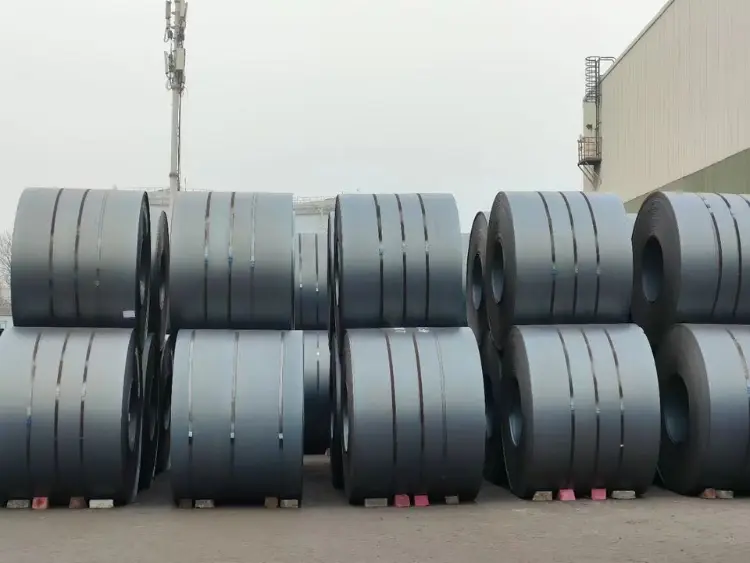
GL E620 Shipbuilding Steel Coil
GL E620 Shipbuilding Steel Coil: High-Strength Quenched & Tempered Steel for Marine Engineering
Detailed material data for GL E620 shipbuilding steel coil, including chemical composition, mechanical properties, thermal and electrical properties, international equivalents, and application guidance. Compliant with Germanischer Lloyd (now DNV GL) specifications.
Quenching and tempering (Q&T) or thermo-mechanical controlled processing (TMCP); suitable for cold forming, cutting, welding, and machining
- Phone : +8618037372205
- Email : [email protected]
- WhatsApp: Contact via Whtsapp
- WeChat: +8618037372205
GL E620 Shipbuilding Steel Coil Introduction
GL E620 is a high-strength quenched and tempered (Q&T) structural steel grade specified by Germanischer Lloyd (GL, now part of DNV GL) for shipbuilding and offshore constructions. It offers a minimum yield strength of 620 MPa, combined with excellent toughness and weldability, suitable for heavy-load components in marine environments. The steel is delivered in coil form, allowing efficient processing. Its fine-grained microstructure ensures reliable performance even at low temperatures, typically meeting E-grade impact toughness requirements (≥50 J at -40°C). The material is primarily used in critical structural parts of ships, offshore platforms, and other marine applications where high strength-to-weight ratios are essential.
GL E620 Shipbuilding Steel Coil Chemical Composition
The typical ladle analysis for GL E620 steel according to GL/DNV GL specifications. Values are maximum unless a range is specified.
- Carbon content is kept low to ensure good weldability.
- Microalloying elements like Nb, V, and Ti are added for grain refinement and precipitation strengthening.
- Phosphorus and sulfur are strictly controlled to enhance purity and toughness.
| Chemical Element | Standard Value | Remarks |
|---|---|---|
| Carbon (C) | ≤ 0.20 | |
| Silicon (Si) | ≤ 0.55 | |
| Manganese (Mn) | 0.70 - 1.70 | Higher Mn for strength and toughness |
| Phosphorus (P) | ≤ 0.025 | Strict control for low-temperature toughness |
| Sulfur (S) | ≤ 0.025 | Strict control for cleanliness |
| Aluminum (Al), total | ≥ 0.015 | Grain refining element |
| Niobium (Nb) | ≤ 0.06 | Microalloy for grain refinement |
| Vanadium (V) | ≤ 0.10 | Precipitation strengthening |
| Titanium (Ti) | ≤ 0.05 | Grain refinement |
| Copper (Cu) | ≤ 0.35 | |
| Chromium (Cr) | ≤ 0.25 | |
| Nickel (Ni) | ≤ 0.40 | |
| Molybdenum (Mo) | ≤ 0.08 | |
| Nitrogen (N) | ≤ 0.012 | Bound by Al, Ti to avoid aging |
GL E620 Shipbuilding Steel Coil Thermal and Electrical Physical Properties
Typical physical properties for a quenched and tempered high-strength low-alloy steel like E620. Values are indicative and can vary slightly with exact chemical composition and heat treatment.
- Density is standard for steel.
- Elastic modulus and shear modulus are similar to other structural steels.
- Thermal expansion and conductivity are temperature-dependent; the given values are around room temperature.
| Property | Typical Value | Unit | Test Condition |
|---|---|---|---|
| Density (ρ) | 7.85 | g/cm³ | 20 °C |
| Modulus of elasticity (E) | 206 | GPa | Ambient |
| Shear modulus (G) | 80 | GPa | Ambient (calculated from E and ν) |
| Poisson's ratio (ν) | 0.3 | - | Ambient |
| Thermal expansion coefficient (α) | 11.5 - 13.0 | 10⁻⁶/K | 20 - 200 °C (average) |
| Thermal conductivity (λ) | 42 - 48 | W/(m·K) | 20 °C |
| Specific heat capacity | 450 - 480 | J/(kg·K) | 20 °C |
| Electrical resistivity (ρ_e) | 0.23 - 0.28 | μΩ·m | 20 °C |
GL E620 Shipbuilding Steel Coil Mechanical Properties
Minimum mechanical properties for GL E620 steel (thickness ≤ 50 mm) in the quenched and tempered condition as per GL/DNV GL rules. Testing is performed at ambient temperature unless otherwise specified.
- Tensile testing is longitudinal.
- Impact testing is conducted on Charpy V-notch specimens at the specified temperature for E-grade (-40 °C).
- Bend test requirements exist but exact bend diameter depends on thickness and standard; a typical 180° bend over 3t is required without cracking (t = plate thickness).
| Property | Required Value | Unit | Test Condition |
|---|---|---|---|
| Yield strength (ReH) | ≥ 620 | MPa | Room temperature, t ≤ 50 mm |
| Tensile strength (Rm) | 720 - 890 | MPa | Room temperature, t ≤ 50 mm |
| Elongation (A5) | ≥ 15 | % | Gauge length 5.65√S0, longitudinal |
| Impact energy (KV2) | ≥ 50 (longitudinal), ≥ 33 (transverse) | J | At -40 °C (E-grade) |
| Bend test (bend angle / mandrel diameter) | 180° / 3t (typical) | - | No cracks after bending, t = sample thickness |
GL E620 Shipbuilding Steel Coil Fully Equivalent Material Standards and Replaceable Grade Recommendations
| Country/Region | Standard | Grade | Remarks |
|---|---|---|---|
| International / Norway | DNV GL | E620 | Unified after GL-DNV merger |
| USA | ABS | EQ70 | Equivalent 620 MPa yield class |
| France | BV | E620 | Bureau Veritas |
| United Kingdom | LR | E620 | Lloyd's Register |
| Japan | NK | E620 | Nippon Kaiji Kyokai |
| Italy | RINA | E620 | Registro Italiano Navale |
| China | CCS | E620 | China Classification Society |
GL E620 Shipbuilding Steel Coil Application Introduction
GL E620 steel is designed for heavy-duty marine and offshore applications where high strength, good weldability, and low-temperature toughness are required. It is typically processed by cold forming or machining from coil/plate stock. The material can be welded using all common methods, provided preheating and interpass temperature control are observed in thicker sections. Post-weld heat treatment (PWHT) is usually not required but may be specified for critical components.
Product Applications: Hull structural frames and stiffeners, Deck plating and superstructures, Offshore platform legs and braces, Boom sections for cranes and lifting equipment, Transition pieces for offshore wind foundations
Processed into products: Highly loaded ship plates and profiles, Cold-formed or welded T-bars and bulb flats, Machined flange connectors and brackets, Heavy-lift pad-eyes and shackle bodies, Shear keys and guide rails for jacking systems
Application industries: Shipbuilding (container ships, bulk carriers, tankers, naval vessels), Offshore oil and gas (platforms, jack-up rigs, subsea structures), Marine engineering (port equipment, lock gates, docks), Heavy machinery and structural engineering (cranes, bridges, pressure vessels)
GL E620 Shipbuilding Steel Coil Similar / Comparable Alternative Material Recommendations
| Country/Region | Standard | Grade | Remarks |
|---|---|---|---|
| Europe | EN 10025-6 | S620Q / S620QL | Quenched and tempered structural steel, similar strength, not necessarily certified by classification societies |
| China | GB/T 16270 | Q620D / Q620E | High-strength structural steel, similar mechanical properties |
| International | ASTM A514 / A517 | Grade B or S | Quenched and tempered alloy steel, 690 MPa class; slightly higher strength, suitable with adjusted design |
| Europe | EN 10225 | S620G1+M / S620G2+M | Weldable structural steels for fixed offshore structures, same strength level with additional weldability and toughness guarantees |
Notes:
- This grade is often supplied with through-thickness (Z-direction) property testing per GL rules for critical weldments to avoid lamellar tearing.
- Carbon equivalent (CEV) is typically limited to 0.50% for improved weldability; preheating recommendations depend on thickness and CEV.
- Ultrasonic testing according to EN 10160 or equivalent is commonly required for plates above certain thicknesses.
- Material certificates (3.1 or 3.2 per EN 10204) are issued by the classification society for traceability.
- Share



