
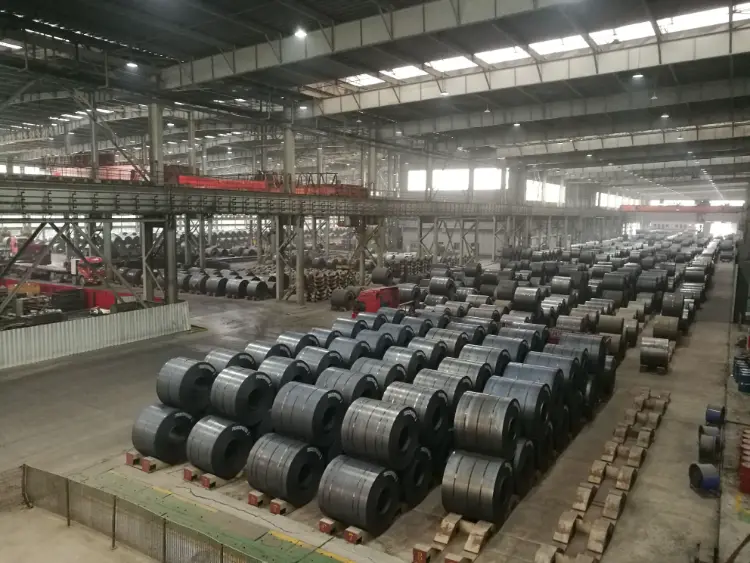
GL D620 Shipbuilding Steel Coil
GL D620 Shipbuilding Steel Coil: Chemical Composition, Mechanical Properties & Equivalent Grades
Detailed material data for GL D620 shipbuilding steel coil per Germanischer Lloyd rules. Includes chemical composition, mechanical and physical properties, international equivalents, similar grades, and application guide for marine and offshore structures.
Suitable for welding (with preheating and interpass control), bending, cutting, and forming. Typically processed by quench and tempering or TMCP.
- Phone : +8618037372205
- Email : [email protected]
- WhatsApp: Contact via Whtsapp
- WeChat: +8618037372205
GL D620 Shipbuilding Steel Coil Introduction
GL D620 is a high-strength structural steel grade certified by Germanischer Lloyd (now DNV GL) for shipbuilding and offshore applications. It is designed for welded structures requiring minimum yield strength of 620 MPa and high toughness at low temperatures.
- Key features: excellent strength-to-weight ratio, good weldability with proper precautions, and reliable impact properties at sub-zero temperatures.
- Typical delivery condition: quenched and tempered (Q&T) or thermo-mechanically controlled processed (TMCP), supplied as coils or cut-to-length plates.
- Main applications: hulls, decks, bulkheads, offshore platform components, and other critical load-bearing elements in marine environments.
This grade corresponds to the "D" series for high tensile steels in the GL Rules, with the number indicating the minimum yield stress.
GL D620 Shipbuilding Steel Coil Chemical Composition – typical ladle analysis
The chemical composition is based on GL Rules for hull structural steels and typical mill production data. Elements are controlled to ensure the required mechanical properties and weldability. Carbon equivalent (CEV) is usually limited to ≤0.50–0.52% to avoid cold cracking. Microalloying elements such as Nb, V, Ti, and Al are added for grain refinement and precipitation strengthening.
| Chemical Element | Standard Values (wt%) | Remarks |
|---|---|---|
| Carbon (C) | ≤ 0.20 | max |
| Silicon (Si) | ≤ 0.55 | max |
| Manganese (Mn) | ≤ 1.70 | max |
| Phosphorus (P) | ≤ 0.025 | max |
| Sulfur (S) | ≤ 0.025 | max |
| Chromium (Cr) | ≤ 0.80 | max |
| Molybdenum (Mo) | ≤ 0.70 | max |
| Nickel (Ni) | ≤ 1.00 | max |
| Copper (Cu) | ≤ 0.50 | max |
| Aluminium (Al) total | ≥ 0.020 | min, grain refining |
| Niobium (Nb) | ≤ 0.05 | typical microalloy |
| Vanadium (V) | ≤ 0.10 | typical microalloy |
| Titanium (Ti) | ≤ 0.05 | typical microalloy |
| Nitrogen (N) | ≤ 0.012 | max |
| Carbon Equivalent (CEV) | ≤ 0.50–0.52 | depending on thickness |
GL D620 Shipbuilding Steel Coil Thermal and Electrical Physical Properties
These physical properties are typical for quenched and tempered steels similar to GL D620 and are provided as a general reference. Actual values may vary slightly depending on the exact chemical composition and heat treatment condition.
| Property | Typical Value | Unit | Test Condition / Remarks |
|---|---|---|---|
| Density (ρ) | 7.85 | g/cm³ | At 20°C |
| Modulus of elasticity (E) | 205 | GPa | At 20°C, tension |
| Shear modulus (G) | 80 | GPa | Calculated from E and ν |
| Poisson's ratio (ν) | 0.30 | – | At 20°C |
| Thermal expansion coefficient (α) | 11.5 – 12.5 | 10⁻⁶/K | Between 20°C and 200°C |
| Thermal conductivity (λ) | 30 – 35 | W/m·K | At 20°C |
| Specific heat capacity | 460 – 500 | J/kg·K | At 20°C |
| Electrical resistivity (ρ_e) | 0.25 – 0.35 | μΩ·m | At 20°C |
GL D620 Shipbuilding Steel Coil Mechanical Properties
Mechanical properties are measured on quenched and tempered or TMCP material in accordance with GL Rules. Yield strength (ReH) and tensile strength (Rm) depend on plate/coil thickness. Charpy V-notch impact energy (KV) is typically required at -20°C or -40°C.
| Property | Standard Required Value | Unit | Test Condition / Remarks |
|---|---|---|---|
| Yield strength (ReH) | ≥ 620 | MPa | Thickness ≤ 100 mm, transverse |
| Tensile strength (Rm) | 720 – 890 | MPa | Thickness ≤ 100 mm, transverse |
| Elongation (A) | ≥ 15 | % | Gauge length L0 = 5.65√S0, transverse |
| Charpy impact energy (KV) | ≥ 34 (average) | J | At -20°C, transverse, 10x10 mm specimen |
| Charpy impact energy (KV) | ≥ 27 (average) | J | At -40°C, transverse, 10x10 mm specimen |
| Bend test (mandrel diameter) | 3t (t = specimen thickness) | – | Bend angle 180°, no cracks acceptable |
GL D620 Shipbuilding Steel Coil Fully Equivalent International Standards and Replaceable Grades
| Country / Region | Standard | Grade | Remarks |
|---|---|---|---|
| International (IACS) | DNV GL Rules (former GL) | GL D620 | Original grade, now under DNV GL |
| Norway / International | DNV Rules | DNV E620 | Equivalent min. yield 620 MPa |
| France / International | Bureau Veritas Rules | BV E620 | Equivalent high-strength ship steel |
| USA / International | ABS Rules | ABS E620 | Equivalent grade |
| UK / International | Lloyd's Register Rules | LR E620 | Equivalent grade |
| China | CCS Rules | CCS E620 | Equivalent grade |
| Japan | ClassNK Rules | NK K620 | Equivalent grade |
| South Korea | Korean Register Rules | KR RE620 | Equivalent grade |
GL D620 Shipbuilding Steel Coil Application Introduction
GL D620 steel coil is specifically designed for shipbuilding and offshore applications where high strength reduces structural weight without compromising safety. Its excellent toughness at low temperatures makes it suitable for Arctic-class vessels and cold-climate marine operations.
- Machining: can be cut by plasma, laser, or water jet; forming requires adequate press capacity due to high strength.
- Welding: requires low-hydrogen processes, preheating typically 100–150°C, and controlled interpass temperature to avoid cold cracking. Post-weld heat treatment may be necessary depending on thickness and design.
Product Applications: Hull plates and shell plating, Strength decks and bulkheads, Longitudinal and transverse stiffeners, Offshore module support frames, Crane booms and lifting equipment
Processed into products: Hull inserts and doubler plates, Keel and bilge strakes, Stringers and web frames, Column stabilizer structures, Jack-up leg chords and rack plates
Application industries: Shipbuilding (merchant ships, naval vessels, luxury yachts), Offshore oil & gas platforms (jack-up rig legs, deck structures), Marine engineering (port cranes, container handling equipment), Renewable energy (offshore wind turbine foundations, transition pieces), Heavy machinery (mining equipment, bridge components)
GL D620 Shipbuilding Steel Coil Similar / Alternative Materials with Comparable Performance
| Country / Region | Standard | Grade | Remarks |
|---|---|---|---|
| Europe | EN 10025-6 | S690Q / S690QL | Structural steel, min. yield 690 MPa; higher strength, may substitute with design adjustments |
| USA | ASTM A514 / A517 | Grade Q / Grade F | Quenched & tempered alloy steel plate; comparable toughness and strength |
| International | ISO 4950-2 | S690Q | High yield strength structural steel, similar to S690Q |
| Germany | DIN EN 10025-6 | S690QL1 | Fine grain structural steel with improved low-temperature toughness |
Notes:
Certification: Material must be supplied with GL (now DNV GL) inspection certificates, typically 3.2 type as per EN 10204. Thickness range: usually up to 100 mm for guaranteed properties; thicker plates may be available with special agreement. Surface condition: as-rolled or blasted and primed. Additional testing: ultrasonic testing, through-thickness properties (Z-quality) to Z25 or Z35 may be specified. Storage: store in dry conditions to avoid surface rust; apply protective oil if exposed to marine atmosphere.
- Share



