
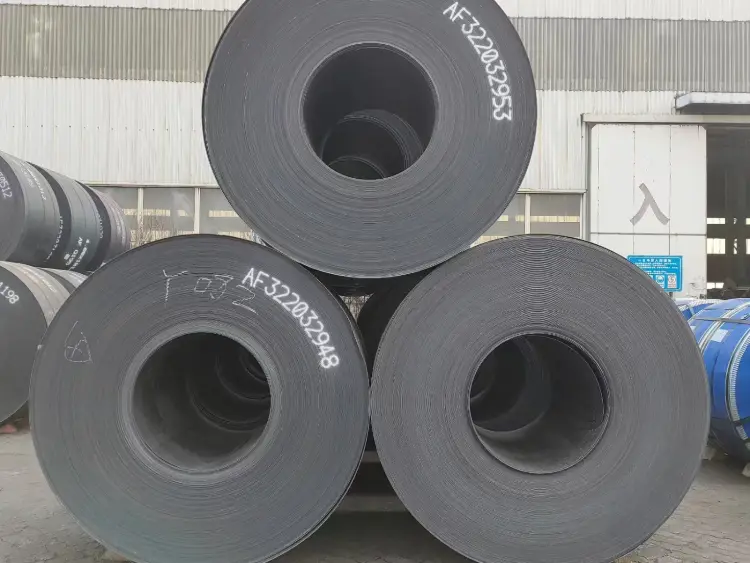
GL A620 Shipbuilding Steel Coil
GL A620 Shipbuilding Steel Coil: High-Strength QT Structural Steel for Marine & Offshore
Detailed material data for GL A620 steel coil – chemical composition, mechanical properties, thermal and electrical properties, international equivalents, and application guidelines per GL and IACS standards.
Hot rolling, quenching and tempering, welding, cold forming (limited), machining
- Phone : +8618037372205
- Email : [email protected]
- WhatsApp: Contact via Whtsapp
- WeChat: +8618037372205
GL A620 Shipbuilding Steel Coil Introduction
GL A620 is an extra-high-strength quenched and tempered (QT) structural steel coil certified by Germanischer Lloyd (now DNV GL) for ship and offshore construction. It delivers a minimum yield strength of 620 MPa in thicknesses up to 50 mm, combined with good toughness and weldability. The grade is designed in accordance with IACS UR W31 and classification society rules, ensuring consistent properties worldwide. Typical delivery condition is quenched and tempered. The steel is supplied as hot-rolled coil, suitable for cutting into plates and strips, and finds use in highly stressed hull members, decks, and offshore platform components.
GL A620 Shipbuilding Steel Coil Chemical Composition according to IACS UR W31
The following chemical limits apply as per IACS Unified Requirements for extra-high-strength quenched and tempered steels, grade A620. All values are maximum unless a range or minimum is indicated. The steel is fully killed and fine grained. Elements like Nb, V, and Ti may be added singly or in combination. When boron is added, it is not allowed to exceed 0.005%.
| Element | Standard Value (mass %) | Remarks |
|---|---|---|
| Carbon (C) | ≤ 0.20 | |
| Silicon (Si) | 0.10 – 0.55 | |
| Manganese (Mn) | 0.90 – 1.70 | |
| Phosphorus (P) | ≤ 0.025 | |
| Sulfur (S) | ≤ 0.020 | |
| Aluminium (Al) total | ≥ 0.020 | Minimum acid soluble |
| Niobium (Nb) | 0.02 – 0.05 | If added |
| Vanadium (V) | 0.05 – 0.10 | If added |
| Titanium (Ti) | 0.007 – 0.05 | |
| Chromium (Cr) | ≤ 1.00 | |
| Nickel (Ni) | ≤ 1.50 | |
| Molybdenum (Mo) | ≤ 0.50 | |
| Copper (Cu) | ≤ 0.50 | |
| Nitrogen (N) | ≤ 0.020 |
GL A620 Shipbuilding Steel Coil Physical Properties
The following typical values are derived from general data for low-alloy quenched and tempered steels with similar composition. They are not part of the material specification but provide practical guidance for design and thermal analysis. Actual values may vary slightly depending on exact tempering temperature and product form.
| Property | Typical Value | Unit | Remarks |
|---|---|---|---|
| Density (ρ) | 7850 | kg/m³ | at 20 °C |
| Modulus of elasticity (E) | 205 | GPa | at 20 °C |
| Shear modulus (G) | 80 | GPa | at 20 °C |
| Poisson's ratio (ν) | 0.3 | Elastic region | |
| Thermal expansion (α) | 11.5 | 10⁻⁶/K | between 20 °C and 100 °C |
| Thermal conductivity (λ) | 45 | W/(m·K) | at 20 °C |
| Specific heat capacity | 460 | J/(kg·K) | at 20 °C |
| Electrical resistivity (ρₑ) | 0.22 | 10⁻⁶ Ω·m | at 20 °C |
GL A620 Shipbuilding Steel Coil Mechanical Properties
Mechanical properties are determined on test pieces taken in the transverse direction unless otherwise stated. Tensile and impact tests are mandatory for thicknesses above 25 mm; for thinner sections (≤ 25 mm) impact testing may be omitted only when agreed. Bending test is mandatory for all thicknesses. The values below are valid for thickness ≤ 50 mm. For 50 < t ≤ 75 mm, yield strength reduces to min. 580 MPa and tensile strength to 680–850 MPa.
| Property | Required Value | Unit | Test Condition |
|---|---|---|---|
| Yield strength (ReH) | ≥ 620 | MPa | Room temperature, transverse, t ≤ 50 mm |
| Tensile strength (Rm) | 720 – 890 | MPa | Room temperature, transverse |
| Elongation (A5) | ≥ 15 | % | Longitudinal, gauge length 5d |
| Charpy V‑notch impact energy (KV₂) | ≥ 27 (average), min single 20 | J | At 0 °C, transverse specimens |
| Bending test | No cracks | 180° bend; mandrel dia. d = 3a for t ≤ 25 mm; d = 4a for 25 < t ≤ 50 mm |
GL A620 Shipbuilding Steel Coil Fully Equivalent Grades – International Standards & Classification Societies
| Country / Region | Standard / Society | Grade | Remarks |
|---|---|---|---|
| International | IACS UR W31 | A620 | Mother grade, adopted by all IACS members |
| Germany / Norway | DNV GL | NV A620 / GL A620 | DNV GL merged class |
| USA | American Bureau of Shipping (ABS) | AQ620 | Identical requirements per IACS |
| UK | Lloyd's Register (LR) | A620 | Same as IACS A620 |
| France | Bureau Veritas (BV) | A620 | Same chemical/mechanical limits |
| Japan | ClassNK | KA620 | Nippon Kaiji Kyokai |
| Italy | RINA | A620 | Registro Italiano Navale |
| China | China Classification Society (CCS) | A620 | Harmonised with IACS |
GL A620 Shipbuilding Steel Coil Application Introduction
GL A620 steel coil and cut plates are engineered for demanding welded structures where high strength, good toughness, and controlled weight are critical. The quenched and tempered condition provides an optimum balance of yield strength (≥ 620 MPa) and ductility. It is used predominantly in shipbuilding and offshore engineering, but also finds use in heavy-lift equipment, bridges, and pressure vessels. Suitable for cold forming to limited radii and all common arc welding processes with low-hydrogen electrodes and adequate preheat.
Product Applications: Hull structural plates and coils for shell, deck, bottom, and bulkhead panels, Longitudinals, stiffeners, and girders for ship frames, Deck modules and caissons for offshore platforms, Tubular joints and nodes for jack‑up rigs, Welded box sections and heavy‑duty columns, Wind turbine tower sections and monopile foundations
Processed into products: Cut‑to‑length plates for hull sections, Rolled profiles (angles, channels, bulb flats) when requalified, Transverse and longitudinal stiffeners, Brackets and gussets, Main deck stringers, Offshore crane booms and pedestals, Bending‑restricted formed parts (cambered beams, heavy brackets)
Application industries: Shipbuilding (containerships, bulk carriers, tankers, naval vessels), Offshore oil & gas (platform topsides, jack‑up legs, templates), Renewable energy (offshore wind turbine foundations, transition pieces), Heavy engineering (cranes, excavators, lifting equipment), Bridge construction (in particular for large welded girders), Pressure equipment (e.g. industrial autoclaves)
GL A620 Shipbuilding Steel Coil Similar Structural Steels with Comparable Application Profile
| Country / Region | Standard | Grade | Remarks |
|---|---|---|---|
| Europe | EN 10225:2009 | S620Q / S620QL | Weldable structural steel for offshore fixed structures, yield 620 MPa, often QT; very close in chemistry and properties; S620QL with low temperature impact tests. |
| Europe | EN 10025-6:2019 | S690Q | Hot rolled QT structural steel, yield 690 MPa, slightly higher strength level; can be used where higher strength is acceptable with adjustments. |
| USA | ASTM A514/A514M | Grade B / Grade H | High yield strength QT alloy steel plate, yield typically 690 MPa; suitable for similar heavy structural applications but higher strength; weldability similar with preheat. |
| USA | ASTM A709/A709M | Grade 100 | High-strength low-alloy structural steel for bridges, yield 690 MPa; not marine certified but occasionally used in equivalent applications. |
Notes:
Welding recommendations: use low‑hydrogen processes (SMAW with E11018‑M type electrodes, SAW, GMAW). Preheat typically 100–150 °C depending on thickness and weld section to avoid hydrogen cracking. Post‑weld heat treatment (PWHT) is generally not required if the steel is tempered at a temperature above the planned PWHT temperature. Cold forming: minimum bending radius of 3–4t as per bending test. If severe forming is needed, hot forming or re‑tempering may be necessary. Certification: original GL/DNV GL certificate mandatory for hull construction; must be tested to IACS UR W31 and stamped accordingly. Supplementary testing: ultrasonic testing, through‑thickness properties (Z‑quality) can be ordered separately per GL rules.
- Share



