
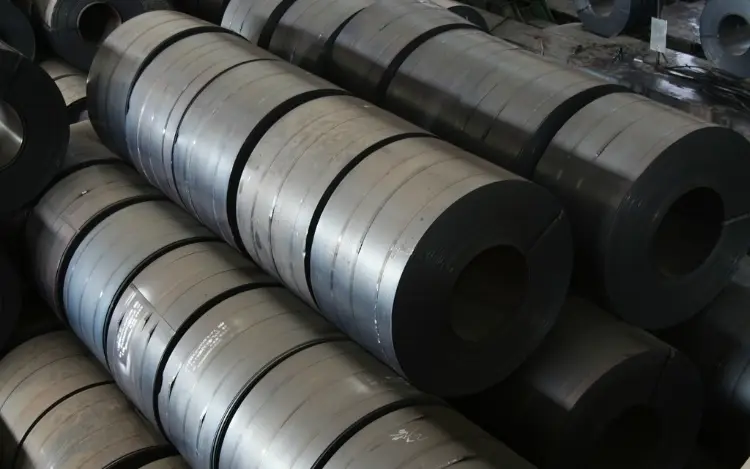
GL F550 Shipbuilding Steel Coil
GL F550 Shipbuilding Steel Coil – High Strength Quenched & Tempered Marine Steel
Complete technical data for GL F550 steel coil: chemical composition, mechanical and physical properties, international equivalents, similar materials, and detailed application guidance for offshore and shipbuilding industries.
Hot rolling, cold rolling, quenching, tempering, welding, cutting, forming
- Phone : +8618037372205
- Email : [email protected]
- WhatsApp: Contact via Whtsapp
- WeChat: +8618037372205
GL F550 Shipbuilding Steel Coil Introduction
GL F550 is a high-strength, quenched and tempered shipbuilding steel specified by Germanischer Lloyd (GL). It offers a minimum yield strength of 550 MPa combined with excellent low-temperature toughness, making it suitable for critical structural components in harsh marine environments. The steel is delivered in the quenched and tempered (Q+T) condition, ensuring uniform mechanical properties across the thickness. Its fine-grained microstructure provides good weldability and formability, while meeting strict requirements for sulfur and phosphorus content to enhance corrosion resistance. Typical applications include hull structures, deck plating, icebreaker shells, offshore platforms, and heavy-lift vessels. This steel grade is internationally recognized and has direct equivalents in most major classification societies, facilitating global procurement and construction.
GL F550 Shipbuilding Steel Coil Chemical Composition
The chemical composition of GL F550 is strictly controlled to achieve the required strength and toughness after quenching and tempering. Besides the individual elements, the carbon equivalent values (CEV and Pcm) are limited to ensure good weldability. All values are in weight percent, determined by ladle analysis in accordance with GL rules. Residual elements such as Cu, Cr, Ni, Mo are kept low to maintain consistent properties.
| Chemical Element | Standard Value (wt%) | Remarks |
|---|---|---|
| C | ≤0.18 | Ladle analysis |
| Si | 0.10 – 0.50 | |
| Mn | 0.90 – 1.60 | |
| P | ≤0.025 | |
| S | ≤0.025 | |
| Cr | ≤0.25 | |
| Ni | ≤0.40 | |
| Mo | ≤0.08 | |
| Cu | ≤0.35 | |
| Nb | 0.02 – 0.05 | |
| V | 0.05 – 0.10 | |
| Ti | ≤0.02 | |
| Al (acid soluble) | ≥0.020 | |
| N | ≤0.009 | For non-Al-killed steel, Al/N ratio ≥2 required |
| CEV | ≤0.43 | C + Mn/6 + (Cr+Mo+V)/5 + (Ni+Cu)/15 |
| Pcm | ≤0.25 | C + Si/30 + (Mn+Cu+Cr)/20 + Ni/60 + Mo/15 + V/10 + 5B |
GL F550 Shipbuilding Steel Coil Thermal and Electrical Physical Properties
The physical properties are typical for low-alloy, quenched and tempered steels and are provided as general engineering references. Actual values may vary slightly depending on exact composition and heat treatment condition. These properties assist in design calculations involving thermal loads, weight estimation, and electrical resistance considerations.
| Property | Typical Value | Unit | Condition |
|---|---|---|---|
| Density (ρ) | 7.85 | g/cm³ | At room temperature |
| Modulus of Elasticity (E) | 205 – 210 | GPa | At room temperature |
| Shear Modulus (G) | 79 – 81 | GPa | Typical |
| Poisson's Ratio (ν) | 0.3 | – | Typical |
| Thermal Expansion Coefficient (α) | 11.5 × 10⁻⁶ | 1/K | Between 20 and 100°C |
| Thermal Conductivity (λ) | ~51 | W/(m·K) | At 20°C |
| Specific Heat Capacity (c) | ~460 | J/(kg·K) | At 20°C |
| Electrical Resistivity (ρ_e) | ~0.20 × 10⁻⁶ | Ω·m | At 20°C |
GL F550 Shipbuilding Steel Coil Mechanical Properties
The mechanical properties of GL F550 are determined on quenched and tempered test specimens. The values listed below are the minimum requirements as per GL rules for thicknesses up to 50 mm. Both tensile and impact tests are performed in the transverse direction as standard, with impact tests at -20°C demonstrating the steel's excellent low-temperature toughness. Bend tests verify ductility and freedom from defects.
| Property | Specified Value | Unit | Test Condition |
|---|---|---|---|
| Yield Strength (ReH) | ≥550 | MPa | Transverse, thickness ≤ 50 mm |
| Tensile Strength (Rm) | 670 – 830 | MPa | Transverse, thickness ≤ 50 mm |
| Elongation (A5) | ≥16 | % | Gauge length 5.65√S0, thickness ≤ 50 mm |
| Charpy Impact Energy (KV) at -20°C, longitudinal | ≥31 | J | V-notch, thickness ≤ 50 mm |
| Charpy Impact Energy (KV) at -20°C, transverse | ≥21 | J | V-notch, thickness ≤ 50 mm |
| Bend Test | 180° bend, no cracks | d = 3a | d = mandrel diameter, a = specimen thickness |
GL F550 Shipbuilding Steel Coil Fully Equivalent Standards and Replaceable Grades
| Country/Region | Standard | Grade | Remarks |
|---|---|---|---|
| International (ABS) | ABS Rules | EH550 | Direct equivalent quenched and tempered shipbuilding steel |
| International (DNV) | DNV Rules | E550 | Same strength and toughness category |
| International (BV) | BV Rules | E550 | Same strength and toughness category |
| International (LR) | LR Rules | EH550 | Same strength and toughness category |
| International (CCS) | CCS Rules | EH550 | Same strength and toughness category |
| International (NK) | NK Rules | E550 | Same strength and toughness category |
| International (RINA) | RINA Rules | E550 | Same strength and toughness category |
GL F550 Shipbuilding Steel Coil Application Introduction
GL F550 is ideally suited for demanding marine and offshore structural applications where high strength-to-weight ratio and low-temperature toughness are critical. Typical usage includes:
Product Applications: Hull plates for ice-class vessels, Deck and shell plates for heavy-lift ships, Offshore platform structural components (e.g., jack-up rig legs), Reinforcement plates for stress concentration areas, Crane booms and heavy machinery supports on ships
Processed into products: Longitudinal stiffeners and stringers, Transverse frames and web frames, Bulkhead plates and watertight doors, Hatch coaming plates and corner reinforcements, Brackets and tripping brackets, Foundation plates for main engines and winches
Application industries: Shipbuilding, Offshore Engineering, Marine Construction, Heavy-Lift Vessels, Naval Architecture, Arctic/Subarctic Operations
GL F550 Shipbuilding Steel Coil Similar / Alternative Material Recommendations
| Country/Region | Standard | Grade | Remarks |
|---|---|---|---|
| Europe | EN 10025-6 | S550Q / S550QL | Quenched and tempered structural steel with min. 550 MPa yield. Very close chemistry and mechanical properties; can replace GL F550 for non-classed structures. |
| USA | ASTM A514 / A517 | Grade Q | Higher strength (min. YS 690 MPa) in similar Q&T condition. Suitable where higher strength is required, but weldability considerations must be reviewed. |
Notes:
GL F550 steel is supplied exclusively in the quenched and tempered condition. Preheating (100–150°C) is generally recommended for welding, especially in thick sections. Post-weld heat treatment (PWHT) may be applied to relieve residual stresses. The steel exhibits excellent low-temperature toughness, making it suitable for operations down to -20°C and below. When substituting with equivalent grades from other classification societies, check any additional requirements specific to the project. All processing, including welding and forming, must follow GL rules or an approved fabrication procedure.
- Share



