
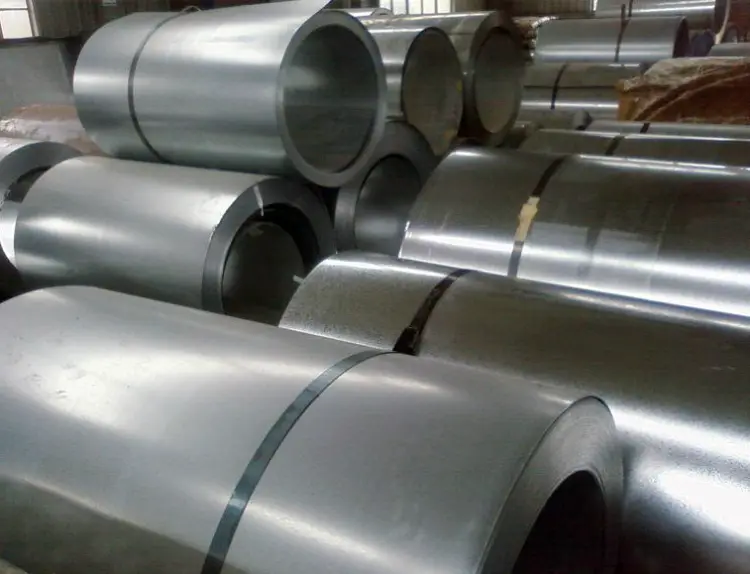
GL E550 Shipbuilding Steel Coil
GL E550 Shipbuilding Steel Coil: High-Strength Marine Structural Steel for Demanding Offshore Applications
Detailed analysis of GL E550 shipbuilding steel coil: chemical composition, mechanical and thermal properties, international equivalents, and key applications in ship and offshore structures.
Hot rolling, controlled rolling, normalizing rolling, thermo-mechanical controlled processing (TMCP), quenching and tempering
- Phone : +8618037372205
- Email : [email protected]
- WhatsApp: Contact via Whtsapp
- WeChat: +8618037372205
GL E550 Shipbuilding Steel Coil Introduction
GL E550 is a high-strength shipbuilding structural steel grade certified under the rules of Germanischer Lloyd (GL), designed for use in ship hulls and offshore platforms where weight reduction and high load-bearing capacity are critical. With a minimum yield strength of 550 MPa, it belongs to the family of high-strength hull structural steels and offers excellent weldability, good toughness at low temperatures, and resistance to brittle fracture.
- Key features: Micro-alloying with niobium, vanadium, and titanium to refine grain size and enhance strength without sacrificing toughness.
- Delivery condition: Typically supplied as coils or plates in normalized, thermo-mechanically controlled processed (TMCP), or quenched and tempered condition to meet specified mechanical properties.
- Low-temperature performance: The 'E' designation indicates impact testing at -40°C, ensuring suitability for Arctic and cold-climate operations.
- Processing flexibility: Compatible with common welding techniques and forming processes, making it a preferred choice for shipyards worldwide.
GL E550 Shipbuilding Steel Coil Chemical Composition
Typical ladle analysis of GL E550 shipbuilding steel in accordance with GL Rules. Values are maximum unless a range is indicated. The micro-alloying elements (Nb, V, Ti) are added to achieve fine grain structure and high strength. The steel is fully killed and fine-grain treated with aluminum.
| Element | Typical Value (%) | Remarks |
|---|---|---|
| Carbon (C) | ≤0.18 | Ladle analysis; reduces hardening and improves weldability |
| Silicon (Si) | 0.10 – 0.50 | Deoxidation and strength |
| Manganese (Mn) | 0.90 – 1.60 | Improves hardenability and tensile strength |
| Phosphorus (P) | ≤0.025 | Low content for enhanced toughness |
| Sulfur (S) | ≤0.025 | Control to avoid hot cracking |
| Aluminum total (Al) | ≥0.015 | Grain refining and deoxidation |
| Niobium (Nb) | 0.02 – 0.05 | Grain refinement and precipitation strengthening |
| Vanadium (V) | 0.05 – 0.10 | Precipitation strengthening |
| Titanium (Ti) | ≤0.02 | Grain refinement, weldability improvement |
| Nickel (Ni) | ≤0.40 | Optional for improved toughness at low temperatures |
| Chromium (Cr) | ≤0.20 | Residual element limit |
| Molybdenum (Mo) | ≤0.08 | Residual element limit |
| Copper (Cu) | ≤0.35 | Atmospheric corrosion resistance, limited for weldability |
| Nitrogen (N) | ≤0.009 | Tie-up with strong nitride formers to avoid free nitrogen effect |
GL E550 Shipbuilding Steel Coil Thermal and Electrical Physical Properties
Typical physical properties for GL E550 steel at ambient temperature (20°C) and ranges. These values are representative for carbon-manganese micro-alloy steels and may vary slightly depending on actual composition and heat treatment. Thermal conductivity decreases with increasing temperature, while thermal expansion increases.
| Property | Typical Value | Unit | Test Condition |
|---|---|---|---|
| Density (ρ) | 7850 | kg/m³ | 20°C |
| Elastic Modulus (E) | 210 | GPa | 20°C |
| Shear Modulus (G) | 81 | GPa | Calculated, 20°C |
| Poisson's Ratio (ν) | 0.3 | — | 20°C |
| Thermal Expansion Coefficient (α) | 11.5 (20–100°C) 12.4 (20–200°C) 13.0 (20–300°C) | 10⁻⁶ /K | Mean coefficient |
| Thermal Conductivity (λ) | 50 (at 20°C) 45 (at 100°C) 38 (at 300°C) | W/(m·K) | Temperature dependent |
| Specific Heat Capacity (cp) | 460 | J/(kg·K) | 20°C |
| Electrical Resistivity (ρ_e) | 0.22 | 10⁻⁶ Ω·m | 20°C |
GL E550 Shipbuilding Steel Coil Mechanical Properties
Mechanical properties of GL E550 shipbuilding steel at room temperature, based on GL Rules for thickness up to 100 mm. The values are for transverse test pieces unless otherwise noted. Elongation is measured on a gauge length of 5.65√So (A5). The high yield to tensile ratio ensures safe plastic deformation behavior under overload conditions.
| Property | Standard Required Value | Unit | Test Condition |
|---|---|---|---|
| Yield Strength (ReH) | ≥550 (t ≤ 50 mm) ≥530 (50 < t ≤ 70 mm) ≥510 (70 < t ≤ 100 mm) | MPa | Room temperature, transverse |
| Tensile Strength (Rm) | 660 – 820 | MPa | Room temperature, transverse |
| Elongation (A5) | ≥14 (t ≤ 50 mm) ≥13 (50 < t ≤ 70 mm) ≥12 (70 < t ≤ 100 mm) | % | Gauge length 5.65√So |
| Charpy V-notch Impact Energy (KV) | ≥50 (longitudinal) ≥34 (transverse) | J | At -40°C |
| Bending Test (180°) | No cracks; D = 3t (t ≤ 35 mm) D = 4t (t > 35 mm) | — | Mandrel diameter (D) ratio to thickness (t) |
GL E550 Shipbuilding Steel Coil Full Equivalent Material Standards and Replaceable Grade Recommendations
| Country / Region | Standard | Grade | Remarks |
|---|---|---|---|
| International | DNV (Det Norske Veritas) | E550 | Identical yield class, similar chemical and mechanical requirements |
| USA | ABS (American Bureau of Shipping) | EQ70 | Reflects yield in ksi (70 ksi = 483 MPa nominal, but actual ABS EQ70 applies 550 MPa) – fully interchangeable |
| France | BV (Bureau Veritas) | E550 | Same grade designation |
| China | CCS (China Classification Society) | E550 | Directly corresponds to E550 |
| UK | LR (Lloyd's Register) | E550 | Same grade, equivalent toughness class |
| Japan | NK (Nippon Kaiji Kyokai) | E550 | Class NK E550 high-strength hull steel |
| South Korea | KR (Korean Register) | E550 | Equivalent high-strength steel |
| Italy | RINA (Registro Italiano Navale) | E550 | Same designation |
GL E550 Shipbuilding Steel Coil Application Introduction
GL E550 is engineered for critical structural applications in the marine and offshore industry where high strength, low weight, and excellent low-temperature toughness are mandatory. Its application in shipbuilding and offshore engineering results in lighter structures, reduced fuel consumption, and higher payload capacity. Typical use cases include:
Product Applications: Hull plates and coils for ship outer plating, Deck plates and bulkhead panels, Longitudinal stiffeners and transverse web frames, Vertical keels and bottom shell plating, Modular bridge components and pontoon structures
Processed into products: Ship hull shell plates and deck stringers, Watertight bulkheads and collision boundaries, Flare towers and helicopter decks, Jack-up leg chords and rack plates, Foundation structures for offshore wind transition pieces, Main frames, brackets, and stiffening members in high-stress zones
Application industries: Shipbuilding (commercial vessels, naval ships, Arctic tankers), Offshore oil and gas (fixed platforms, FPSO, jack-up rigs), Marine civil engineering (bridge structures, lock gates), Heavy-lift and crane manufacturing, Renewable energy (offshore wind turbine foundations)
GL E550 Shipbuilding Steel Coil Similar / Comparable Substitute Materials Recommendation
| Country / Region | Standard | Grade | Remarks |
|---|---|---|---|
| International | EN 10225 (Offshore structures) | S550G2+M | Hot-rolled structural steel for offshore fixed structures, similar strength, but differs in delivery condition (TMCP) |
| International | EN 10025-6 | S550QL | Quenched and tempered structural steel; not for shipbuilding, but applicable in general heavy engineering |
| International | API 2Y-50 | Grade 50 (345 MPa SMYS) | Lower yield, but similar toughness; for offshore structural steel |
| International | IACS UR W11 | E550 | IACS unified requirement for high-strength hull structural steel, incorporates same grade |
Notes:
Welding of GL E550 must follow qualified procedures with low-hydrogen electrodes to avoid cold cracking. Preheating (typically 50–100°C) and interpass temperature control are recommended depending on thickness and carbon equivalent value (CEV). Post-weld heat treatment is generally not required for this TMCP steel when correctly welded. For severe forming operations, a fine-grain practice and suitable bending radii should be applied. Customers should verify the latest GL/DNV rules for any updates to chemical and mechanical requirements.
- Share



