
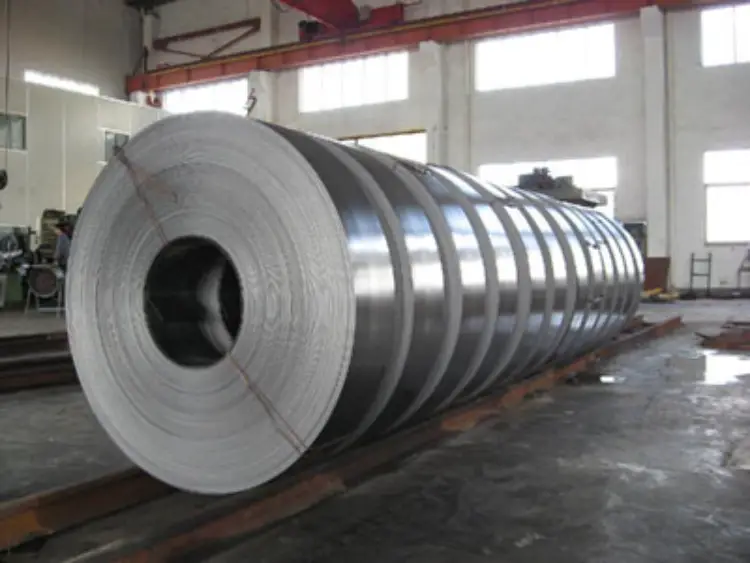
GL D550 Shipbuilding Steel Coil
GL D550 Shipbuilding Steel Coil - High Strength Marine & Offshore Grade
Detailed material data for GL D550 shipbuilding steel coil, including chemical composition, mechanical properties, physical performance and international equivalents according to Germanischer Lloyd standards.
Hot rolling, TMCP (Thermo-Mechanical Controlled Process), normalizing, cold forming, welding, gas/plasma/laser cutting, bending, machining
- Phone : +8618037372205
- Email : [email protected]
- WhatsApp: Contact via Whtsapp
- WeChat: +8618037372205
GL D550 Shipbuilding Steel Coil Introduction
GL D550 is a high-strength structural steel grade specified in the Germanischer Lloyd (GL) classification rules for ships and offshore structures. It is designed for critical hull and marine components requiring a minimum yield strength of 550 MPa and good toughness at low temperatures. The grade 'D' indicates guaranteed impact properties at -20°C. Typically supplied as wide thin-gauge coil or plate in normalized or thermo-mechanical rolled (TMCP) condition, it offers an excellent balance of strength, weldability and fracture resistance. This alloy relies on a refined microstructure achieved through microalloying with niobium, vanadium or titanium, combined with a low carbon content to ensure field weldability without excessive preheating. Compared to conventional shipbuilding steels, D550 allows weight reduction and higher payload capacity while maintaining safety margins against brittle failure. It is widely adopted for container ships, bulk carriers, ice-class vessels and offshore platforms.
GL D550 Shipbuilding Steel Coil Chemical Composition
The chemical composition of GL D550 is controlled to achieve high strength while maintaining weldability and toughness. Maximum limits are specified for impurities, while microalloying elements are added to refine grain size. Actual values are reported on the mill test certificate. The carbon equivalent (CEV) is limited to ensure good field weldability without excessive preheat.
| Element | Typical requirement (max unless noted) | Remarks |
|---|---|---|
| C | ≤ 0.18 | Carbon, controlled for weldability and strength |
| Si | ≤ 0.55 | Silicon, deoxidiser and strength contributor |
| Mn | ≤ 1.60 | Manganese, for strength and hardenability |
| P | ≤ 0.025 | Phosphorous, restricted for toughness |
| S | ≤ 0.025 | Sulfur, restricted for ductility and lamellar tearing resistance |
| Al (total) | ≥ 0.020 | Grain refinement via aluminium nitride formation |
| Nb | ≤ 0.05 | Niobium, microalloying for grain refinement and precipitation strengthening |
| V | ≤ 0.10 | Vanadium, optional microalloying element |
| Ti | ≤ 0.03 | Titanium, grain refiner and N-fixer |
| Cu | ≤ 0.35 | Copper (residual or intentionally added), can improve atmospheric corrosion resistance |
| Cr | ≤ 0.25 | Chromium, may be present as residual |
| Ni | ≤ 0.40 | Nickel, may be present as residual or addition for toughness |
| Mo | ≤ 0.10 | Molybdenum, limited residual |
| CEV | ≤ 0.43 | Carbon Equivalent Value (CEV = C + Mn/6 + (Cr+Mo+V)/5 + (Ni+Cu)/15) as per IACS UR W11 |
GL D550 Shipbuilding Steel Coil Thermal and Electrical Physical Properties
The following physical properties are typical for high-strength low-alloy shipbuilding steels at ambient temperature and are provided for reference in design calculations. Slight variations may occur depending on the exact composition and processing route. These values are not part of the minimum mandatory specification but are widely accepted in the industry.
| Property | Typical value | Unit | Test conditions |
|---|---|---|---|
| Density (ρ) | 7.85 | g/cm³ | Room temperature (approx. 20°C) |
| Modulus of elasticity (E) | 210 | GPa | Room temperature, static |
| Shear modulus (G) | ≈ 81 | GPa | Calculated from E and Poisson's ratio |
| Poisson's ratio (ν) | 0.3 | — | Elastic range, room temperature |
| Coefficient of thermal expansion (α) | 11.5 - 12.5 | ×10⁻⁶/K | Ambient to 100°C (mean value) |
| Thermal conductivity (λ) | 42 - 50 | W/(m·K) | At 20°C |
| Specific heat capacity (Cp) | 460 | J/(kg·K) | Around 20°C |
| Electrical resistivity (ρ_e) | 0.22 - 0.28 | ×10⁻⁶ Ω·m | At 20°C, typical for low-alloy steel |
GL D550 Shipbuilding Steel Coil Mechanical Properties
Mechanical properties are determined from tensile and impact tests on specimens in the delivery condition and, where applicable, after strain ageing to simulate service conditions. The requirements depend on the product thickness. All values are minimum unless otherwise noted. Transverse test pieces are standard for plate/coil; impact values are given separately for longitudinal and transverse directions.
| Property | Standard requirement | Unit | Test conditions |
|---|---|---|---|
| Yield strength (ReH) t≤50 mm | ≥ 550 | MPa | Room temperature, transverse |
Yield strength (ReH) 50| ≥ 530 | MPa | Room temperature, transverse | |
| Tensile strength (Rm) t≤50 mm | 670 - 830 | MPa | Transverse |
Tensile strength (Rm) 50| 650 - 800 | MPa | Transverse | |
| Elongation (A) t≤50 mm | ≥ 16 | % | 5.65√So gauge length, transverse |
Elongation (A) 50| ≥ 16 | % | 5.65√So gauge length, transverse | |
| Impact energy (KV) -20°C longitudinal | ≥ 41 | J | Charpy V-notch, average of 3 specimens |
| Impact energy (KV) -20°C transverse | ≥ 27 | J | Charpy V-notch, average of 3 specimens |
| Bend test (t≤50 mm) | No cracks | - | 180° bending over mandrel diameter = 4t (t=thickness); through-thickness direction as applicable |
| Bend test (t>50 mm) | No cracks | - | 180° bending over mandrel diameter = 5t |
GL D550 Shipbuilding Steel Coil Identical International Grades – Equivalent Classification Societies
| Country / Region | Standard / Society | Grade | Remarks |
|---|---|---|---|
| International | DNV GL (merged) | D550 | Directly equivalent; same requirements |
| USA | American Bureau of Shipping (ABS) | DH550 | Identical strength and toughness grade, -20°C impact |
| France | Bureau Veritas (BV) | D550 | Same yield and impact requirements |
| China | China Classification Society (CCS) | D550 | Same specification, widely used in Chinese yards |
| UK | Lloyd's Register (LR) | D550 | Equivalent material grade, recognised in LR rules |
| Japan | Nippon Kaiji Kyokai (ClassNK) | KD550 | Equivalent high-strength grade with -20°C guarantee |
| Italy | RINA | D550 | Identical designation and properties |
| India | Indian Register of Shipping (IRS) | D550 SH | Aligned with IACS UR W11, same mechanicals |
GL D550 Shipbuilding Steel Coil Application Introduction
GL D550 steel coil is engineered for demanding marine and offshore environments where high strength and excellent low-temperature toughness are essential. Its TMCP or normalized microstructure provides reliable weldability, making it suitable for large welded assemblies. The material is used in both newbuild and repair projects requiring lightweight design without compromising structural integrity.
Product Applications: Container ships, bulk carriers, tankers, Ice-class hulls and ice belt strengthening, Drill ships and semi-submersible rigs, Offshore wind transition pieces and monopiles (with certified grades), Ship-to-shore (STS) crane booms and gantries
Processed into products: Main deck and strength deck plating, Side shell and bottom shell plating, Transverse bulkheads and stringer plates, Longitudinal stiffeners and frames, Hatch coaming and crane pedestal structures, Bilge keels and rudder horns, Offshore module support frames and skid beams
Application industries: Shipbuilding (commercial and naval vessels), Offshore oil and gas (platforms, FPSO modules), Renewable marine energy (offshore wind turbine foundations, substations), Heavy engineering and port machinery, Icebreaker and arctic vessel construction
GL D550 Shipbuilding Steel Coil Similar Alternative Materials with Close Performance
| Country / Region | Standard / Specification | Grade | Remarks |
|---|---|---|---|
| Europe / International | EN 10025-6 / ISO 4950-2 | S550Q / S550QL | Quenched and tempered structural steel with minimum yield 550 MPa; higher toughness variants (QL) available. Requires careful welding procedure unlike TMCP D550. |
| USA | ASTM A1011 / A1018 | Grade 80 (550) | High-strength low-alloy hot-rolled sheet steel, yield min 550 MPa, not specifically for shipbuilding; additional classification approval needed. |
| Germany | DIN EN 10025-6 | S550Q | Similar strength level, commonly used in crane and mobile equipment; differs in delivery condition (Q&T vs TMCP/normalized). |
| International | API 2W / 2Y | Grade 60 (415 MPa yield typical) | Offshore structural steel typically up to 415 MPa yield; D550 offers higher strength for weight-sensitive designs. |
| Europe | EN 10225 | S550G2+M | Weldable structural steel for offshore structures with TMCP delivery, designed for fixed offshore platforms; similar strength, may have different through-thickness properties. |
Notes:
Weldability note: GL D550 exhibits good weldability using all common processes (SMAW, SAW, GMAW, FCAW), provided low-hydrogen consumables and appropriate preheat/interpass temperatures are used. Preheating is generally not required for thicknesses up to 30 mm when welding with hydrogen-controlled electrodes. Through-thickness properties: When specified (e.g., Z35 quality according to GL rules), this steel can be produced to meet enhanced lamellar tearing resistance. Corrosion protection: As with all carbon-manganese steels, D550 requires a protective coating system (paint, cathodic protection) in seawater environments. Certification: All deliveries must be accompanied by GL (or approved classification society) certificates confirming compliance with the applicable rules and standards.
- Share



