
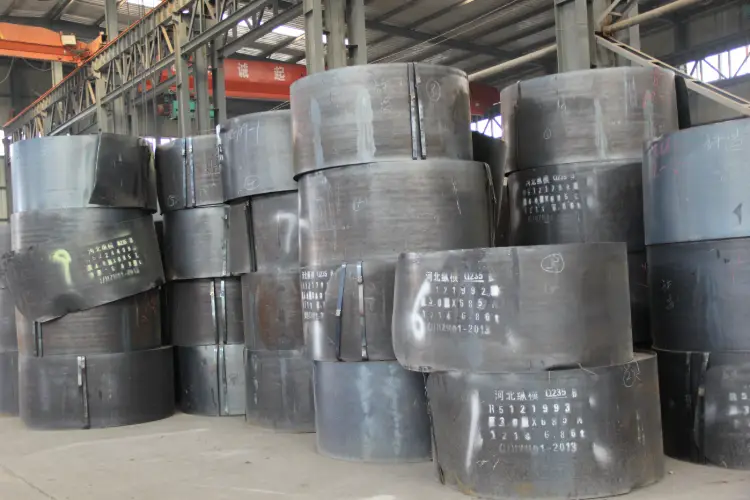
GL A550 Shipbuilding Steel Coil
GL A550 Shipbuilding Steel Coil: Premium High-Strength Steel for Demanding Marine Structures
Detailed material data for GL A550 shipbuilding steel coil: chemical composition, mechanical & physical properties, international equivalents, and applications as per Germanischer Lloyd rules.
Cutting, cold or hot forming, welding (preheating may be required depending on thickness and CEV), machining, shot blasting and priming
- Phone : +8618037372205
- Email : [email protected]
- WhatsApp: Contact via Whtsapp
- WeChat: +8618037372205
GL A550 Shipbuilding Steel Coil Introduction
GL A550 is a high-strength, quenched and tempered structural steel specified by Germanischer Lloyd (now DNV GL) for shipbuilding and offshore applications. It is designed to provide a minimum yield strength of 550 MPa, combined with excellent weldability and toughness at temperatures down to 0°C. This grade is typically delivered in coil form for efficient processing into plates and structural components. Key characteristics include:
- High strength-to-weight ratio, enabling lighter structures without compromising safety
- Good ductility and impact resistance in the quenched and tempered condition
- Strict conformity to GL rules, ensuring reliability in harsh marine environments
- Suitable for cold forming, welding, and machining
GL A550 Shipbuilding Steel Coil Chemical Composition
The chemical composition of GL A550 is controlled to achieve the required strength and toughness while maintaining good weldability. The following table lists the maximum and minimum limits as per GL rules (based on IACS UR W11 for grade A550). Elements not shown shall not be intentionally added without the purchaser's consent. Carbon equivalent (CEV) is typically ≤0.52% for thicknesses ≤50 mm to ensure weldability.
| Element | Standard Value (max unless range) | Remarks |
|---|---|---|
| C | ≤ 0.20 | Influences strength and toughness |
| Si | ≤ 0.55 | Deoxidizer, contributes to strength |
| Mn | 0.90 – 1.65 | Enhances hardenability and strength |
| P | ≤ 0.025 | Phosphorus, controlled for toughness |
| S | ≤ 0.025 | Sulfur, controlled for ductility |
| Al (total) | ≥ 0.015 | Grain refining element, minimum for fine grain practice |
| Nb | ≤ 0.06 | Microalloying for grain refinement and precipitation strengthening |
| V | ≤ 0.10 | Microalloying for strength and temper resistance |
| Ti | ≤ 0.02 | Grain refinement and nitrogen fixing |
| Cu | ≤ 0.35 | Weathering resistance and strengthening |
| Cr | ≤ 0.30 | Hardenability agent |
| Ni | ≤ 0.40 | Toughness and hardenability |
| Mo | ≤ 0.08 | Hardenability and creep resistance |
| N | ≤ 0.012 | Nitrogen, controlled to avoid ageing |
| Ceq (IIW) | ≤ 0.52 (typical) | Carbon equivalent, for guidance on weldability |
GL A550 Shipbuilding Steel Coil Physical Properties
The physical properties are representative for low-alloy, quenched and tempered steels like GL A550. Actual values may vary slightly depending on exact heat treatment and composition. These data are useful for design calculations involving thermal and electrical loads.
| Property | Typical Value | Unit | Test Condition / Remarks |
|---|---|---|---|
| Density (ρ) | 7.85 | g/cm³ | At 20°C |
| Modulus of elasticity (E) | 210 | GPa | At 20°C |
| Shear modulus (G) | 81 | GPa | Calculated from E and Poisson's ratio |
| Poisson's ratio (ν) | 0.3 | - | At 20°C, elastic range |
| Thermal expansion coefficient (α) | 11.1 | 10⁻⁶/K | Between 20°C and 100°C |
| Thermal conductivity (λ) | 46 | W/m·K | At 20°C |
| Specific heat capacity (cp) | 460 | J/kg·K | At 20°C |
| Electrical resistivity (ρe) | 0.15 | µΩ·m | At 20°C |
GL A550 Shipbuilding Steel Coil Mechanical Properties
The mechanical properties of GL A550 are valid for quenched and tempered condition and for thicknesses up to 50 mm. Testing is performed in accordance with GL rules (transverse test pieces unless otherwise agreed). The minimum impact energy is specified for longitudinal Charpy V-notch specimens at 0°C.
| Property | Standard Requirement | Unit | Test Condition / Remarks |
|---|---|---|---|
| Yield strength (ReH) | ≥ 550 | MPa | Transverse, t ≤ 50 mm |
| Tensile strength (Rm) | 670 – 830 | MPa | Transverse, t ≤ 50 mm |
| Elongation (A5) | ≥ 14 | % | Transverse, gauge length 5.65√So |
| Bend test (180°) | d = 3a | Transverse, bend diameter d related to thickness a; no cracks allowed | |
| Impact energy (KV2) | ≥ 27 (average) | J | Longitudinal, at 0°C, t ≤ 50 mm |
| Impact energy (KV2) | ≥ 20 (individual) | J | Longitudinal, at 0°C, single value minimum |
GL A550 Shipbuilding Steel Coil Equivalent Material Standards and Substitute Grades
| Country/Region | Standard | Grade | Remarks |
|---|---|---|---|
| International | IACS UR W11 | A550 | Unified requirement for shipbuilding steel, directly equivalent to GL A550 |
| Norway / DNV | DNV Rules | A550 | DNV A550 matches GL A550 in chemical and mechanical requirements |
| United Kingdom | Lloyd's Register Rules | AH550 | LR AH550 is fully interchangeable with GL A550 |
| France | Bureau Veritas Rules | A550 | BV A550 equivalent grade |
| USA | ABS Rules | A550 | American Bureau of Shipping equivalent for marine structures |
| China | CCS Rules | A550 | China Classification Society grade matching GL A550 |
| Japan | ClassNK Rules | KA550 | Nippon Kaiji Kyokai grade for 550 MPa yield strength steel |
| Korea | KR Rules | A550 | Korean Register equivalent grade |
| Italy | RINA Rules | A550 | Registro Italiano Navale matching grade |
GL A550 Shipbuilding Steel Coil Application Introduction
GL A550 steel is primarily utilized in critical structural components where high strength, good weldability, and reliable toughness are essential. Due to its quenched and tempered condition, it can be shaped and welded into complex parts while maintaining mechanical integrity. Its compliance with classification society rules makes it the preferred choice for marine and offshore projects.
Product Applications: Hull plates and stiffeners, Deck plating and bulkheads, Leg structures of jack-up rigs, Offshore module frames and turrets, Bridges, mast structures, and crane booms, Submarine pressure hulls
Processed into products: Welded beams and columns for ship framing, Flanged-plate girders and brackets, Connecting nodes for offshore structures (cast or welded), Cut-to-shape base plates for winches and equipment foundations, Machined pins, lashing points, and padeyes, Roll-formed cold-bent profiles for lightweight structures
Application industries: Shipbuilding (military and commercial vessels), Offshore oil and gas platforms (jack-up rigs, semi-submersibles), Marine renewable energy (wind turbine foundation structures), Heavy engineering and crane manufacturing, Pressure vessel and boiler fabrication (where class approval is required)
GL A550 Shipbuilding Steel Coil Similar/Alternative Materials with Comparable Performance
| Country/Region | Standard | Grade | Remarks |
|---|---|---|---|
| Europe | EN 10025-6 | S550Q | Quenched and tempered structural steel with min. 550 MPa yield. Not classed, but mechanical properties are close. CEV and weldability may differ; check certification for marine use. |
| USA | ASTM A514/A514M | Grade Q (min 690 MPa) | Higher strength alternative; yield ≥ 620 MPa. Not directly interchangeable; thicker sections may require special welding procedures. |
| USA | ASTM A517/A517M | Grade Q | Similar to A514, for pressure vessels. Higher strength, but can be considered if re-certified for shipbuilding. |
| Germany / EU | GL Rules | A500 (or AH500) | Lower yield strength (500 MPa) alternative in the same class series; may be used where reduced weight is not critical. |
| Germany / EU | GL Rules | A620 | Higher yield strength (620 MPa) option within the GL high-strength series; provides weight savings but requires more stringent welding control. |
Notes:
All delivery of GL A550 steel must be accompanied by GL certificates for material and test results. Production requires approval of the manufacturer's quality management system and welding procedures by the classification society. For thicknesses above 50 mm, specific additional requirements for chemical composition, mechanical testing, and toughness may apply as per the latest GL rules. It is recommended to consult the current GL Rules II or IACS UR W11 for detailed technical conditions before procurement.
- Share



