
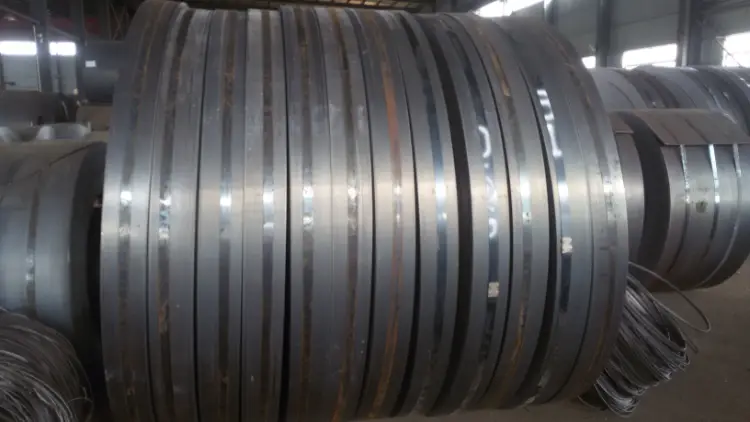
GL F500 Shipbuilding Steel Coil
GL F500 Shipbuilding Steel Coil: High-Strength Marine Grade for Arctic and Offshore Structures
Comprehensive material data sheet for GL F500 shipbuilding steel coil, including chemical composition, mechanical and physical properties, international equivalents, and application guidelines.
Cutting, welding, bending, forming, machining
- Phone : +8618037372205
- Email : [email protected]
- WhatsApp: Contact via Whtsapp
- WeChat: +8618037372205
GL F500 Shipbuilding Steel Coil Introduction
GL F500 is a high-strength, fine-grain hull structural steel grade certified by Germanischer Lloyd (GL). It belongs to the F-type toughness class, ensuring superior notch toughness down to -60 °C. This quenched and tempered or thermo-mechanically rolled steel offers a minimum yield strength of 500 MPa, making it ideal for lightweight yet robust shipbuilding, offshore platforms, and Arctic marine structures. The grade guarantees excellent weldability, formability, and resistance to brittle fracture under extreme conditions. Typical delivery conditions include TMCP, normalizing rolling, or Q&T, with ultrasonic testing and strict control of carbon equivalent (CEV) to facilitate reliable fabrication.
GL F500 Shipbuilding Steel Coil Chemical Composition
The chemical composition of GL F500 is designed to provide a balanced combination of strength, toughness, and weldability. Typical limits are based on GL Rules for hull structural steels, with a maximum thickness range of up to 50 mm. Fine-grain melting practice and controlled additions of micro-alloying elements (e.g., Nb, V, Ti) ensure grain refinement and precipitation strengthening. The carbon equivalent value (CEV) is kept below 0.43% to guarantee cold cracking resistance during welding.
| Element | Typical Value (wt.%) | Remarks |
|---|---|---|
| Carbon (C) | ≤ 0.18 | For thickness ≤ 50 mm |
| Silicon (Si) | ≤ 0.55 | Influences deoxidation and strength |
| Manganese (Mn) | 0.90 – 1.70 | Provides strength and toughness |
| Phosphorus (P) | ≤ 0.025 | Controls embrittlement |
| Sulfur (S) | ≤ 0.020 | Improves weldability and ductility |
| Chromium (Cr) | ≤ 0.25 | Optional for additional hardenability |
| Nickel (Ni) | ≤ 0.80 | Enhances low-temperature toughness |
| Molybdenum (Mo) | ≤ 0.20 | Permitted as a micro-alloying element |
| Copper (Cu) | ≤ 0.35 | Weathering resistance; limited for castings |
| Nitrogen (N) | ≤ 0.020 | Bound by Al, Ti, or Nb to prevent ageing |
| Vanadium (V) | ≤ 0.10 | Grain refiner and precipitation strengthener |
| Niobium (Nb) | ≤ 0.05 | Grain refiner, contributes to TMCP strengthening |
| Titanium (Ti) | ≤ 0.05 | Forms nitrides, refines grain size |
| Aluminium (Al) | ≥ 0.020 total | Grain refinement and deoxidation |
| CEV (IIW) | ≤ 0.43 | Carbon equivalent: C + Mn/6 + (Cr+Mo+V)/5 + (Ni+Cu)/15 |
GL F500 Shipbuilding Steel Coil Physical Properties
The following physical properties are typical for high-strength low-alloy steel of the F500 grade. These values are not part of the GL material specification but serve as engineering references for design, heat transfer, and welding calculations. Values may vary with plate processing conditions and temperature.
| Property | Typical Value | Unit | Test Conditions |
|---|---|---|---|
| Density (ρ) | 7850 | kg/m³ | Ambient temperature |
| Modulus of Elasticity (E) | 210 | GPa | Tension, ambient temperature |
| Shear Modulus (G) | 81 | GPa | Calculated from E and ν |
| Poisson's Ratio (ν) | 0.3 | — | Ambient temperature |
| Thermal Expansion Coefficient (α) | 12.0 × 10⁻⁶ | K⁻¹ | 20–100 °C |
| Thermal Conductivity (λ) | 45 | W/(m·K) | 20 °C |
| Specific Heat Capacity (c) | 460 | J/(kg·K) | 20 °C |
| Electrical Resistivity (ρ_e) | 0.25 × 10⁻⁶ | Ω·m | 20 °C |
| Melting Range | 1425 – 1540 | °C | Approximate |
GL F500 Shipbuilding Steel Coil Mechanical Properties
Mechanical properties of GL F500 are verified on samples taken in accordance with GL standards. The yield strength (ReH), tensile strength (Rm), and elongation (A) are minimum values for plates up to 50 mm thickness. Impact toughness is tested at -60 °C on Charpy V-notch specimens to guarantee the F-grade classification. Bend tests are performed with a mandrel diameter of 3t (t = specimen thickness) without cracking.
| Property | Standard Requirement | Unit | Test Conditions |
|---|---|---|---|
| Yield Strength (ReH) | ≥ 500 | MPa | t ≤ 50 mm, longitudinal specimen |
| Tensile Strength (Rm) | 610 – 770 | MPa | t ≤ 50 mm, longitudinal specimen |
| Elongation (A) | ≥ 16 (longitudinal), ≥ 14 (transverse) | % | Gauge length 5.65√S₀, t ≤ 50 mm |
| Charpy Impact (KV₂) | ≥ 27 (longitudinal), ≥ 20 (transverse) | J | -60 °C, V-notch, average of 3 specimens |
| Bend Test | 180° bend, mandrel diameter 3t (no cracks) | — | t = plate thickness, room temperature |
GL F500 Shipbuilding Steel Coil Exact Equivalent Standards & Substitute Grades
| Country / Region | Standard / Classification Society | Grade | Remarks |
|---|---|---|---|
| Norway / Germany (DNV GL) | DNVGL Rules | F500 | Merged DNV and GL; identical toughness and strength |
| USA | ABS Rules | ABS F500 | Same yield strength and -60 °C Charpy requirement |
| United Kingdom | Lloyd's Register Rules | LR FH500 | FH designation for ≥500 MPa, F toughness |
| France | Bureau Veritas Rules | BV F500 | Full equivalence with GL F500 |
| Italy | RINA Rules | RINA F500 | F class at -60 °C |
| China | CCS Rules | CCS F500 | China Classification Society equivalent |
| Japan | ClassNK Rules | NK F500 | Nippon Kaiji Kyokai equivalent |
| South Korea | Korean Register Rules | KR F500 | Same mechanical and toughness requirements |
GL F500 Shipbuilding Steel Coil Application Introduction
GL F500 steel coils and plates are primarily intended for weight-critical and safety-critical marine and offshore applications where high yield strength combined with excellent low-temperature toughness is required. Its reliable weldability and formability make it a preferred choice for hull components, deck structures, and subsea frameworks. The F-grade certification guarantees ductile behaviour at -60 °C, making the material suitable for ice-class vessels and Arctic service.
Product Applications: Icebreakers and ice-going cargo ships, Jack-up rig legs and spudcans, Semi-submersible platform columns and braces, Heavy-lift vessel hulls and crane pedestals, Wind turbine transition pieces and monopile foundations, Subsea templates and manifolds
Processed into products: Bulkhead plates and web frames, Deck stringer plates and stiffeners, Bottom shell plates in ice-strengthened areas, Crane boom sections and mast structures, Pinion housings and slew bearing seats, Weld-in pad eyes and lifting lugs, Reinforcement rings for subsea pipelines
Application industries: Shipbuilding and repair, Offshore oil & gas, Marine engineering and heavy lifting, Renewable energy – offshore wind, Arctic & ice-class vessel construction, Port & harbour infrastructure
GL F500 Shipbuilding Steel Coil Similar / Alternative Materials with Comparable Properties
| Country / Region | Standard | Grade | Remarks |
|---|---|---|---|
| Europe | EN 10225 | S500G2+M (TMCP delivery) | 500 MPa offshore structural steel; similar strength, but toughness class may differ (e.g., -40 °C). Check CEV and through-thickness properties. |
| Europe | EN 10025-6 | S500QL (Q&T) | Quenched and tempered structural steel with min. 500 MPa yield; useful for heavy welding, but typically lower Ni content, toughness down to -40 °C rather than -60 °C |
| International | API 2Y / API 2W | Grade 60 (yield 415 MPa) / Grade 60 | Offshore structural steels; lower yield strength than F500; suitable where higher toughness is not mandatory. Grade 60 (60 ksi) is approx. 415 MPa. |
| USA | ASTM A514 / A517 | Grade F / Grade H | High-yield quenched and tempered structural steel plates (690 MPa); higher strength, but typically higher alloy content and lower impact temperature for certain grades. Not interchangeable with F500 due to weldability concerns. |
Notes:
Additional information:
- GL F500 steel coils are typically supplied in the TMCP or normalized condition and can undergo further heat treatment after fabrication only with prior agreement.
- Ultrasonic testing to GL standards (e.g., SEL 072) is common for thicknesses above 15 mm.
- Preheating and interpass temperature control during welding are required; recommended preheat is usually 50–100 °C, depending on section thickness and ambient conditions.
- For welding consumables, matching electrodes with high basicity (e.g., AWS E11018-M or equivalent) should be used to ensure toughness of the joint.
- The material may be certified with additional Z-direction through-thickness properties (Z25 or Z35) if specified in the order.
- Share



