
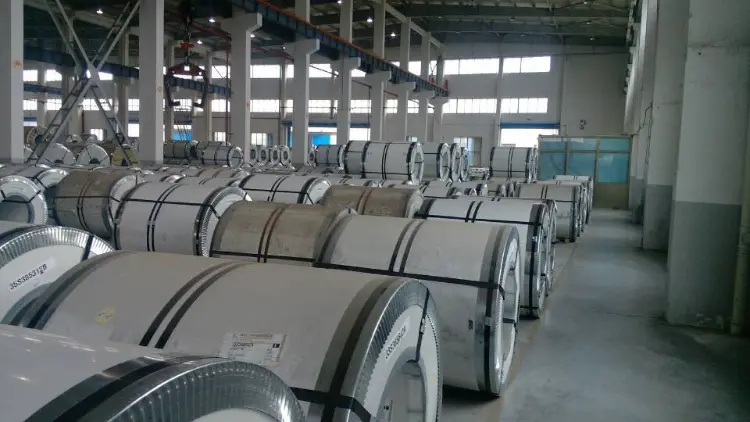
GL E500 Shipbuilding Steel Coil
GL E500 Shipbuilding Steel Coil: High-Strength Marine Structural Plate
GL E500 is a high-strength shipbuilding steel grade certified by Germanischer Lloyd (now DNV GL), offering minimum yield strength of 500 MPa, excellent toughness and weldability for demanding marine applications.
TMCP (Thermo-mechanical controlled rolling), normalized, or quenched and tempered as agreed
- Phone : +8618037372205
- Email : [email protected]
- WhatsApp: Contact via Whtsapp
- WeChat: +8618037372205
GL E500 Shipbuilding Steel Coil Introduction
GL E500 is a high-strength, fine-grained structural steel developed for ship and offshore construction, certified under the former Germanischer Lloyd (now DNV GL) rules. Belonging to the E500 strength class, it provides a minimum yield strength of 500 MPa and guaranteed Charpy V-notch impact toughness at -40 °C. The steel is designed for use in critical hull members, enabling weight reduction without compromising structural integrity. It is produced via fine grain practice and microalloying with Nb, V and Ti, and is typically delivered in the thermomechanically rolled (TMCP) condition for an optimum balance of strength, ductility and weldability. This steel complies with the DNVGL-OS-B101 standard and equivalent IACS UR W11 requirements, and is suitable for all major classification society approvals.
GL E500 Shipbuilding Steel Coil Chemical composition of GL E500
Chemical requirements as per DNVGL-OS-B101 for EH500 with thickness typically ≤ 50 mm. Grain refinement elements such as Al, Nb, V and Ti are added according to the manufacturer's practice. The carbon equivalent CEV is normally ≤ 0.43% for good weldability.
| Chemical Element | Standard Value (wt.%) | Remarks |
|---|---|---|
| Carbon (C) | ≤ 0.18 | Ladle analysis |
| Manganese (Mn) | 0.90 - 1.60 | Depending on thickness and CEV |
| Silicon (Si) | ≤ 0.50 | |
| Phosphorus (P) | ≤ 0.025 | |
| Sulfur (S) | ≤ 0.025 | |
| Nitrogen (N) | ≤ 0.012 | If not otherwise fixed by Al or other elements |
| Aluminum (Al total) | ≥ 0.020 | Grain refinement; acid soluble Al |
| Niobium (Nb) | ≤ 0.05 | Microalloying element |
| Vanadium (V) | ≤ 0.10 | Microalloying element |
| Titanium (Ti) | ≤ 0.05 | If added for grain refinement |
| Chromium (Cr) | ≤ 0.25 | |
| Nickel (Ni) | ≤ 0.40 | |
| Molybdenum (Mo) | ≤ 0.08 | |
| Copper (Cu) | ≤ 0.35 | |
| Carbon Equivalent CEV | ≤ 0.43 | Typical limit for TMCP delivery, often guaranteed |
GL E500 Shipbuilding Steel Coil Thermal and electrical physical properties of GL E500
The following physical properties are typical for low-alloy structural steels and can be used for design calculations. They are not mandatory nor part of the classification standard, but are representative for a microalloyed steel with about 0.15% C and 1.4% Mn.
| Property | Typical Value | Unit | Condition |
|---|---|---|---|
| Density (ρ) | 7850 | kg/m³ | At 20 °C |
| Modulus of Elasticity (E) | 205 | GPa | At room temperature |
| Shear Modulus (G) | 80 | GPa | At room temperature |
| Poisson's ratio (ν) | 0.3 | - | At room temperature |
| Thermal Expansion (α) | 11.5 × 10⁻⁶ | K⁻¹ | Between 20 °C and 100 °C |
| Thermal Conductivity (λ) | 40 | W/(m·K) | At 20 °C |
| Specific Heat Capacity | 460 | J/(kg·K) | At 20 °C |
| Electrical Resistivity (ρ_e) | 0.20 × 10⁻⁶ | Ω·m | At 20 °C |
GL E500 Shipbuilding Steel Coil Mechanical properties of GL E500
Mechanical properties are tested in accordance with DNV GL requirements. Specimens are taken transverse to the rolling direction unless otherwise agreed. Impact tests are performed on Charpy V-notch specimens in the longitudinal direction at -40 °C. Bend test criteria: no cracks after 180° bending over a mandrel of diameter d=3a.
| Property | Standard Requirement | Unit | Test Condition |
|---|---|---|---|
| Yield Strength (ReH) | ≥ 500 | MPa | Transverse, room temperature, t ≤ 50 mm |
| Tensile Strength (Rm) | 610 - 770 | MPa | Transverse, room temperature, t ≤ 50 mm |
| Elongation (A5) | ≥ 16 | % | Gauge length L0 = 5.65√S0, t ≤ 50 mm |
| Impact Energy (KV2) | ≥ 34 | J | Longitudinal, -40 °C, t ≤ 50 mm (average of 3 tests, single min 24 J) |
| Bend Test | d=3a, 180° | - | No cracking; mandrel diameter 3 × thickness |
GL E500 Shipbuilding Steel Coil Fully equivalent material standards and replaceable grades
| Country/Region | Classification Society / Standard | Grade | Remarks |
|---|---|---|---|
| International | DNV GL | NV E500 | Direct successor of GL E500 in unified rules |
| USA | ABS | EH500 | Identical strength and toughness class |
| UK | Lloyd's Register (LR) | EH500 | Equivalent to GL E500 |
| France | Bureau Veritas (BV) | EH500 | Interchangeable for class-approved structures |
| China | China Classification Society (CCS) | EH500 | Equivalent grade under CCS rules |
| Japan | Nippon Kaiji Kyokai (NK) | EH500 | Same mechanical and toughness requirements |
| Korea | Korean Register (KR) | EH500 | Fully equivalent shipbuilding steel |
| Italy | RINA | EH500 | Accepted as direct substitute |
| Russia | Russian Maritime Register of Shipping (RS) | EH500 | Meets IACS UR W11 requirements |
GL E500 Shipbuilding Steel Coil Application Introduction
GL E500 steel is primarily intended for ship and offshore structural applications where a combination of high strength, excellent low-temperature toughness and good weldability is required. It is suitable for both longitudinal and transverse strength members, enabling lighter and more economic designs. The steel is readily processed by hot working, cold forming, welding and cutting.
Product Applications: Hull plates and shell plating, Weather decks and strength decks, Longitudinal bulkheads and tank tops, Bottom and side structures, Offshore platform topside modules and jackets, Marine crane booms and lifting equipment
Processed into products: Bottom longitudinals and frames, Deck girders and stiffeners, Bracket plates and floor plates, Rudder horns and rudder stocks, Hatch coamings and container guides, Reinforced shell inserts and stern frames, Fatigue-critical nodes in offshore structures
Application industries: Shipbuilding (container ships, tankers, bulk carriers, LNG carriers), Offshore engineering and marine structures, Port and harbour construction, Naval and defence vessels
GL E500 Shipbuilding Steel Coil Similar or approximate alternative material recommendations
| Country/Region | Standard | Grade | Remarks |
|---|---|---|---|
| Europe | EN 10025-6 | S500Q / S500QL | Quenched and tempered structural steel with comparable strength; toughness and certification differ from shipbuilding requirements |
| Europe | EN 10225 | S500G2+M | Weldable structural steel for offshore structures, similar strength, may substitute in non-classed applications |
| USA | ASTM A514 | Grade B | High strength quenched and tempered alloy steel (690 MPa yield) with limited marine suitability |
| International | API 2Y-500 | API 2Y-500 | High strength steel for offshore structures, yield 500 MPa, but not directly certified by class societies for ship hulls |
Notes:
- Material is typically delivered with a class certificate issued by the classification society.
- For TMCP condition, the steel should not be heated above 600 °C for prolonged times to preserve mechanical properties.
- Welding consumables and procedures must be qualified in accordance with the applicable classification rules.
- The latest edition of DNVGL-OS-B101 (or the relevant class rules) should be consulted for any updates to chemical and mechanical requirements.
- Thicker products (>50 mm) may have slightly adjusted minimum elongation and different CEV limits; these values are available in the full standard.
- Share



