
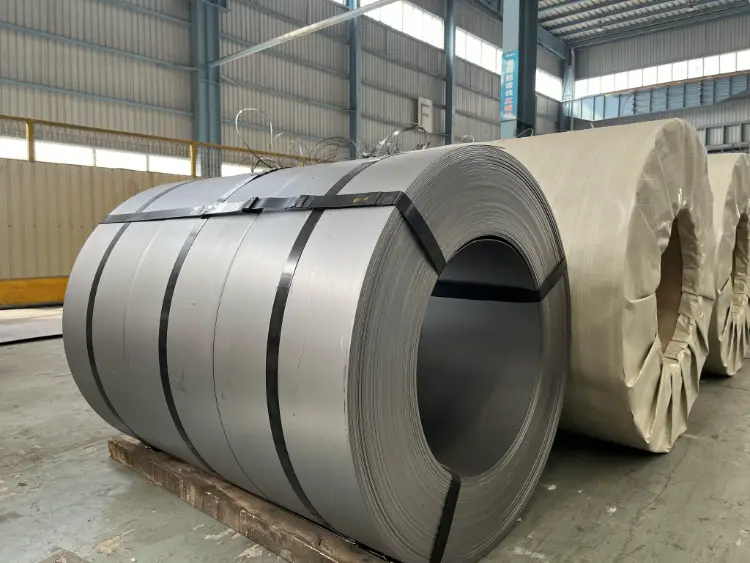
GL E690 Shipbuilding Steel Coil
GL E690 Shipbuilding Steel Coil - Quenched & Tempered High Strength Marine Plate
Detailed technical data for GL E690 shipbuilding steel coil: chemical composition, mechanical properties, thermal and electrical physical properties, international equivalent grades, and typical applications in offshore and marine engineering.
Hot rolling, quenching, tempering, cutting, welding, cold forming (limited), machining
- Phone : +8618037372205
- Email : [email protected]
- WhatsApp: Contact via Whtsapp
- WeChat: +8618037372205
GL E690 Shipbuilding Steel Coil Introduction
GL E690 is a high-strength, quenched and tempered structural steel primarily used in the construction of ships and offshore structures. It is certified by Germanischer Lloyd (now part of DNV GL) and meets the stringent requirements for toughness at low temperatures (E-grade, -40°C). With a minimum yield strength of 690 MPa and a tensile strength range of 760–940 MPa, E690 offers an excellent strength-to-weight ratio, enabling lighter designs without sacrificing structural integrity. The steel exhibits good weldability when proper preheating and low-hydrogen procedures are applied, and it is specifically developed to resist brittle fracture in harsh marine environments. Typical delivery condition is quenched and tempered (Q+T). The material is available in the form of coils, plates, and sheets, and is widely used for critical components such as ship hulls, jack-up rig leg racks, heavy-lift crane booms, and pressure vessels. Its chemical composition is carefully controlled to maintain low carbon content and a fine-grained microstructure, with elements like niobium, vanadium, and titanium added for grain refinement and precipitation strengthening. Carbon equivalent (CEV) is restricted to ensure weldability.
GL E690 Shipbuilding Steel Coil Chemical Composition
The chemical composition complies with GL/DNV GL rules for E690 grade. Maximum limits are given unless a range is specified. The steel is microalloyed with Nb, V, Ti to achieve fine grain size and high strength. Carbon equivalent (CEV) is typically restricted to ≤0.53% for weldability.
- CEV = C + Mn/6 + (Cr+Mo+V)/5 + (Ni+Cu)/15
- All values are nominal and may vary slightly within the standard's limits.
| Element | Standard Value (max, %) | Remarks |
|---|---|---|
| Carbon (C) | 0.20 | Typical range 0.14–0.18 |
| Silicon (Si) | 0.55 | Generally 0.20–0.50 |
| Manganese (Mn) | 1.70 | Often 0.90–1.60 for thickness ≤50 mm |
| Phosphorus (P) | 0.020 | Maximum |
| Sulfur (S) | 0.010 | Maximum |
| Chromium (Cr) | 0.70 | Optional |
| Nickel (Ni) | 0.70 | May be increased to 1.00 for thicker sections |
| Molybdenum (Mo) | 0.50 | Optional |
| Copper (Cu) | 0.35 | Maximum |
| Niobium (Nb) | 0.06 | 0.02–0.05 common |
| Vanadium (V) | 0.10 | 0.05–0.10 |
| Titanium (Ti) | 0.05 | 0.01–0.03 |
| Aluminum (Al) | 0.015–0.055 | Minimum soluble, required for grain refinement |
| Nitrogen (N) | 0.012 | Maximum |
| Boron (B) | 0.005 | Optional, rarely used |
| CEV (IIW) | 0.53 | Depending on thickness and delivery condition |
GL E690 Shipbuilding Steel Coil Thermal and Electrical Physical Properties
The following physical properties are typical for quenched and tempered high-strength steel and may vary slightly with exact chemical composition and heat treatment. They are useful for design calculations involving heat transfer, stress analysis, and electrical applications. Note: Values are not part of the mandatory certification but are based on published data for similar steels (e.g., EN 10025-6 S690QL).
| Property | Typical Value | Unit | Condition / Remarks |
|---|---|---|---|
| Density (ρ) | 7850 | kg/m³ | At 20°C |
| Elastic Modulus (E) | 205 – 210 | GPa | At 20°C, static |
| Shear Modulus (G) | 80 – 85 | GPa | Calculated from E and ν |
| Poisson's Ratio (ν) | 0.3 | – | In elastic range |
| Thermal Expansion Coefficient (α) | 12.0 – 13.0 | ×10⁻⁶/K | 20–100°C |
| Thermal Expansion Coefficient (α) | 13.0 – 14.0 | ×10⁻⁶/K | 20–200°C |
| Thermal Conductivity (λ) | 35 – 45 | W/(m·K) | At 20°C |
| Thermal Conductivity (λ) | 30 – 38 | W/(m·K) | At 200°C |
| Specific Heat Capacity (cp) | 450 – 500 | J/(kg·K) | At 20°C |
| Electrical Resistivity (ρe) | 0.15 – 0.25 | µΩ·m | At 20°C |
GL E690 Shipbuilding Steel Coil Mechanical Properties
The mechanical properties are valid for quenched and tempered condition. Testing is performed according to GL/DNV GL rules, typically on samples taken from a plate or coil. Note: Values may vary depending on product thickness and sampling orientation. Tension tests use proportional specimens (e.g., L0=5.65√S0). Impact tests are conducted on Charpy V-notch specimens at -40°C (E-grade).
| Property | Standard Requirement | Unit | Test Condition / Remarks |
|---|---|---|---|
| Yield Strength (ReH) | ≥ 690 | MPa | Thickness ≤ 50 mm, transverse direction |
| Yield Strength (ReH) | ≥ 650 | MPa | Thickness > 50 mm up to 100 mm |
| Tensile Strength (Rm) | 760 – 940 | MPa | All thicknesses, transverse |
| Elongation (A5) | ≥ 14 | % | Gauge length 5.65√S0, transverse |
| Charpy Impact Energy (KV2) | ≥ 50 (average) | J | At -40°C, longitudinal direction |
| Charpy Impact Energy (KV2) | ≥ 35 (single) | J | At -40°C, longitudinal |
| Charpy Impact Energy (KV2) | ≥ 35 (average) | J | At -40°C, transverse direction (if specified) |
| Charpy Impact Energy (KV2) | ≥ 24 (single) | J | At -40°C, transverse |
| Bend Test (180°) | No cracks | – | Mandrel diameter = 3 × thickness (t), bend to 180° |
GL E690 Shipbuilding Steel Coil Fully Equivalent Standards and Replaceable Grades
| Country / Society | Standard / Rule | Grade | Remarks |
|---|---|---|---|
| Germanischer Lloyd (GL) | GL Rules II-1 | E690 | Base specification; now incorporated in DNV GL |
| DNV GL (Det Norske Veritas) | DNV-OS-B101 | E690 | Direct equivalent when issued with DNV GL certificate |
| American Bureau of Shipping (ABS) | ABS Rules (Part 2, Chapter 1) | EH69 | Same strength and toughness level (E-grade, -40°C) |
| Lloyd's Register (LR) | LR Rules (Pt.2) | EH69 | Identical requirements |
| Bureau Veritas (BV) | BV Rules (NR216) | EH690 | Suffix may differ; EH690 is equivalent |
| China Classification Society (CCS) | CCS Rules (Part 1) | E690 | Direct equivalent in Chinese shipbuilding |
| Nippon Kaiji Kyokai (ClassNK) | NK Rules (Part K) | KE690 | Equivalent strength and toughness |
| Registro Italiano Navale (RINA) | RINA Rules (Pt. B) | E690 | Same designation |
| Korean Register (KR) | KR Rules (Pt. 2) | REH69 / KE690 | Designation may vary; technical equivalence |
GL E690 Shipbuilding Steel Coil Application Introduction
GL E690 steel is extensively used in the shipbuilding and offshore industries where high strength and low temperature toughness are paramount. Its 690 MPa yield strength allows for weight reduction in large structures, leading to cost savings and improved payload. Typical applications include:
Product Applications: Ship hull plates, decks, and bulkheads, Jack-up rig leg chords and rack plates, Crane pedestals and boom sections, Pressure vessels and storage tanks for low-temperature service, Structural nodes and transition rings
Processed into products: Hull side shells and bottom plates, Longitudinals and stiffeners, Heavy brackets and gussets, Jack-up leg rack teeth and pinions, Boom chord and lattice members for shipboard cranes, Main deck and strength deck panels, Cofferdam bulkheads and watertight doors, Offshore skid beams and substructure members
Application industries: Shipbuilding (commercial, naval, and specialized vessels), Offshore oil & gas (jack-up rigs, semi-submersibles, fixed platforms), Heavy lifting and transport (crane booms, heavy-lift vessels), Bridge construction (when marine environment exposure requires class-approved steel), Renewable energy (offshore wind turbine foundations, transition pieces)
GL E690 Shipbuilding Steel Coil Performance-Close Alternative Materials
| Country / Standard | Standard / Grade | Key Property Comparison | Remarks |
|---|---|---|---|
| European (EN 10025-6) | S690QL / S690QL1 | YS ≥690 MPa, TS 770–940 MPa, KV at -40°C or -60°C | Structural steel; often used offshore with additional qualification. S690QL1 offers better cold formability. |
| USA (ASTM A514 / A517) | Grade Q / A517 Grade Q | YS ≥690 MPa, TS 760–895 MPa | Quenched & tempered plate; used in pressure vessels and structures, but toughness at -40°C may need verification. |
| USA (ASTM A709) | Grade HPS 690W | YS ≥690 MPa, improved weathering | High-performance bridge steel, not automatically certified for marine usage. |
| China (GB/T 16270) | Q690D / Q690E | YS ≥690 MPa, TS 770–940 MPa, KV at -20°C/-40°C | Structural quenched and tempered steel; marine classification may be requested. |
| Japan (JIS G 3128) | SHY685 / SHY685N | YS ≥685 MPa, TS 780–930 MPa | High yield strength rolled steel for welded structures; check maritime approval. |
Notes:
Welding Considerations: Preheating (typically 100–150°C) and low-hydrogen consumables are required. Control heat input and interpass temperature. Post-weld heat treatment is generally not required but may be specified for thick sections. Certification: Material must be delivered with original class society inspection certificates (e.g., GL/DNV GL stamp 3.1 or 3.2). CEV limiting: If the carbon equivalent exceeds 0.53%, special welding procedures may be necessary. Corrosion protection: Typical marine coatings or cathodic protection should be applied.
- Share



