
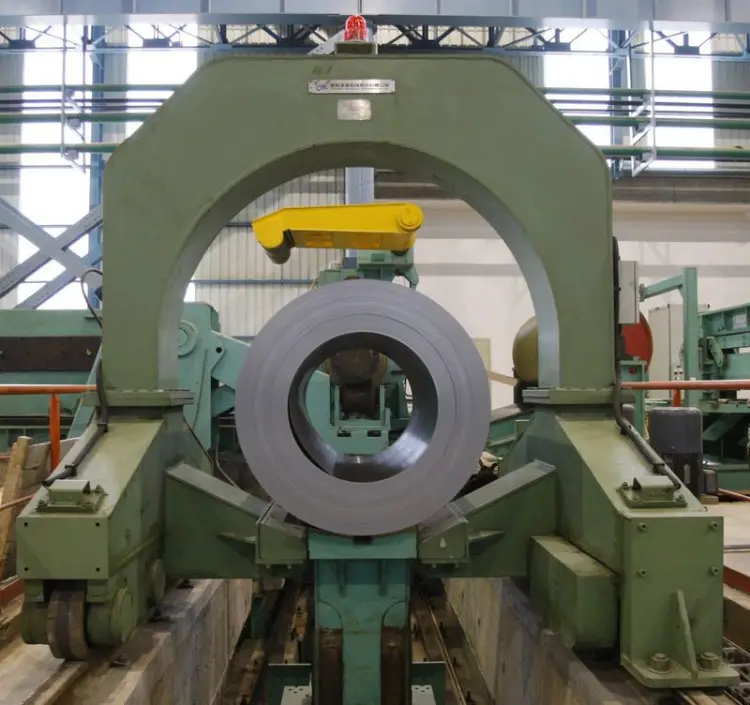
GL F460 Shipbuilding Steel Coil
GL F460 Shipbuilding Steel Coil: High-Strength Marine Structural Steel
Comprehensive technical data and equivalents for GL F460 shipbuilding steel coil, including chemical composition, mechanical and thermal properties, applications, and international cross-references.
Welding, cutting, cold forming, hot forming (limited due to TMCP), machining
- Phone : +8618037372205
- Email : [email protected]
- WhatsApp: Contact via Whtsapp
- WeChat: +8618037372205
GL F460 Shipbuilding Steel Coil Introduction
GL F460 is a high-strength structural steel grade for shipbuilding, specified by Germanischer Lloyd (now DNV) under their Rules for Classification and Construction. It offers a minimum yield strength of 460 MPa and is primarily delivered in the thermomechanically rolled (TMCP) condition. This fine-grain steel provides excellent weldability, low-temperature toughness, and high strength-to-weight ratio, enabling lighter ship structures and improved payload capacity. It is typically used for critical hull members, offshore platforms, and marine structures exposed to dynamic loading and severe corrosion environments.
- Nominal yield strength: 460 MPa
- Excellent impact toughness down to -40°C
- TMCP delivery for optimal balance of strength and ductility
GL F460 Shipbuilding Steel Coil Chemical Composition
The chemical composition conforms to IACS UR W22 (International Association of Classification Societies) for Grade F460. Values are maxima unless a range is indicated. The steel is fully killed with fine-grain practice and contains microalloying elements (Nb, V, Ti) for strength and toughness.
- Carbon equivalent (CEV) typically ≤ 0.47-0.49 depending on thickness
- Low impurity levels guarantee weldability and resistance to brittle fracture
| Element | Standard Value (max, %) | Remarks |
|---|---|---|
| Carbon (C) | ≤ 0.18 | Ladle analysis |
| Silicon (Si) | ≤ 0.55 | Ladle analysis |
| Manganese (Mn) | 1.00 - 1.70 | Ladle analysis |
| Phosphorus (P) | ≤ 0.025 | Ladle analysis |
| Sulfur (S) | ≤ 0.025 | Ladle analysis |
| Chromium (Cr) | ≤ 0.20 | Residual element |
| Molybdenum (Mo) | ≤ 0.08 | Residual element |
| Nickel (Ni) | ≤ 0.40 | Residual element |
| Copper (Cu) | ≤ 0.35 | Residual element |
| Aluminium (Al total) | ≥ 0.015 | Minimum for fine-grain practice |
| Niobium (Nb) | ≤ 0.05 | Microalloying |
| Vanadium (V) | ≤ 0.10 | Microalloying |
| Titanium (Ti) | ≤ 0.05 | Microalloying |
| Nitrogen (N) | ≤ 0.012 | Ladle analysis |
| Nb + V + Ti | ≤ 0.12 | Sum of microalloying elements |
GL F460 Shipbuilding Steel Coil Thermal and Electrical Physical Properties
Physical properties are representative for typical high-strength low-alloyed structural steels and are not part of the mandatory classification testing. They may vary slightly with actual chemical composition and heat treatment. Values are given at ambient temperature unless noted.
- Thermal properties are important for welding preheat calculations
- Electrical resistivity may be used for eddy current inspection or induction heating
| Property | Typical Value | Unit | Test Condition |
|---|---|---|---|
| Density (ρ) | 7.85 | g/cm³ | 20°C |
| Elastic Modulus (E) | 205 - 210 | GPa | 20°C, tensile |
| Shear Modulus (G) | approx. 80 | GPa | Calculated from E and Poisson |
| Poisson's Ratio (ν) | 0.28 - 0.30 | - | Elastic range |
| Thermal Expansion Coefficient (α) | 11.5 - 12.5 | 10⁻⁶/K | 20°C to 100°C |
| Thermal Expansion Coefficient (α) | 12.5 - 13.5 | 10⁻⁶/K | 20°C to 200°C |
| Thermal Conductivity (λ) | 50 - 55 | W/(m·K) | 20°C |
| Specific Heat Capacity | 460 - 500 | J/(kg·K) | 20°C |
| Electrical Resistivity (ρ_e) | 0.20 - 0.25 | μΩ·m | 20°C |
GL F460 Shipbuilding Steel Coil Mechanical Properties
Test specimens are taken transverse to the rolling direction for plate/coil thicknesses as specified in the classification rules. Tensile and impact requirements are valid for thicknesses up to 100 mm unless otherwise stated. Impact test temperature is -40°C for grade F460. Reported values are minimum requirements.
- Bend test mandrel diameter: 3 × thickness for tensile strength ≤ 690 MPa
- Through-thickness properties (Z-grade) can be agreed for improved lamellar tearing resistance
| Property | Standard Requirement | Unit | Test Condition |
|---|---|---|---|
| Yield Strength (ReH) | ≥ 460 | MPa | t ≤ 50 mm |
| Yield Strength (ReH) | ≥ 440 | MPa | 50 < t ≤ 70 mm |
| Yield Strength (ReH) | ≥ 420 | MPa | 70 < t ≤ 100 mm |
| Tensile Strength (Rm) | 570 - 720 | MPa | t ≤ 100 mm |
| Elongation (A5) | ≥ 17 | % | Gauge length 5.65√So; t ≤ 50 mm |
| Elongation (A5) | ≥ 16 | % | Gauge length 5.65√So; 50 < t ≤ 70 mm |
| Elongation (A5) | ≥ 15 | % | Gauge length 5.65√So; 70 < t ≤ 100 mm |
| Impact Energy (KV2) | ≥ 41 (average), ≥ 28 (individual) | J | at -40°C, transverse, V-notch, t ≤ 100 mm |
| Bend Test (180°) | No cracks or ruptures | - | d = 3a (a = specimen thickness) |
GL F460 Shipbuilding Steel Coil Fully Equivalent Material Standards and Replaceable Grades
| Country/Region | Standard | Grade | Remarks |
|---|---|---|---|
| International | IACS UR W22 | F460 | Unified Requirement for Normal and High Strength Hull Structural Steels; base document |
| International | EN 10225 | S460G2+M | Weldable structural steels for fixed offshore structures; TMCP delivery |
| Norway/Germany | DNV Rules | F460 | DNV GL historic classification, now DNV |
| USA | ABS Rules | F460 | American Bureau of Shipping; identical mechanical requirements |
| France | BV Rules | F460 | Bureau Veritas; interchangeable with GL F460 |
| UK | LR Rules | F460 | Lloyd's Register; equivalent strength and toughness category |
| Italy | RINA Rules | F460 | Registro Italiano Navale; accepted as direct substitute |
| China | CCS Rules | F460 | China Classification Society; same IACS W22 base |
GL F460 Shipbuilding Steel Coil Application Introduction
GL F460 steel coil is ideally suited for heavily loaded marine and offshore constructions where weight savings and high reliability are critical. It is commonly employed in shipbuilding and offshore platforms that must withstand harsh sea environments and dynamic loading.
- Recommended welding consumables should be selected according to the strength and toughness levels; preheat and interpass temperature must be controlled to avoid hydrogen cracking.
- Formability is good for a TMCP steel; cold forming radii must comply with classification society guidelines.
- Where lamellar tearing is a concern, Z-grade (through-thickness) options can be specified as per EN 10164 or equivalent.
Product Applications: Container ships and bulk carriers, Oil tankers and LNG carriers, Jack-up rig legs and spudcans, Offshore platform topsides and jackets, Ship deckhouses and hatch coamings, Crane pedestals and heavy-lift vessel structures
Processed into products: Stiffened panels for hull girder, Bottom and side shell plates, Stringers and longitudinals, Bulkhead plating, Bracket plates and web frames, Deck girders, Offshore module support beams, Padeyes and lifting points
Application industries: Shipbuilding (commercial and naval vessels), Offshore oil and gas platforms, Marine renewable energy (wind turbine foundations), Heavy-duty structural engineering, Port and harbour construction
GL F460 Shipbuilding Steel Coil Similar/Alternative Material Grades
| Country/Region | Standard | Grade | Remarks |
|---|---|---|---|
| International | IACS UR W22 | F420, F500 | F420 offers lower yield (420 MPa) with better toughness; F500 offers higher strength (500 MPa) with reduced formability. |
| Europe | EN 10025-6 | S460Q/QL/QL1 | Quenched and tempered high-strength structural steel, not fully equivalent due to different delivery condition, but similar strength level for non-marine applications. |
| USA | ASTM A572/A572M | Grade 65 | Yield 450 MPa, lower than F460, but often used in similar structural applications; not certified for shipbuilding. |
| USA | API 2W | Grade 60 | Yield ≥ 415 MPa, intended for offshore platforms; similar chemistry and toughness. |
| Japan | JIS G 3106 | SM570 | Weldable structural steel with min. 460 MPa tensile; yield ~430 MPa, lower than F460, used in bridges and buildings. |
Notes:
GL F460 is certified by classification societies based on product testing per batch (ladle analysis, tensile, impact). Additional requirements like CTOD testing, through-thickness tensile (Z-grade), or higher temperature (e.g., -60°C) impact may be agreed upon between the purchaser and manufacturer. The steel is typically supplied with mill certificates (EN 10204 type 3.1 or 3.2).
- Ultrasonic testing according to EN 10160 or classification society standard is common for thick plates.
- Welding procedures must be qualified following the relevant society rules to ensure joints maintain the required toughness.
- Share



