
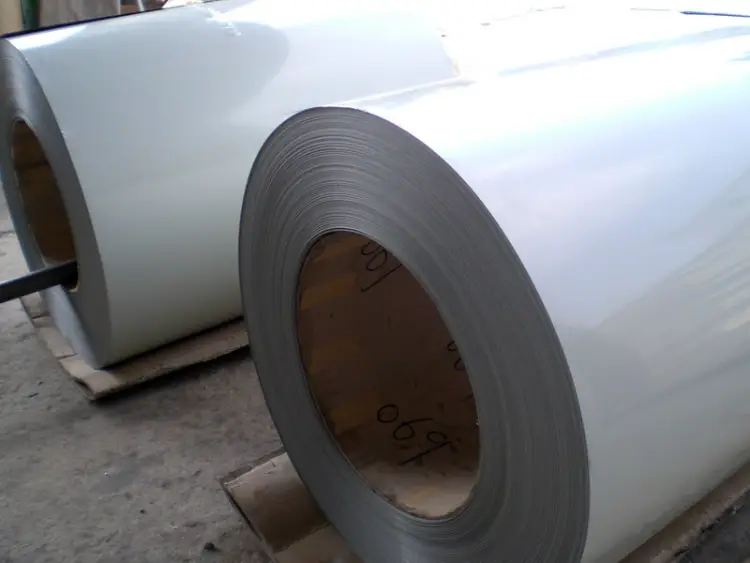
GL A500 Shipbuilding Steel Coil
GL A500 Shipbuilding Steel Coil: High-Strength, Weldable Structural Steel for Marine Applications
Explore GL A500 shipbuilding steel coil, a quenched and tempered high-yield-strength steel (500 MPa min) certified by Germanischer Lloyd. Ideal for hull structures, offshore platforms, and marine equipment requiring excellent toughness and weldability.
Hot rolling, controlled rolling, quenching and tempering, cutting, cold forming, welding (all standard shipbuilding methods)
- Phone : +8618037372205
- Email : [email protected]
- WhatsApp: Contact via Whtsapp
- WeChat: +8618037372205
GL A500 Shipbuilding Steel Coil Introduction
GL A500 is a high-strength shipbuilding steel grade certified by Germanischer Lloyd (GL), now part of DNV GL. It offers a minimum yield strength of 500 MPa in thicknesses up to 100 mm, combining high strength with good notch toughness and excellent weldability. The steel is supplied in the quenched and tempered (Q&T) condition, enabling weight reduction without compromising structural integrity. Typical applications include critical hull components, offshore structures, and heavy-duty marine equipment. Its balanced alloy design ensures consistent mechanical properties after thermal cutting and welding, meeting the rigorous requirements of the GL Rules for Classification and Construction.
GL A500 Shipbuilding Steel Coil Chemical Composition
The chemical composition of GL A500 is tightly controlled to achieve the required strength and toughness after quenching and tempering. Typical ladle analysis limits according to GL Rules Part 2, Chapter 1 are given below. The steel is fully killed and fine-grained treated. Microalloying elements (Nb, V, Ti) are used singularly or in combination, with a sum constraint for Cr+Ni+Mo+Cu+Ti+V+Nb not exceeding 0.80%. Carbon equivalent (CEV) is typically ≤0.47% for thickness ≤50 mm, ensuring good weldability.
| Element | Standard Value (wt%) | Remarks |
|---|---|---|
| Carbon (C) | ≤0.18 | Max for strength and weldability |
| Silicon (Si) | 0.10 – 0.55 | Killing and strength |
| Manganese (Mn) | 0.90 – 1.70 | Hardenability and toughness |
| Phosphorus (P) | ≤0.035 | Max for ductility |
| Sulfur (S) | ≤0.035 | Max for toughness |
| Chromium (Cr) | ≤0.20 | Optional, limited |
| Nickel (Ni) | ≤0.40 | Optional, limited |
| Molybdenum (Mo) | ≤0.08 | Optional, limited |
| Copper (Cu) | ≤0.35 | Optional, limited |
| Aluminium (Al, total) | ≥0.015 | Minimum for fine-grain practice |
| Niobium (Nb) | ≤0.05 | Microalloy optional |
| Vanadium (V) | ≤0.10 | Microalloy optional |
| Titanium (Ti) | ≤0.02 | Microalloy optional |
| Nitrogen (N) | ≤0.012 | Max, for toughness |
| Cr+Ni+Mo+Cu+Ti+V+Nb | ≤0.80 | Sum of alloying elements (any combination) |
GL A500 Shipbuilding Steel Coil Physical Properties
The physical properties listed are typical for a quenched and tempered structural steel with similar composition to GL A500. Actual values may vary slightly depending on heat treatment condition and exact chemical composition. These properties are essential for engineering calculations (thermal loads, structural analysis, and electrical grounding). Data are provided at room temperature unless specified otherwise.
| Property | Typical Standard Value | Unit | Test Condition / Remarks |
|---|---|---|---|
| Density (ρ) | 7850 | kg/m³ | At 20 °C |
| Elastic Modulus (E) | 205 | GPa | At 20 °C, longitudinal |
| Shear Modulus (G) | 80 | GPa | At 20 °C, calculated from E and ν |
| Poisson's Ratio (ν) | 0.3 | – | At 20 °C, elastic range |
| Thermal Expansion Coefficient (α) | 12.0 × 10⁻⁶ | K⁻¹ | Linear, 20–100 °C |
| Thermal Expansion Coefficient (α) | 13.2 × 10⁻⁶ | K⁻¹ | 20–200 °C |
| Thermal Expansion Coefficient (α) | 14.0 × 10⁻⁶ | K⁻¹ | 20–400 °C |
| Thermal Conductivity (λ) | 42 | W/(m·K) | At 20 °C |
| Thermal Conductivity (λ) | 38 | W/(m·K) | At 200 °C |
| Specific Heat Capacity (cp) | 460 | J/(kg·K) | At 20 °C |
| Electrical Resistivity (ρe) | 0.25 × 10⁻⁶ | Ω·m | At 20 °C, typical for low-alloy steel |
GL A500 Shipbuilding Steel Coil Mechanical Properties
Mechanical properties are determined on quenched and tempered test pieces taken from the finished product. The values below correspond to the GL A500 grade as per GL Rules (valid for thicknesses up to 100 mm). Yield strength (ReH), tensile strength (Rm), elongation (A5), and impact energy (KV) are verified in the longitudinal direction unless otherwise specified. The bend test ensures formability without cracking. All tests are witnessed by a GL surveyor.
| Property | Standard Required Value | Unit | Test Condition / Remarks |
|---|---|---|---|
| Yield Strength (ReH) | ≥500 | MPa | Transverse tensile test, ambient temperature, t ≤ 50 mm |
| Tensile Strength (Rm) | 610 – 770 | MPa | Transverse tensile test, ambient temperature, t ≤ 50 mm |
| Elongation (A5) | ≥16 | % | Gauge length 5.65√So, transverse specimen, t ≤ 50 mm |
| Yield Strength (ReH) | ≥480 | MPa | For thickness 50 < t ≤ 100 mm |
| Tensile Strength (Rm) | 590 – 770 | MPa | For thickness 50 < t ≤ 100 mm |
| Elongation (A5) | ≥16 | % | For thickness 50 < t ≤ 100 mm |
| Impact Energy (KV, -20°C) | ≥27 (average of 3) | J | Charpy V-notch, longitudinal, -20 °C test temperature (A500 marking: impact class at -20 °C) |
| Impact Energy (KV, -20°C) | ≥20 (min individual) | J | Same test condition; single value minimum |
| Bend Test (t ≤ 25 mm) | Mandrel diameter = 3t | – | 180° bending, no cracks, width ≥ 30 mm |
| Bend Test (t > 25 mm) | Mandrel diameter = 4t | – | 180° bending, no cracks |
GL A500 Shipbuilding Steel Coil Fully Equivalent Material Standards and Substitutable Grades
| Country / Region | Standard | Grade Designation | Remarks |
|---|---|---|---|
| International | DNV GL (merged rules) | DNV A500 (formerly NV A500) | Same as GL A500, fully integrated |
| USA | ABS Rules | ABS A500 (or AH500/DH500/EH500) | Equivalent high-strength grade; A500 for normal temperature, AH500 for 0°C, etc. |
| France | Bureau Veritas (BV) | BV A500 | Identical requirements to GL A500 |
| UK | Lloyd's Register (LR) | LR A500 (also AH500 template) | Fully equivalent; can be welded to GL materials |
| Italy | RINA | RINA A500 | Same chemical and mechanical limits |
| Japan | ClassNK (Nippon Kaiji Kyokai) | NK KA500 | K – high strength, 500 MPa grade |
| China | CCS (China Classification Society) | CCS A500 | Corresponds to GL A500 in all respects |
| Korea | Korean Register (KR) | KR RA500 | R stands for high strength steel; A500 identical |
| Russia | Russian Maritime Register (RMRS) | RMRS A500 | Equivalent, with minor differences in sampling |
| Europe (EN standard) | EN 10025-6 | S500QL / S500Q | Similar base specification; additional marine certification possible, CEV and toughness aligned |
GL A500 Shipbuilding Steel Coil Application Introduction
GL A500 steel is engineered for demanding marine and offshore environments. Its high strength-to-weight ratio allows designers to reduce structural mass while maintaining safety margins. The typical quenched and tempered supply condition guarantees uniform properties across the plate/coil. It is used where strength, toughness at -20°C, and weldability are critical. The steel can be fabricated using conventional shipyard practices including plasma cutting, submerged arc welding, and cold forming (with suitable minimum bend radii).
Product Applications: Hull plates and stiffeners for high-speed vessels and ice-class ships, Deck and bottom plating in VLCC (Very Large Crude Carrier) and container ships, Inner bottom and longitudinal structural members, Jack-up rig legs and spudcans, Offshore crane booms and A-frames, Transition pieces and monopile doors for offshore wind, Heavy-duty ship-to-shore container crane bodies, Pressure hulls for submarines and deep-sea vehicles (subject to additional requirements)
Processed into products: Shear plates and brackets, Web frames and girders, Bulkhead plating (strength part), Rudder horns and stock plates, Engine room supporting structures, Helideck support beams, Mooring equipment foundations, Crane pedestals and slewing rings, Laid-down coffer dams and temporary bulkheads (where high strength needed)
Application industries: Shipbuilding (commercial and naval vessels), Offshore oil & gas (platforms, FPSO, jack-up rigs), Renewable offshore energy (wind turbine foundations, substations), Marine heavy lifting and transport, Port and harbor equipment, Bridge construction (where marine certification accepted), Pressure vessels (supplementary approval required)
GL A500 Shipbuilding Steel Coil Similar / Nearby Alternative Materials
| Country / Region | Standard | Grade | Remarks |
|---|---|---|---|
| Europe | EN 10025-6 | S500QL / S500Q | Quenched and tempered; similar YS 500 MPa, Rm 590-770 MPa; typical roll application; not automatically marine certified, but testable to GL requirements. |
| USA | ASTM A514 / A517 | Grade B, H, Q (etc.) | Quenched and tempered high-strength plate; YS 690 MPa (higher), but 500 MPa grades not directly covered; require re-certification for marine service. |
| Germany | DIN EN 10137-2 (withdrawn) | S500Q | Predecessor of EN 10025-6; similar properties. |
| International | API 2H / 2W | Grade 50 | Offshore structural steel with YS 345-415 MPa; lower strength; not a direct substitute but often used in similar applications with higher thickness. |
| International | DNV GL (Rules) | GL AH500, DH500, EH500, FH500 | Same strength level with improved toughness at lower temperatures (0°C, -20°C, -40°C, -60°C respectively); interchangeable with A500 if toughness is adequate. |
Notes:
Weldability: GL A500 has a maximum carbon equivalent (CEV) typically ≤0.47% for thickness ≤50 mm, ensuring good weldability with preheat recommended when t > 30 mm or at low ambient temperatures. Corrosion resistance: Standard low-alloy steel, not intended for corrosive service; protective coatings or cathodic protection required. Supplementary testing: Ultrasonic testing (UT) per GL requirements, through-thickness properties (Z-quality) option for high restraint joints. Identification: Each plate is stamped with GL mark, grade A500, heat number, and surveyor's stamp. Delivery condition: Quenched and tempered; TMCP delivery subject to separate approval; surface condition: as-rolled and inspected; edge trimmed for coil products.
- Share



