
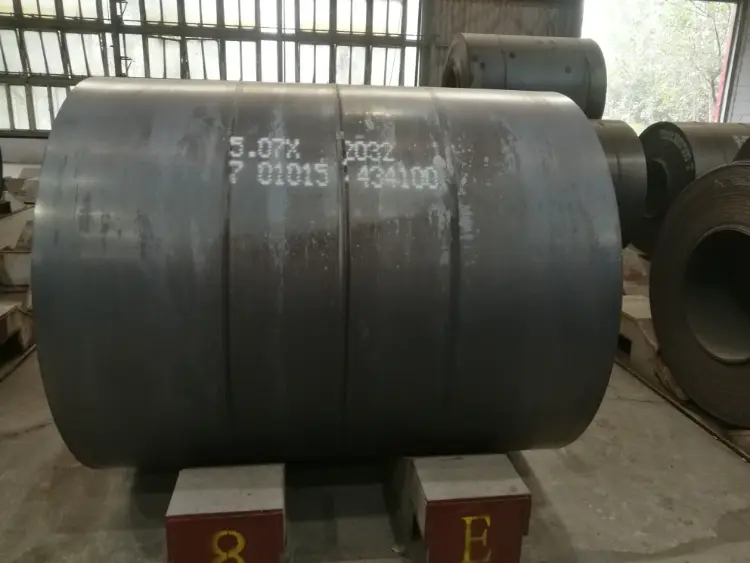
GL E460 Shipbuilding Steel Coil
GL E460 Shipbuilding Steel Coil - High-Strength Structural Steel for Hull Construction
GL E460 is a high-strength shipbuilding steel grade certified by Germanischer Lloyd, offering minimum yield strength of 460 MPa, excellent notch toughness at low temperatures, and good weldability for critical ship and offshore structures.
Hot rolling, normalizing, thermo-mechanical rolling, quenching and tempering, cutting, cold forming, welding
- Phone : +8618037372205
- Email : [email protected]
- WhatsApp: Contact via Whtsapp
- WeChat: +8618037372205
GL E460 Shipbuilding Steel Coil Introduction
GL E460 is a normalized or thermo-mechanically rolled high-strength shipbuilding structural steel defined under the rules of Germanischer Lloyd (GL, now part of DNV GL). It is primarily used in the construction of hulls and offshore platforms where high strength, good toughness, and reliable weldability are required. Key features include:
- Minimum yield strength of 460 MPa for thicknesses up to 50 mm
- Excellent low-temperature impact energy, typically tested at -40 °C
- Fine-grained microstructure with micro-alloying (Nb, V, Ti) for enhanced toughness
- Good weldability with low carbon equivalent, suitable for automatic and manual welding processes
- Available in various delivery conditions: normalized (N), thermo-mechanically rolled (M), or quenched and tempered (Q) depending on thickness and specification
It complies with IACS UR W11 and GL rules, ensuring consistent quality for marine environments.
GL E460 Shipbuilding Steel Coil Chemical Composition for GL E460
The chemical composition meets the requirements of GL rules and IACS UR W11 for high-strength steels with minimum yield strength 460 MPa. Ladle analysis limits shown below. Micro-alloying elements (Nb, V, Ti, Al) are typically added singly or in combination to achieve fine grain size and strength. Carbon equivalent (CEV) is controlled to ensure good weldability, normally ≤ 0.45% for thermomechanical rolled condition.
| Element | Standard Value (max %) | Remarks |
|---|---|---|
| Carbon (C) | ≤ 0.20 | Reduced for better weldability |
| Silicon (Si) | ≤ 0.55 | Deoxidation and strength |
| Manganese (Mn) | 0.90 - 1.70 | Strength and toughness |
| Phosphorus (P) | ≤ 0.025 | Harmful impurity |
| Sulfur (S) | ≤ 0.025 | Harmful impurity |
| Chromium (Cr) | ≤ 0.20 | Optional, limited |
| Nickel (Ni) | ≤ 0.40 | Optional, for toughness |
| Molybdenum (Mo) | ≤ 0.08 | Optional, limited |
| Copper (Cu) | ≤ 0.30 | Optional |
| Niobium (Nb) | 0.02 - 0.05 | Microalloying, grain refinement |
| Vanadium (V) | 0.05 - 0.10 | Microalloying, precipitation hardening |
| Titanium (Ti) | ≤ 0.02 | Grain refinement, nitrogen fixation |
| Aluminum (Al) | ≥ 0.020 (total) | Fine grain practice, deoxidation |
| Nitrogen (N) | ≤ 0.009 | Controlled for toughness |
| Carbon Equivalent (CEV) | ≤ 0.45 (typical) | Based on IIW formula for M condition |
GL E460 Shipbuilding Steel Coil Thermal and Electrical Physical Properties of GL E460
The following data represent typical values for high-strength structural steel at room temperature and ambient conditions. These are not specified in classification rules but are useful for design calculations. Values may vary slightly depending on actual composition and manufacturing route.
| Property | Standard Value | Unit | Test Conditions |
|---|---|---|---|
| Density (ρ) | 7850 | kg/m³ | Room temperature |
| Elastic modulus (E) | 210,000 | MPa | Room temperature |
| Shear modulus (G) | 80,770 | MPa | Calculated from E and Poisson's ratio |
| Poisson's ratio (ν) | 0.3 | - | Room temperature |
| Thermal expansion coefficient (α) | 12 × 10⁻⁶ | 1/K | 20 °C to 100 °C |
| Thermal conductivity (λ) | 50 | W/(m·K) | Room temperature |
| Specific heat capacity | 460 | J/(kg·K) | Room temperature |
| Electrical resistivity (ρₑ) | 0.20 × 10⁻⁶ | Ω·m | Room temperature |
GL E460 Shipbuilding Steel Coil Mechanical Properties of GL E460
Mechanical properties are determined on transverse test pieces unless otherwise specified. The values below conform to GL rules and IACS UR W11. Impact test temperature for E-grade is -40 °C. For thicknesses > 50 mm up to 100 mm, strength values may be slightly reduced; consult the specific product certificate.
| Property | Standard Value | Unit | Test Conditions |
|---|---|---|---|
| Yield strength (ReH) | ≥ 460 | MPa | t ≤ 50 mm, transverse |
| Yield strength (ReH) | ≥ 440 | MPa | 50 < t ≤ 70 mm, transverse |
| Yield strength (ReH) | ≥ 400 | MPa | 70 < t ≤ 100 mm, transverse |
| Tensile strength (Rm) | 570 - 720 | MPa | t ≤ 100 mm, transverse |
| Elongation (A5) | ≥ 17 | % | Gauge length 5.65√S0, t ≤ 100 mm |
| Charpy V-notch impact energy (KV2) | ≥ 31 | J | Longitudinal, -40 °C, average of 3 tests |
| Charpy V-notch impact energy (KV2) | ≥ 22 | J | Transverse, -40 °C, average of 3 tests |
| Bend test (diameter d) | d = 3a | - | 180° bend, crack-free, t ≤ 50 mm (a = thickness) |
GL E460 Shipbuilding Steel Coil Completely Equivalent Material Standards and Substitutable Grades
| Country / Region | Standard | Grade | Remarks |
|---|---|---|---|
| International (IACS) | IACS UR W11 | E460 | Universal requirement for all class societies |
| DNV GL | DNVGL-OS-B101 | VL E460 | Same as GL E460 under unified rules |
| Lloyd's Register (LR) | Lloyd's Register Rules | EH46 | Impact test -40 °C, yield 460 MPa |
| American Bureau of Shipping (ABS) | ABS Rules | EH46 | High-strength hull structural steel |
| Bureau Veritas (BV) | BV Rules | E460 | Yield 460 MPa; -40 °C Charpy |
| China Classification Society (CCS) | CCS Rules | E460 | Equivalent to IACS E460 |
| ClassNK (NK) | NK Rules | KE46 | KE46 corresponds to E460 grade |
| Korean Register (KR) | KR Rules | RE46 | RE46 with -40 °C impact test |
| RINA (Italy) | RINA Rules | E460 | High-strength grade with same properties |
| Indian Register of Shipping (IRS) | IRS Rules | EH46 | Equivalent E-grade with 460 MPa YS |
GL E460 Shipbuilding Steel Coil Application Introduction
GL E460 steel is designed for the most demanding marine and offshore structural applications. Its high strength-to-weight ratio allows for design optimization and weight reduction. Typical use includes:
- Main deck and bottom shell plating in large container ships and bulk carriers
- Hull longitudinal stiffeners and web frames
- Offshore platform columns, braces, and deck structures
- Icebreaker and arctic vessel hulls, where low-temperature toughness is critical
- Crane pedestals and heavy-lift ship components
Product Applications: Large container ships (hull and superstructure), Bulk carriers and tankers, Ice-class vessels, Offshore support vessels (OSV), Jack-up rigs leg chords and spudcans, Floating production units hull and decks, Bridge and harbor construction components
Processed into products: Shell plates and stiffeners, Longitudinal and transversal bulkheads, Deck plating and deck girders, Hatch coamings and corner pieces, Web frames and floors, Bracket stools, Bollard and mooring foundations, Bracket and node connections in tubular structures, Heavy lift crane booms and pedestals
Application industries: Shipbuilding (commercial and naval vessels), Offshore oil & gas platforms (jack-ups, semi-submersibles, FPSOs), Renewable energy offshore structures (wind turbine foundations), Heavy engineering and construction
GL E460 Shipbuilding Steel Coil Similar / Comparable Alternative Materials Recommendation
| Country / Region | Standard | Grade | Remarks |
|---|---|---|---|
| European Union | EN 10025-4 | S460ML | Thermomechanical rolled, min YS 460 MPa, impact -50 °C; for structural applications, not class-certified |
| European Union | EN 10025-6 | S460Q | Quenched and tempered; YS 460 MPa, high toughness; used in heavy machinery and offshore if accepted |
| Japan | JIS G 3106 | SM570 | Welded structural steel, YS 460 MPa class, but not automatically certified for marine use |
| USA | ASTM A514 / A517 | Grade Q | Quenched and tempered alloy steel, YS ≥ 620 MPa, but chemical composition differs; requires qualification for shipbuilding |
Notes:
Certification: Material must be produced by a GL-approved manufacturer and supplied with GL inspection certificate (e.g., 3.1 or 3.2 per EN 10204). Welding: Preheating and interpass temperature control may be required based on the thickness and carbon equivalent. Post-weld heat treatment (PWHT) is generally not needed for thicknesses under 50 mm. Tolerances: Dimensional tolerances typically comply with EN 10029 for plates. Corrosion protection: Shop primers and coatings recommended for marine environment. Further queries: Consult latest DNV GL rules for any updates.
- Share



