
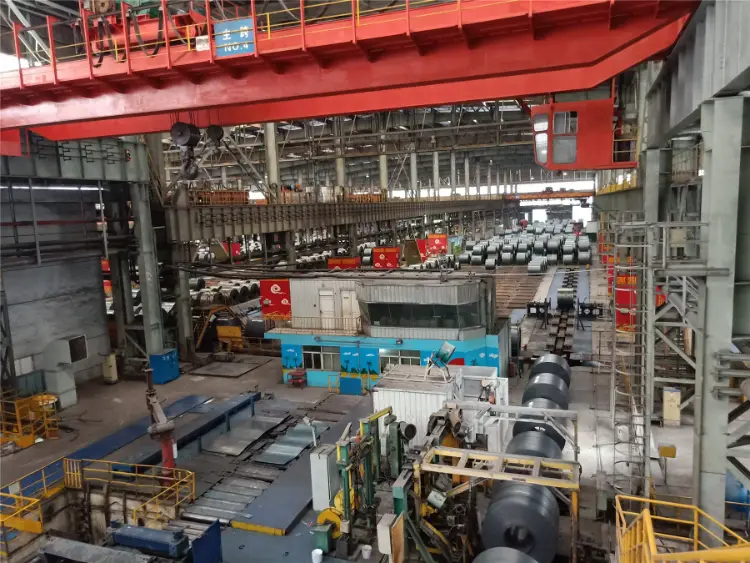
GL D460 Shipbuilding Steel Coil
GL D460 Shipbuilding Steel Coil: High-Strength Marine Steel with Excellent Low-Temperature Toughness
Comprehensive technical data for GL D460 shipbuilding steel coil, including chemical composition, mechanical properties, thermal and electrical physical properties, equivalent standards, similar materials, and application guidance.
Hot rolling, controlled rolling (TMCP), normalizing, quenching and tempering (limited), cutting, welding, forming, and machining.
- Phone : +8618037372205
- Email : [email protected]
- WhatsApp: Contact via Whtsapp
- WeChat: +8618037372205
GL D460 Shipbuilding Steel Coil Introduction
GL D460 is a high-strength shipbuilding structural steel grade regulated by Germanischer Lloyd (GL, now DNV GL). It is primarily supplied in coil or plate form and is designed for critical ship and offshore structures that require a minimum yield strength of 460 MPa. This steel grade combines high tensile strength with excellent weldability and superior notch toughness at low temperatures (down to -20°C), achieved through fine-grain practice and controlled rolling (TMCP) or normalizing treatments. Its balanced composition of manganese, silicon, and micro-alloying elements (Nb, V, Ti) ensures uniform mechanical properties even in thick sections, making it ideal for demanding marine environments, including hull girders, decks, and offshore platforms where weight reduction and structural integrity are essential.
GL D460 Shipbuilding Steel Coil Chemical Composition of GL D460
The chemical composition of GL D460 steel is designed to provide high strength while maintaining good weldability and low-temperature toughness. The ladle analysis limits are specified in accordance with GL Rules for D-grade high-strength hull structural steel (minimum yield 460 MPa). Micro-alloying elements such as niobium, vanadium, and titanium are added individually or in combination to refine grain size and improve strength. The carbon equivalent (CEV) is controlled to ensure weldability, typically not exceeding 0.45% for thicknesses up to 50 mm; for greater thicknesses individual requirements apply. Nitrogen content is limited to avoid strain aging and should be sufficient to bind nitrogen if boron is added.
| Element | Standard Value (wt.%) | Remarks |
|---|---|---|
| Carbon (C) | ≤ 0.20 | Depending on thickness; lower C enhances weldability |
| Silicon (Si) | ≤ 0.55 | For deoxidation; may be reduced for TMCP products |
| Manganese (Mn) | 0.90 - 1.65 | Contributes to strength and toughness |
| Phosphorus (P) | ≤ 0.025 | Strict limit to avoid embrittlement |
| Sulfur (S) | ≤ 0.025 | Strict limit for cleanliness and through-thickness properties |
| Aluminum (Al, acid soluble) | ≥ 0.015 | Required for fine grain practice; total Al is controlled |
| Niobium (Nb) | ≤ 0.05 | Optional grain refiner; can be combined with V and/or Ti |
| Vanadium (V) | ≤ 0.10 | Optional grain refiner and precipitation strengthener |
| Titanium (Ti) | ≤ 0.02 | Optional, for grain refinement and sulfide shape control |
| Nickel (Ni) | ≤ 0.40 | May be present as residual; higher amounts require agreement |
| Chromium (Cr) | ≤ 0.25 | Residual; for special thick plates may be increased with agreement |
| Molybdenum (Mo) | ≤ 0.08 | Residual; for special thick plates may be specified |
| Copper (Cu) | ≤ 0.35 | Residual; for special applications (e.g., pitting resistance) may be added |
| Nitrogen (N) | ≤ 0.012 | Typically low; should be bound by Al, Ti, or B if present |
| Boron (B) | ≤ 0.0005 | Only with agreement; very small amounts increase hardenability |
GL D460 Shipbuilding Steel Coil Thermal and Electrical Physical Properties of GL D460
The physical properties listed are typical for high-strength low-alloy (HSLA) structural steels of this class and are not part of material certification. They are provided for design and engineering calculations. Values may vary slightly depending on exact chemical composition, heat treatment, and temperature. Data are considered representative for ambient temperature (20°C) unless a temperature range is specified.
| Property | Typical Value | Unit | Condition / Remarks |
|---|---|---|---|
| Density (ρ) | 7.85 | g/cm³ | At 20°C |
| Elastic Modulus (E) | 210 | GPa | At room temperature; decreases with increasing temperature |
| Shear Modulus (G) | 81 | GPa | Calculated from E and Poisson's ratio |
| Poisson's Ratio (ν) | 0.3 | - | Within elastic range |
| Thermal Expansion Coefficient (α) | 12 × 10⁻⁶ | 1/K | Average for range 20-100°C; for 20-200°C: 12.5 × 10⁻⁶; for 20-300°C: 13.0 × 10⁻⁶ |
| Thermal Conductivity (λ) | 50 - 52 | W/(m·K) | At room temperature; reduces with temperature (approx. 42 at 300°C) |
| Specific Heat Capacity (cₚ) | 460 - 480 | J/(kg·K) | At 20°C; increases with temperature (approx. 550 at 300°C) |
| Electrical Resistivity (ρₑ) | 0.15 - 0.20 | µΩ·m | At 20°C; may vary with alloy content |
GL D460 Shipbuilding Steel Coil Mechanical Properties of GL D460
The mechanical properties are determined on test pieces taken from the finished product (usually transverse for plates/coils). The values below represent the minimum requirements for acceptance according to GL Rules. Tensile and impact tests are mandatory per heat and per rolled batch. For thicknesses beyond 100 mm, properties must be specially agreed. The impact test temperature is -20°C for D-grade (longitudinal Charpy V-notch). Average absorbed energy is required to be not less than 41 J for thickness ≤ 50 mm; for thicknesses 51-70 mm, the minimum is 37 J; for thicknesses 71-100 mm, it is 34 J. The bend test is generally not required for routine certification unless specified for thickness > 12.5 mm (mandrel diameter related to thickness).
| Property | Standard Required Value | Unit | Test Condition |
|---|---|---|---|
| Yield Strength (ReH) | ≥ 460 | MPa | For thickness t ≤ 50 mm, transverse test piece |
| Yield Strength (ReH) | ≥ 440 | MPa | For thickness 50 < t ≤ 70 mm |
| Yield Strength (ReH) | ≥ 420 | MPa | For thickness 70 < t ≤ 100 mm |
| Tensile Strength (Rm) | 570 - 720 | MPa | All thicknesses, transverse |
| Elongation (A5) | ≥ 17 | % | Gauge length L0 = 5.65√S0; transverse test piece |
| Elongation (A5) | ≥ 17 | % | For thickness > 50 mm: gauge length 50 mm (A50) may be applied; minimum values vary |
| Charpy Impact Energy (KV2) | ≥ 41 | J | Longitudinal, at -20°C; average of 3 specimens; min. single 29 J; thickness ≤ 50 mm |
| Charpy Impact Energy (KV2) | ≥ 37 | J | Thickness > 50 mm to 70 mm; at -20°C, longitudinal |
| Charpy Impact Energy (KV2) | ≥ 34 | J | Thickness > 70 mm to 100 mm; at -20°C, longitudinal |
| Bend Test (through 180°) | No cracks or lamination | - | Mandrel diameter = 3 × thickness for t ≤ 35 mm; = 4 × thickness for t > 35 mm; normally waived for shipbuilding steel certified by GL if chemical and tensile requirements met |
GL D460 Shipbuilding Steel Coil Identical Substitute Standards and Equivalents for GL D460
| Country/Region | Standard | Equivalent Grade | Remarks |
|---|---|---|---|
| Denmark/Norway (DNV GL) | DNV GL Ship Rules | NV D460 | Full equivalence; same -20°C impact test |
| USA (ABS) | ABS Rules for Materials and Welding | ABS D460 | IACS unified requirements; equivalent mechanicals, -20°C |
| France (BV) | BV Rules for Steel Ships | BV D460 | Recognized IACS equivalent |
| UK (LR) | LR Rules and Regulations | LR D460 | Matches GL D460 specification |
| Japan (NK/ClassNK) | NK Rules for the Survey and Construction of Steel Ships | NK D460 | ClassNK D460 is directly equivalent |
| Italy (RINA) | RINA Rules for the Classification of Ships | RINA D460 | Same grade designation and requirements |
| Korea (KR) | KR Rules for the Classification of Steel Ships | KR D460 | Korean Register equivalent |
| China (CCS) | CCS Rules for Material and Welding | CCS D460 | China Classification Society equivalent |
| Europe (EN) | EN 10225: Off-shore Structural Steels | S460G2+M (TMCP) | EN 10225-1 S460G2+M corresponds to D-grade TMCP delivery; S460G1+M for normalized route; similar properties, but separate certification is required between EN and GL standards |
| International (IACS) | IACS UR W11 | High Strength Hull Structural Steel | IACS Unified Requirement W11 defines the standard; all IACS members recognize the D460 grade |
GL D460 Shipbuilding Steel Coil Application Introduction
GL D460 steel is engineered for heavy-duty marine and offshore constructions where high strength-to-weight ratio and reliable low-temperature notch toughness are critical. Its excellent weldability under common shipyard procedures (FCAW, SAW, SMAW) with appropriate preheat and consumables ensures efficient fabrication. The steel can be formed, cut (oxy-fuel, plasma, laser), and machined with standard equipment. It is suitable for both newbuilding and repair projects. Delivery condition (TMCP, normalized, or rolled) should be selected based on thickness to ensure homogeneous properties. Post-weld heat treatment is generally not required but can be applied if agreed.
Product Applications: Container ships, bulk carriers, tankers (hull girder, double bottom, transverse frames), Offshore platforms (deck plates, legs, braces for jack-ups, semisubmersible columns), Monopile and jacket foundations for offshore wind turbines, Piling and mooring equipment, Armor plates for specialized vehicles (where LLNL properties needed)
Processed into products: Longitudinal stiffeners and girders, Deck and bottom plating (main deck, strength deck), Shell plating (side shell, bilge strake, sheer strake), Bulkheads and stringer plates, Hatch coamings and frame brackets, Offshore crane pedestals and kingposts, Transition pieces and flanges for wind turbine towers, Heavy-lift padeyes and lifting lugs
Application industries: Shipbuilding (commercial and naval vessels), Offshore oil & gas (platform topsides, jackets, modules), Renewable energy (offshore wind turbine towers, transition pieces, foundations), Heavy engineering (bridges, pressure vessels, crane booms), Arctic and cold-region infrastructure
GL D460 Shipbuilding Steel Coil Similar/Comparable Substitute Materials
| Country/Region | Standard | Grade | Remarks / Differences |
|---|---|---|---|
| USA | ASTM A131/A131M | EH46 | Tensile properties similar, but Charpy impact at -40°C (E-grade) vs -20°C for D460; can be used if better toughness is acceptable |
| Europe | EN 10025-4 | S460M/ML | Hot-rolled structural steel with min. yield 460 MPa; impact at -20°C (ML) or -50°C (M); not directly certified for shipbuilding, but often considered for marine structures |
| Europe | EN 10025-6 | S460QL/QL1 | Quenched and tempered steel, yield 460 MPa; impact at -40°C; higher strength consistency; not typical for hull steel without extra qualification |
| International | ISO 4950-2 | S460QL | High yield strength structural steel, QT; similar to EN 10025-6 S460QL, requires detailed assessment for ship use |
| China | GB/T 712 | DH46 | Chinese shipbuilding steel DH46 yields 460 MPa, D-grade (-20°C); close but thinner gauge performance needs verification; EH46 is -40°C |
| Japan | JIS G 3106 | SM570 | Weldable structural steel with min. tensile 570 MPa, typical yield ~460 MPa; impact at 0°C or -20°C depending on variant; not automatically certified for ship class but used in heavy fabrication |
Notes:
The data provided complies with GL Rules Part 2, Chapter 1 (2022 edition) and general IACS UR W11.
- Actual minimum Charpy values depend on plate thickness: for t ≤ 50 mm, 41 J average; for 50 < t ≤ 70 mm, 37 J; for 70 < t ≤ 100 mm, 34 J. Individual specimen minimum 70% of average is applied.
- For coiled shipbuilding steel, the width is typically up to 4500 mm, thickness up to 25 mm (coil) or 50 mm (plate). Verification of through-thickness properties (Z-quality) may be required for certain welded joints; consult the purchaser's specification.
- Preheating and interpass temperatures should follow the recommendations of consumable manufacturers and classification societies, usually based on carbon equivalent and plate thickness.
- The classification societies generally do not request bend tests for ship grades as part of standard certification; the values listed are from the GL rules as an optional test.
- For exact compliance with a specific project, reference should be made to the latest edition of the applicable classification society rules and the material certificate issued by the manufacturer.
- Share



