
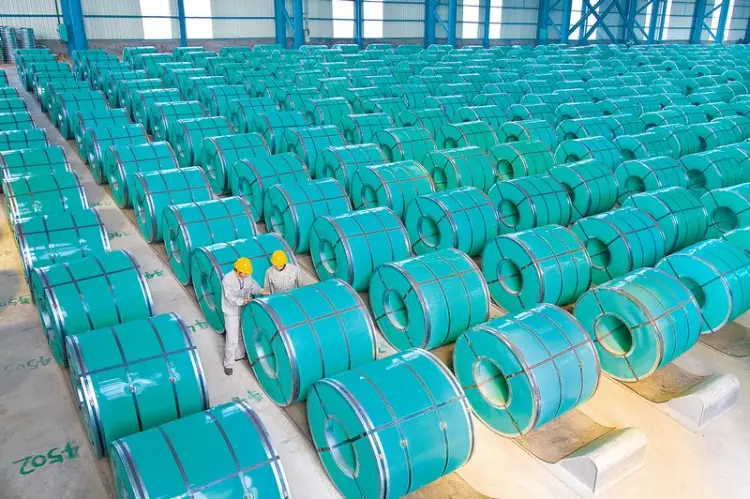
GL A460 Shipbuilding Steel Coil
GL A460 Shipbuilding Steel Coil - High-Strength Hull Structural Steel with 460 MPa Yield
Comprehensive material data for GL A460 shipbuilding steel coil, a high-strength structural steel with minimum 460 MPa yield strength for marine applications. Includes chemical composition, mechanical and thermal properties, international equivalents, similar alternatives, and application guidance.
Hot rolling, controlled rolling, thermomechanical controlled processing (TMCP), normalizing, quenching and tempering (optional for some delivery conditions)
- Phone : +8618037372205
- Email : [email protected]
- WhatsApp: Contact via Whtsapp
- WeChat: +8618037372205
GL A460 Shipbuilding Steel Coil Introduction
GL A460 is a high-strength shipbuilding structural steel grade originally specified by the Germanischer Lloyd (GL) classification society, now part of DNV GL. It belongs to the group of higher-strength hull steels with a specified minimum yield strength of 460 MPa, designated as A460, where "A" indicates a toughness class suitable for service at 0°C. This steel is typically supplied in the form of coils or plates in the thermomechanically controlled rolled (TMCP) or normalized condition, ensuring excellent weldability, good toughness, and high resistance to brittle fracture. The steel is manufactured under strict quality control in compliance with the GL Rules for Classification and Construction (or equivalent IACS UR W11), and it is widely used in decks, bottom structures, longitudinal stiffeners, and other critical hull components of large vessels and offshore platforms. Its balanced composition with microalloying elements (Nb, V, Ti) and low carbon equivalent ensures both high strength and superior toughness, meeting the demanding requirements of modern shipbuilding and offshore engineering.
GL A460 Shipbuilding Steel Coil Chemical Composition
Typical ladle analysis limits for GL A460 / AH460 according to IACS UR W11 and GL Rules. The composition is controlled to achieve high strength and toughness while ensuring good weldability. Carbon equivalent (CEV) is restricted to ≤0.40% for thicknesses up to 50mm to prevent cold cracking. Aluminium is added for grain refinement, and microalloying with Nb, V, and Ti provides precipitation strengthening and grain size control.
| Element | Standard Value (max unless range given) | Remarks |
|---|---|---|
| Carbon (C) | ≤0.18% | Ladle analysis |
| Silicon (Si) | ≤0.50% | - |
| Manganese (Mn) | 0.90–1.60% | - |
| Phosphorus (P) | ≤0.035% | - |
| Sulfur (S) | ≤0.035% | - |
| Aluminium (Al) acid-soluble | ≥0.015% | Grain refinement |
| Niobium (Nb) | 0.02–0.05% | - |
| Vanadium (V) | 0.05–0.10% | - |
| Titanium (Ti) | ≤0.02% | - |
| Copper (Cu) | ≤0.35% | - |
| Chromium (Cr) | ≤0.20% | - |
| Nickel (Ni) | ≤0.40% | - |
| Molybdenum (Mo) | ≤0.08% | - |
| Nitrogen (N) | ≤0.012% | - |
| Carbon equivalent (CEV) | ≤0.40% (t ≤ 50mm) | CEV = C + Mn/6 + (Cr+Mo+V)/5 + (Ni+Cu)/15 |
GL A460 Shipbuilding Steel Coil Thermal and Electrical Physical Properties
Physical properties for GL A460 are representative of low-alloy structural steels with similar composition. These values are not mandatory specification requirements but serve as practical engineering data for design and thermal analysis. Measurements are typically performed at room temperature unless a specific temperature range is noted.
| Property | Typical Value | Unit | Conditions / Remarks |
|---|---|---|---|
| Density (ρ) | ~7850 | kg/m³ | Room temperature |
| Elastic modulus (E) | ~210 | GPa | Room temperature, tension |
| Shear modulus (G) | ~81 | GPa | Calculated from E and Poisson's ratio |
| Poisson's ratio (ν) | ~0.3 | — | Room temperature, elastic range |
| Thermal expansion coefficient (α) | ~12 × 10⁻⁶ | K⁻¹ | Between 20°C and 100°C |
| Thermal conductivity (λ) | ~50 | W/(m·K) | Room temperature |
| Specific heat capacity | ~460 | J/(kg·K) | Room temperature |
| Electrical resistivity (ρe) | ~0.20 × 10⁻⁶ | Ω·m | Room temperature, typical low-alloy steel |
GL A460 Shipbuilding Steel Coil Mechanical Properties
Mechanical properties for GL A460 steel in as-delivered condition (TMCP or normalized). Test specimens are longitudinal, taken from the finished product with thickness ≤50mm. The yield strength and tensile strength requirements follow GL Rules and IACS UR W11. Charpy V‑notch impact tests are carried out at 0°C for the A grade, with minimum average absorbed energy of 34 J. Bend tests ensure formability and absence of cracks.
| Property | Standard Requirement | Unit | Test Condition |
|---|---|---|---|
| Yield strength (ReH) | ≥460 | MPa | t ≤ 50 mm, longitudinal |
| Tensile strength (Rm) | 570–720 | MPa | t ≤ 50 mm, longitudinal |
| Elongation (A) (5.65√So) | ≥17 | % | t ≤ 50 mm, longitudinal, gauge length 5.65√So |
| Charpy V‑notch impact energy (KV₂) | ≥34 (average), ≥24 (single) | J | at 0°C, longitudinal, 10×10 mm specimen |
| Bend test – bend diameter | 3a (t ≤ 25 mm); 4a (t 26–50 mm) | — | 180° bend, specimen width ≥40 mm, 'a' is thickness |
GL A460 Shipbuilding Steel Coil Exact International Equivalent Grades
GL A460 is recognized globally through the IACS Unified Requirements for ordinary and higher‑strength hull structural steels. The following classification society grades have essentially the same chemical composition limits, mechanical properties, and impact test requirements as GL A460.
| Country / Region | Standard / Classification Society | Grade | Remarks |
|---|---|---|---|
| Germany / International | DNV GL (merged rules) | A460 | Original GL designation; now also DNV A460 |
| United Kingdom | Lloyd's Register (LR) | AH460 | Equivalent toughness class at 0°C |
| France | Bureau Veritas (BV) | AH460 | Identical technical delivery conditions |
| United States | American Bureau of Shipping (ABS) | AH460 | Corresponding grade under ABS Rules |
| China | China Classification Society (CCS) | AH460 | Equivalent in CCS Material Rules |
| Japan | Nippon Kaiji Kyokai (ClassNK) | KA460 | Same strength and impact requirements |
| Korea | Korean Register (KR) | AH460 | Fully interchangeable |
| Italy | RINA | AH460 | Same specification |
| International | IACS UR W11 | AH460 | Unified requirement that defines all the above grades |
GL A460 Shipbuilding Steel Coil Application Introduction
GL A460 steel is specifically designed for high-stress structural components in ship and offshore construction. It combines high strength with excellent weldability and good toughness at 0°C, allowing for lighter and more efficient designs. Its main working temperature range matches the service conditions of globally operating vessels. Typical applications and fabricated components are listed below.
Product Applications: Hull shells (bottom, side, deck plates), Longitudinal and transverse stiffeners, Web frames and floor plates, Bulkhead plates, Hatch coamings and corner plates, Deck girders and foundations for heavy machinery, Offshore platform decks and module support beams, Crane pedestals and slewing rings
Processed into products: Bottom plating and internals (keel, bottom longitudinals, girders), Side shell plates and side frames, Main deck and strength deck plates, Longitudinal stiffeners of decks and bottoms, Transverse web frames and stringers, Watertight bulkhead plating, Brackets, tripping brackets, and collar plates, Stool plates and seatings for heavy equipment, Hatch end beams and coaming stiffeners, Fatigue‑critical details at deck openings and corners
Application industries: Shipbuilding (commercial vessels, naval ships), Offshore engineering (jack‑up rigs, semisubmersibles, TLPs), Marine and port structures, Heavy lifting equipment on ships, Repair and conversion of existing vessels
GL A460 Shipbuilding Steel Coil Similar or Comparable Steel Grades
| Country / Region | Standard | Grade | Remarks |
|---|---|---|---|
| Europe | EN 10025-6 | S460Q / S460QL / S460QL1 | Quenched and tempered structural steels with min YS 460 MPa; not specifically for shipbuilding, but sometimes used in offshore structures with additional requirements. Weldability and toughness differ; CEV limits may vary. |
| Europe | EN 10025-4 | S460M / S460ML | Thermomechanically rolled fine-grain structural steels, similar strength level, used in steel construction; not class-approved for ship hulls unless specially qualified. |
| United States | ASTM A572 / A709 | Grade 65 (450 MPa YS) | High-strength low-alloy structural steel; yield strength slightly lower; not intended directly for marine hull use, but can serve as reference for general structural applications. |
| Japan / International | JIS G 3106 | SM570 | Welded structural steel with min TS 570 MPa; yield strength typically ≥460 MPa at moderate thickness; used in bridges and buildings; not a direct shipbuilding grade. |
| International | IACS UR W11 | DH460 / EH460 / FH460 | Higher toughness variants of the same strength level (impact test at -20°C, -40°C, -60°C respectively); chemically identical but with stricter control for low‑temperature applications. |
Notes:
- Material certification according to class rules requires inspection by the classification society surveyor and documented ladle analysis, tensile tests, and impact tests per casting/heat.
- For thickness above 50 mm, slightly relaxed mechanical values and different chemistry may apply; reference the applicable thickness range tables in GL Rules or IACS UR W11.
- Welding consumables should be matched to yield strength level and toughness requirements; preheating may be necessary based on carbon equivalent and plate thickness.
- Surface condition, tolerances, and flatness are covered by EN 10029 or equivalent standard, unless otherwise agreed.
- This document is for information only; the latest edition of the relevant classification society rules should be consulted for design and procurement.
- Share



