
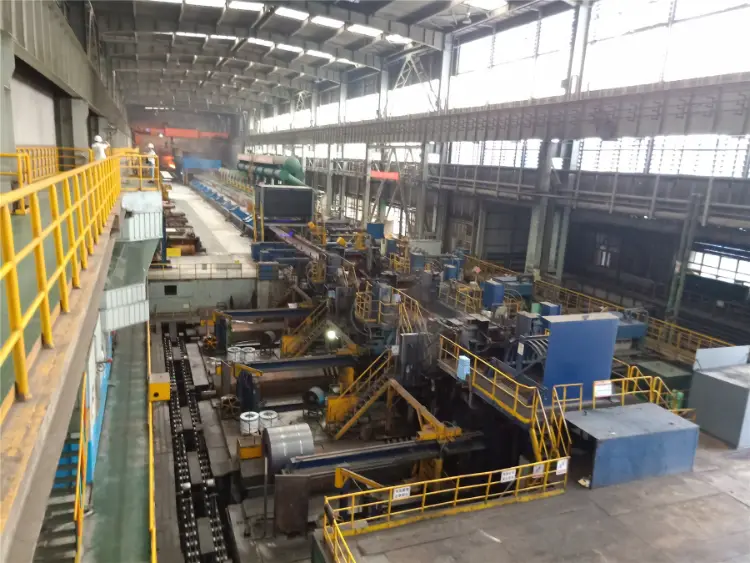
GL F420 Shipbuilding Steel Coil
GL F420 Shipbuilding Steel Coil: High-Strength Plate for Polar & Offshore Structures
Detailed material data for GL F420 shipbuilding steel coil certified by Germanischer Lloyd (now DNV GL). Includes chemical composition, mechanical and thermal properties, international equivalents, and application guidance for marine and offshore engineering.
Hot rolling, normalizing, thermomechanical controlled processing (TMCP), quenching and tempering (depending on thickness and specific requirements)
- Phone : +8618037372205
- Email : [email protected]
- WhatsApp: Contact via Whtsapp
- WeChat: +8618037372205
GL F420 Shipbuilding Steel Coil Introduction
GL F420 is a high-strength structural steel grade specially developed for shipbuilding and offshore applications, certified under the rules of Germanischer Lloyd (now part of DNV GL). It belongs to the family of F-grade steels designed for service temperatures as low as -60 °C, offering excellent notch toughness and weldability. The steel is supplied as coils, plates, or sheets, typically in thicknesses up to 100 mm.
Key characteristics include:
- Minimum yield strength of 420 MPa in the as-delivered condition (depending on thickness)
- Tensile strength in the range of 530–680 MPa
- Guaranteed Charpy V‑notch impact energy at -60 °C
- Controlled chemical composition with low carbon equivalent to ensure good weldability
- Suitable for heavy-load structural components, polar-class vessels, and offshore platforms
GL F420 Shipbuilding Steel Coil Chemical Composition
The chemical composition is specified according to GL rules to ensure adequate strength, toughness, and weldability for low‑temperature service. Typical ladle analysis limits are given below. Microalloying elements such as niobium, vanadium, and titanium are used for grain refinement and precipitation strengthening. The carbon equivalent value is controlled to avoid cold cracking during welding.
| Element | Specified Value (max unless range) | Remarks |
|---|---|---|
| C | ≤0.20 | Ladle analysis |
| Si | ≤0.55 | |
| Mn | 1.00 – 1.60 | |
| P | ≤0.025 | |
| S | ≤0.025 | |
| Al (total) | ≥0.015 | Grain refining |
| Nb | ≤0.05 | Microalloy |
| V | ≤0.10 | |
| Ti | ≤0.02 | |
| Cu | ≤0.35 | |
| Cr | ≤0.20 | |
| Ni | ≤0.40 | |
| Mo | ≤0.08 | |
| N | ≤0.012 |
GL F420 Shipbuilding Steel Coil Thermal and Electrical Physical Properties
The physical properties listed below are typical for fine‑grained structural steels of the F420 type at room temperature unless otherwise indicated. These values are for general design purposes and may vary slightly depending on exact composition and heat treatment condition. They are not mandatory in the classification rules but are widely accepted reference data for heat transfer, strength‑of‑materials, and electrical engineering calculations.
| Property | Typical Value | Unit | Test Condition / Remarks |
|---|---|---|---|
| Density (ρ) | 7850 | kg/m³ | At 20 °C |
| Modulus of elasticity (E) | 207 | GPa | At 20 °C, tensile |
| Shear modulus (G) | 80 | GPa | Calculated from E and ν |
| Poisson's ratio (ν) | 0.30 | — | Elastic range |
| Thermal expansion coefficient (α) | 11.5 × 10⁻⁶ | K⁻¹ | 20 – 100 °C |
| Thermal expansion coefficient (α) | 12.5 × 10⁻⁶ | K⁻¹ | 20 – 200 °C |
| Thermal expansion coefficient (α) | 13.5 × 10⁻⁶ | K⁻¹ | 20 – 400 °C |
| Thermal conductivity (λ) | ~50 | W/(m·K) | At 20 °C |
| Specific heat capacity (cₚ) | ~460 | J/(kg·K) | At 20 °C |
| Electrical resistivity (ρ_e) | ~0.20 | µΩ·m | At 20 °C |
GL F420 Shipbuilding Steel Coil Mechanical Properties
Mechanical properties are determined on test specimens taken in the transverse direction (or longitudinal for some products). The values depend on the product thickness. Charpy V‑notch impact tests are performed at -60 °C for F-grade. Bending test is required with the mandrel diameter dependent on thickness and steel grade. The table shows the minimum requirements according to GL rules for a typical thickness range.
| Property | Specified Value | Unit | Test Condition / Remarks |
|---|---|---|---|
| Yield strength (ReH) | ≥420 | MPa | Thickness ≤ 50 mm, transverse |
| Yield strength (ReH) | ≥390 | MPa | Thickness > 50 mm ≤ 100 mm |
| Tensile strength (Rm) | 530 – 680 | MPa | All thicknesses (typically ≤ 100 mm) |
| Elongation (A5) | ≥18 | % | Gauge length 5.65√S₀, thickness ≤ 50 mm |
| Elongation (A5) | ≥17 | % | Thickness > 50 mm ≤ 100 mm |
| Charpy impact energy (KV) | ≥31 (transverse) | J | Test temperature -60 °C, V‑notch, three specimens average |
| Charpy impact energy (KV) | ≥22 (single min.) | J | Single specimen, -60 °C |
| Bending test (180°) | Mandrel diameter: 3a (t ≤ 50 mm), 4a (t > 50 mm) | a = specimen thickness; no cracks allowed |
GL F420 Shipbuilding Steel Coil Globally Equivalent Material Standards & Replacement Grades
| Country / Region | Standard / Class Society | Grade | Remarks |
|---|---|---|---|
| Norway / International | DNV (Det Norske Veritas) | F420 | Identical strength and low‑temperature requirements |
| USA | ABS (American Bureau of Shipping) | FQ70 | Same yield strength class; toughness for -60 °C service |
| France | BV (Bureau Veritas) | F420 | Direct equivalent under BV Rules |
| China | CCS (China Classification Society) | F420 | Identical chemical and mechanical requirements |
| United Kingdom | LR (Lloyd's Register) | F420 | Same designation under LR Rules |
| Japan | NK (Nippon Kaiji Kyokai) | F420 | Equivalent grade for low‑temperature marine use |
| Italy | RINA (Registro Italiano Navale) | F420 | Directly corresponding grade |
| South Korea | KR (Korean Register) | F420 | Equivalent classification and properties |
GL F420 Shipbuilding Steel Coil Application Introduction
GL F420 steel is engineered for critical marine and offshore structures that demand high strength, excellent low‑temperature toughness, and reliable weldability. It is particularly suitable for thicknesses up to approximately 100 mm. The material can be readily formed, cut, and welded using conventional shipyard processes, provided that appropriate preheating and heat input controls are observed. Post‑weld heat treatment is generally not required for this grade when using standard welding consumables.
Typical uses span from large ocean‑going vessels to fixed and floating offshore installations. The combination of strength and sub‑zero Charpy performance makes it a preferred choice for polar‑class ships and ice‑reinforced structures.
Product Applications: Hull shell plates and stiffeners, Ice belt and structural members of ice‑class vessels, Deck plating of large container ships and bulk carriers, Jacket legs and bracing for offshore platforms, Caissons and suction anchors, Transition pieces for wind turbine monopiles, Heavy‑lift crane booms and offshore crane pedestals
Processed into products: Longitudinal stiffeners and transverse frames, Bulkhead plating, Hatch coamings and corner brackets, Skeg and rudder horn structures, Truss nodes and tubular joints for offshore jackets, Lifting padeyes and tension bars
Application industries: Shipbuilding (merchant, naval, specialized vessels), Offshore oil and gas (platforms, FPSO modules), Renewable energy (offshore wind turbine foundations), Heavy engineering (cranes, bridges, pressure vessels – upon additional approval), Arctic and cold climate infrastructure
GL F420 Shipbuilding Steel Coil Near‑Equivalent or Similar Performance Materials
| Country / Region | Standard / Class Society | Grade | Remarks |
|---|---|---|---|
| European Union | EN 10025‑4 | S420ML / S420MLO | Thermomechanical rolled structural steel with minimum 420 MPa yield; -50 °C toughness; used in offshore structures but not specifically classified for ship hulls. |
| China | GB/T 1591 | Q420E | High‑strength low‑alloy steel with 420 MPa yield; -40 °C impact energy requirement; can be considered for general structural purposes but not directly substitutable without classification society approval. |
| USA | ASTM A572 / A709 | Grade 60 / 60W | Minimum 415 MPa yield; for bridges and buildings; typically not approved for ship construction without additional certification. |
| International | API 2W / 2Y | Grade 60 | Offshore structural steel plates; similar strength but toughness and certification according to API; may substitute in some offshore fixed platform applications. |
Notes:
Additional remarks:
- All data are based on the GL Rules (edition 2016) for F420 steel; current DNV GL unified rules may have slight deviations – consult the latest release.
- The steel must be produced by an approved manufacturer and subject to inspection by the classification society surveyor.
- Typical delivery tolerances comply with EN 10029 for plates and EN 10051 for coils/strips.
- Welding consumables should be selected to match the base material strength and low‑temperature toughness; preheating recommendations depend on carbon equivalent and thickness.
- This grade can be supplied with additional certifications for offshore service (e.g., NACE MR0175 for sour service upon special agreement, but not standard).
- Share



