
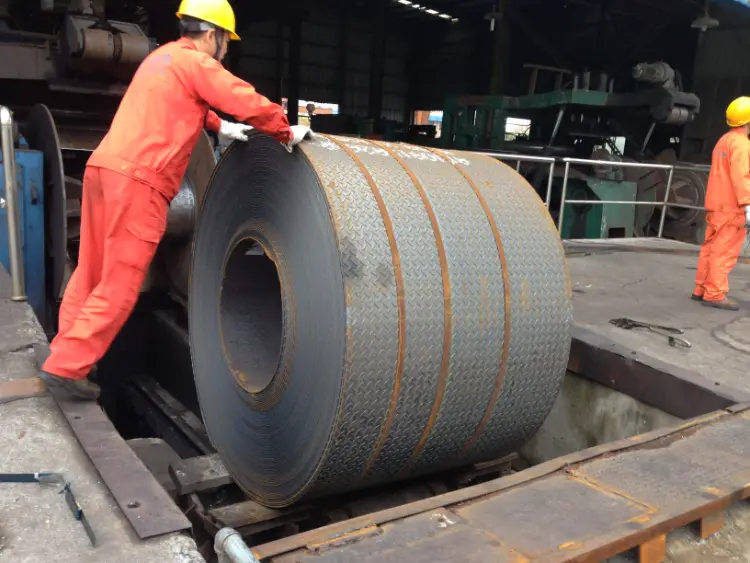
GL E420 Shipbuilding Steel Coil
GL E420 Shipbuilding Steel Coil - High Strength Hull Structural Steel for Marine Applications
Comprehensive material data for GL E420 shipbuilding steel coil: chemical composition, mechanical properties, thermal and electrical properties, equivalent grades, and application guidance.
Thermomechanical control process (TMCP), normalizing (N), quenching and tempering (QT), welding, cutting, forming, machining
- Phone : +8618037372205
- Email : [email protected]
- WhatsApp: Contact via Whtsapp
- WeChat: +8618037372205
GL E420 Shipbuilding Steel Coil Introduction
GL E420 is a high-strength low-alloy shipbuilding steel grade certified by DNV GL (formerly Germanischer Lloyd). It is designed for critical hull structural components requiring a minimum yield strength of 420 MPa and excellent low-temperature toughness. Typically supplied in the thermomechanical control process (TMCP) or normalized condition as coils or plates, it offers a good balance of strength, ductility, and weldability.
- Yield strength ≥ 420 MPa for thicknesses up to 50 mm
- Excellent impact toughness at -40°C (E-grade designation)
- Controlled carbon equivalent value for improved welding performance
- Complies with IACS UR W11 unified requirements for hull steels
- Widely used in construction of large container ships, bulk carriers, offshore platforms, and marine structures
GL E420 Shipbuilding Steel Coil Chemical Composition
The chemical composition of GL E420 conforms to IACS UR W11 for EH420 high-strength hull structural steel. Maximum limits are indicated unless a range is given. Microalloying elements such as niobium, vanadium, and titanium are added to achieve the required strength and toughness without excessive carbon content. The carbon equivalent (CEV) is limited to ensure good weldability.
- Values are typical for ladle analysis from DNV GL rules.
- Some elements have both minimum and maximum specified limits.
| Element | Standard Value (max, or range) | Remarks |
|---|---|---|
| C (Carbon) | ≤0.18 | Carbon equivalent control applies |
| Mn (Manganese) | 0.90 – 1.60 | Higher Mn for strength and toughness |
| Si (Silicon) | ≤0.50 | Deoxidizer, improves strength |
| P (Phosphorus) | ≤0.035 | Low P for toughness |
| S (Sulfur) | ≤0.035 | Low S for shape control and ductility |
| Al (Aluminium, acid soluble) | ≥0.015 min | Fine grain practice |
| Nb (Niobium) | 0.02 – 0.05 | Microalloy for grain refinement |
| V (Vanadium) | 0.05 – 0.10 | Precipitation strengthening |
| Ti (Titanium) | ≤0.02 | Grain refinement, controlled to avoid weld cracking |
| Cu (Copper) | ≤0.35 | Residual element |
| Cr (Chromium) | ≤0.20 | Improves hardenability |
| Ni (Nickel) | ≤0.40 | Improves toughness at low temperature |
| Mo (Molybdenum) | ≤0.08 | Increases strength |
| N (Nitrogen) | ≤0.009 | Limited to avoid strain aging |
| CEV (Carbon Equivalent) | ≤0.40 (TMCP) / ≤0.43 (N) | CEV = C+Mn/6+(Cr+Mo+V)/5+(Ni+Cu)/15 |
GL E420 Shipbuilding Steel Coil Thermal and Electrical Physical Properties
The following thermal and electrical properties are representative of low-alloy structural steels similar to EH420. These values are not specified in classification society rules but are based on typical data for 0.18% C, 1.5% Mn microalloyed steel at room temperature. They can be used for design calculations.
- Values may vary slightly with specific chemical composition and heat treatment.
| Property | Typical Value | Unit | Condition / Temperature |
|---|---|---|---|
| Density (ρ) | 7850 | kg/m³ | At 20°C |
| Elastic modulus (E) | 210 | GPa | At 20°C |
| Shear modulus (G) | 80 | GPa | At 20°C |
| Poisson's ratio (ν) | 0.3 | - | At 20°C |
| Thermal expansion coefficient (α) | 12.0 | 10⁻⁶/K | 20 – 100°C |
| Thermal conductivity (λ) | 50 | W/(m·K) | At 20°C |
| Specific heat capacity | 460 | J/(kg·K) | At 20°C |
| Electrical resistivity (ρ_e) | 0.15 – 0.25 | μΩ·m | At 20°C |
GL E420 Shipbuilding Steel Coil Mechanical Properties
Mechanical properties are specified per DNV GL rules for EH420 steel. Values depend on product thickness and delivery condition. Transverse impact energies are given for specimens at -40°C (E grade). Elongation is measured on a gauge length of 5.65√S₀.
- Typical values for normalized or TMCP condition.
- Yield strength may vary with thickness.
| Property | Standard Requirement | Unit | Test Condition / Thickness |
|---|---|---|---|
| Yield Strength (ReH) | ≥420 | MPa | Thickness ≤50 mm |
| Tensile Strength (Rm) | 530 – 680 | MPa | All thicknesses |
| Elongation (A5) | ≥18 | % | Thickness ≤50 mm; gauge length 5.65√S₀ |
| Impact absorbed energy (KV, transverse) | ≥34 | J | At -40°C (E grade) |
| Bend test (180°), d=3t | No cracks | - | For thickness ≤50 mm |
| Bend test (180°), d=4t | No cracks | - | For thickness 50 < t ≤80 mm |
GL E420 Shipbuilding Steel Coil Complete Equivalent Material Standards and Replaceable Grades
GL E420 is fully equivalent to EH420 grades under various classification societies and to the unified IACS EH420 grade. The following table lists international equivalents that can be substituted without additional qualification, subject to the same thickness and delivery condition. All comply with IACS UR W11.
| Country / Region | Standard / Classification Society | Grade | Remarks |
|---|---|---|---|
| International | IACS UR W11 | EH420 | Unified requirement for high strength hull structural steel |
| USA | ABS (American Bureau of Shipping) | EH420 | Part 2, Chapter 1 |
| UK | LR (Lloyd's Register) | EH420 | Rules for the Manufacture, Testing and Certification of Materials |
| France | BV (Bureau Veritas) | EH420 | NR216 Materials and Welding |
| Norway/Germany | DNV (DNV GL now) | EH420 | DNV-OS-B101 or current rule set |
| China | CCS (China Classification Society) | EH420 | Rules for Materials and Welding |
| Japan | NK (Nippon Kaiji Kyokai) | EH420 | Rules for the Survey and Construction of Steel Ships |
| South Korea | KR (Korean Register) | EH420 | Rules for the Classification of Steel Ships |
| Italy | RINA (Registro Italiano Navale) | EH420 | Rules for the Classification of Ships |
GL E420 Shipbuilding Steel Coil Application Introduction
GL E420 shipbuilding steel coils are primarily employed in the marine and offshore industries where high strength, excellent toughness, and good weldability are crucial. The material is suitable for both sea- and river-going vessels and can be processed into a variety of structural components. Typical applications include:
- Longitudinal and transverse hull stiffening
- Deck and bottom plates in high-stress areas
- Offshore platform topsides and jacket structures
- Cargo hold frames and bulkheads
- Bridges, hatches, and crane pedestals
Product Applications: Container ships, Bulk carriers, Tankers (oil, chemical), Offshore platforms (Jack-up, semi-submersible), FPSO modules, Barges and dredgers, Naval auxiliary vessels
Processed into products: Hull plating (shell, deck, bottom), Longitudinal and transverse stiffeners (flat bars, bulb profiles, angles), Bulkhead panels, Girder webs and flanges, Cargo hold frames, Hatch coamings and covers, Deck beams, Offshore wind turbine transition pieces, Crane pedestals
Application industries: Shipbuilding, Offshore Oil and Gas, Marine Engineering, Harbor and Ocean Structures, Renewable Energy (Offshore Wind)
GL E420 Shipbuilding Steel Coil Approximate/Similar Alternative Material Recommendations
These materials are not direct equivalents but share a similar 420 MPa minimum yield strength and are used in heavy structures. They may require supplementary testing or specific agreements for substitution in shipbuilding applications.
| Country / Region | Standard | Grade | Remarks |
|---|---|---|---|
| Europe | EN 10025-4 | S420ML / S420N | Thermomechanical rolled or normalized structural steels; similar strength, different toughness requirements |
| China | GB/T 1591 | Q420E / Q420D | High-strength low-alloy structural steel; impact energy at -40°C (E) or -20°C (D) |
| USA | ASTM A572 / A709 | Grade 65 | High-strength low-alloy structural steel; yield 450 MPa (65 ksi) min, not exactly 420 MPa |
| International | API 2H Grade 50 | 2H Grade 50 | Offshore structural steel plates; yield 345-414 MPa (50 ksi), close but lower yield strength |
Notes:
- Carbon equivalent (CE) limits depend on delivery condition: typically ≤0.40% for TMCP and ≤0.43% for normalized (N) condition for thickness ≤50 mm.
- Preheating may be required for welding sections above a certain thickness or at low ambient temperatures to avoid hydrogen cracking.
- When ordering, the exact delivery condition (N, TMCP, QT), surface quality, and any supplementary requirements (e.g., ultrasonic testing, through-thickness properties) must be specified.
- Third-party inspection and certification by DNV GL is normally required.
- Share



