
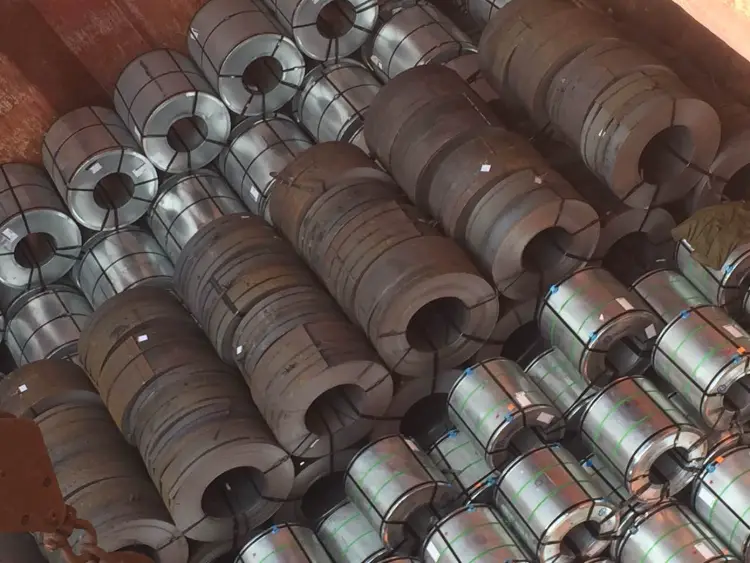
GL D420 Shipbuilding Steel Coil
GL D420 Shipbuilding Steel Coil - Extra High Strength Marine Steel for Hull Structures
Comprehensive material data for GL D420 shipbuilding steel coil per Germanischer Lloyd rules, including chemical composition, mechanical properties, thermal properties, and international equivalents.
Thermo-mechanical rolling (TMCP), normalizing, quenching & tempering; suitable for welding, cutting, forming, and bending
- Phone : +8618037372205
- Email : [email protected]
- WhatsApp: Contact via Whtsapp
- WeChat: +8618037372205
GL D420 Shipbuilding Steel Coil Introduction
GL D420 is an extra high strength shipbuilding steel coil grade originally specified under Germanischer Lloyd (GL) rules, now integrated into the DNV family of standards. It features a minimum yield strength of 420 MPa and is designed for critical structural applications in ship hulls and offshore units. The 'D' designation indicates an impact toughness test temperature of -20°C, ensuring reliable performance in cold environments. The steel is thermo-mechanically controlled processed (TMCP) or normalized to achieve a fine-grained microstructure with excellent weldability and ductility. Key attributes include:
- High strength-to-weight ratio enabling lighter constructions
- Good low-temperature toughness
- Excellent weldability without excessive preheating
- Strict control of harmful elements (S, P) for improved cleanness
GL D420 Shipbuilding Steel Coil Chemical Composition
Chemical composition limits as specified in IACS UR W31 (incorporating GL requirements) for extra high strength grade DH420 / D420. Values are maximum unless a range is given. Microalloying elements Nb, V, Ti are added singly or in combination for grain refinement and precipitation strengthening. Carbon equivalent (CEV) is controlled to ensure weldability.
| Chemical Element | Standard Value (wt%) | Remarks |
|---|---|---|
| Carbon (C) | ≤0.20 | Max |
| Manganese (Mn) | 0.90 - 1.60 | Range |
| Silicon (Si) | ≤0.55 | Max |
| Phosphorus (P) | ≤0.025 | Max |
| Sulfur (S) | ≤0.025 | Max |
| Chromium (Cr) | ≤0.30 | Max |
| Nickel (Ni) | ≤0.40 | Max |
| Molybdenum (Mo) | ≤0.08 | Max |
| Copper (Cu) | ≤0.35 | Max |
| Aluminium (Al total) | ≥0.015 | Min, acid soluble |
| Nitrogen (N) | ≤0.012 | Max |
| Niobium (Nb) | ≤0.05 | Max, microalloy |
| Vanadium (V) | ≤0.10 | Max, microalloy |
| Titanium (Ti) | ≤0.02 | Max, microalloy |
| Carbon Equivalent (CEV) | ≤0.43 - 0.45 | Depending on thickness, see standard |
GL D420 Shipbuilding Steel Coil Thermal and Electrical Physical Properties
The following values are typical for low-carbon microalloyed structural steel of this strength level and are provided for design purposes. Slight variations may occur depending on exact composition and heat treatment condition. Thermal conductivity decreases moderately with increasing temperature.
| Property | Typical Value | Unit | Test Condition |
|---|---|---|---|
| Density (ρ) | 7850 | kg/m³ | At 20°C |
| Elastic Modulus (E) | 210 | GPa | At 20°C |
| Shear Modulus (G) | 80 | GPa | At 20°C |
| Poisson's Ratio (ν) | 0.30 | - | At 20°C |
| Thermal Expansion Coefficient (α) | 12.0 × 10⁻⁶ | 1/K | 20 – 100°C |
| Thermal Conductivity (λ) | 50 | W/(m·K) | At 20°C |
| Specific Heat Capacity (c) | 460 | J/(kg·K) | At 20°C |
| Electrical Resistivity (ρe) | 0.20 | µΩ·m | At 20°C |
GL D420 Shipbuilding Steel Coil Mechanical Properties
Minimum mechanical property requirements for D420 shipbuilding steel coil in delivery condition (TMCP or N) according to IACS UR W31 / GL rules. Tests are performed on flat specimens taken transverse to the rolling direction. Impact energy values are longitudinal (minimum average) for the D-quality level (-20°C). For thickness over 100 mm, slight reductions in yield strength may apply.
| Property | Standard Value | Unit | Test Condition / Remarks |
|---|---|---|---|
| Yield Strength (ReH) | ≥420 | MPa | Upper yield, thickness ≤100 mm |
| Tensile Strength (Rm) | 530 - 680 | MPa | Tensile test transverse |
| Elongation (A5) | ≥18 | % | Gauge length 5.65√S₀, thickness ≤100 mm |
| Charpy V-notch Impact Energy (KV2) | ≥41 | J | Longitudinal, average of 3 tests, at -20°C |
| Charpy V-notch Impact Energy (KV2) | ≥27 | J | Transverse, average of 3 tests, at -20°C |
| Bend Test (180°) | No cracks | - | Bend diameter 3t (t = specimen thickness) |
GL D420 Shipbuilding Steel Coil Exact Equivalent Material Standards and Replaceable Grades
| Country / Region | Standard / Classification Society | Grade | Remarks |
|---|---|---|---|
| International | IACS UR W31 | DH420 | Direct equivalent, D-quality (-20°C), 420 MPa yield |
| Germany / Norway | DNV GL (now DNV) | D420 (NV D420) | Same as GL D420 after merger |
| USA | ABS | DH420 | Equivalent high strength grade |
| France | BV | DH420 | Equivalent high strength grade |
| UK | LR | DH420 | Equivalent high strength grade |
| Japan | NK | KDH420 | Equivalent high strength grade |
| South Korea | KR | RDH420 | Equivalent high strength grade |
| China | CCS | DH420 | Equivalent high strength grade |
| Italy | RINA | DH420 | Equivalent high strength grade |
| Russia | RMRS | DH420 | Equivalent high strength grade |
GL D420 Shipbuilding Steel Coil Application Introduction
GL D420 steel coil is engineered for the most demanding marine structural applications where weight savings, high strength, and reliable low-temperature toughness are essential. It is used throughout the ship's hull envelope and in critical offshore structural components. The following lists typical industries, products and specific components.
Product Applications: Ship hull plates (deck, bottom, side shell), Longitudinal and transverse stiffeners, Bulkheads and superstructure elements, Offshore platform decks and legs, Pressure hulls for submarines and submersibles
Processed into products: Ship frames and stringers, Bilge keels and rudder horns, Keel plates and stern frames, Hatch coamings and container cell guides, Mooring brackets and foundation plates, Heavy-lift crane pedestals, Jack-up rig legs and spudcans, Transition pieces for wind turbine monopiles
Application industries: Shipbuilding (commercial and naval vessels), Offshore oil & gas (platforms, FPSOs, subsea structures), Marine engineering (docks, cranes, heavy lifting equipment), Polar class vessel construction (icebreakers, Arctic cargo ships), Renewable energy (wind turbine foundations, offshore substations)
GL D420 Shipbuilding Steel Coil Similar/Alternative Materials with Comparable Performance
| Country / Region | Standard | Grade | Remarks |
|---|---|---|---|
| International | IACS UR W31 | DH40 | Yield ≥390 MPa, slightly lower strength, may be substitute if design allows |
| International | IACS UR W31 | EH420 | -40°C impact grade, superior toughness, fully interchangeable with D420 |
| EU | EN 10025-4 | S460M/ML | Thermo-mechanically rolled fine-grain structural steel, min yield 460 MPa, may be used with thickness/design adjustments |
| USA | ASTM A131 / A131M | DH40 | Lower strength (390 MPa) alternative for less critical areas |
| International | API | 2W Grade 50 | Offshore structural steel, yield 345-414 MPa, close in strength but different application standard |
Notes:
Welding considerations: D420 has good weldability but a low-hydrogen process is recommended due to the alloy content. Preheating may be required for thick sections (>30 mm) to avoid cold cracking; typically 50–150°C depending on thickness and carbon equivalent. Forming: Cold forming induces work hardening; hot forming should be followed by controlled cooling to preserve mechanical properties. Certification: Material is supplied with classification society certificates (3.1 or 3.2 per EN 10204) as required by the classification rules. Corrosion protection: Normal marine corrosion protection (coatings, cathodic protection) applies.
- Share



