
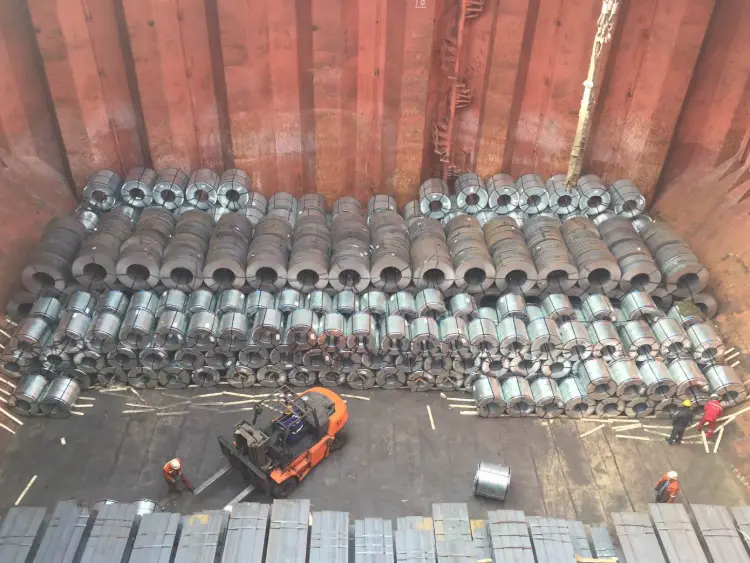
GL A420 Shipbuilding Steel Coil
GL A420 Shipbuilding Steel Coil: High Strength Maritime Grade for Hull and Offshore Structures
GL A420 is a high-tensile shipbuilding steel coil certified by Germanischer Lloyd, offering minimum yield strength of 420 MPa for robust hull and marine construction.
Hot rolling, cold forming, welding, bending, cutting
- Phone : +8618037372205
- Email : [email protected]
- WhatsApp: Contact via Whtsapp
- WeChat: +8618037372205
GL A420 Shipbuilding Steel Coil Introduction
GL A420 shipbuilding steel coil is a high-strength, low-alloy structural steel specifically designed for marine applications and certified by Germanischer Lloyd (GL), now part of DNV GL. It belongs to the higher-strength group of hull structural steels, providing a minimum yield strength of 420 MPa. The steel exhibits excellent weldability, good toughness at low temperatures, and superior resistance to brittle fracture, making it suitable for critical structural components in shipbuilding and offshore engineering. The coil form allows efficient processing and forming for large structures.
GL A420 Shipbuilding Steel Coil Chemical Composition
The chemical composition of GL A420 steel is controlled to ensure high strength combined with good weldability and toughness. The maximum carbon equivalent (CEV) is typically limited to 0.40% to guarantee field weldability. Microalloying elements such as Nb, V, or Ti are commonly added for grain refinement and precipitation strengthening.
| Element | Standard Value (max %) | Remarks |
|---|---|---|
| Carbon (C) | 0.20 | Ladle analysis; for thickness ≤ 100 mm |
| Silicon (Si) | 0.10 - 0.50 | Killed steel |
| Manganese (Mn) | 0.90 - 1.60 | Higher range for thicker gauges |
| Phosphorus (P) | 0.025 | Maximum |
| Sulfur (S) | 0.025 | Maximum |
| Aluminum (Al) acid soluble | ≥ 0.015 | Minimum required for fine grain practice |
| Niobium (Nb) | 0.02 - 0.05 | Optional microalloy, according to manufacturer |
| Vanadium (V) | 0.05 - 0.10 | Optional microalloy, depending on thickness |
| Titanium (Ti) | ≤ 0.02 | Optional; if added to meet impact properties |
| Copper (Cu) | ≤ 0.35 | Maximum; may be limited for forming |
| Chromium (Cr) | ≤ 0.20 | Residual element |
| Nickel (Ni) | ≤ 0.40 | Residual element |
| Molybdenum (Mo) | ≤ 0.08 | Residual element |
| Nitrogen (N) | ≤ 0.009 | If not fixed by Al or other binders |
| Carbon Equivalent (CE) | ≤ 0.40 | Typically CE = C + Mn/6 + (Cr+Mo+V)/5 + (Ni+Cu)/15 |
GL A420 Shipbuilding Steel Coil Physical Properties
Physical properties are typical for high-strength low-alloy steels and may vary slightly depending on the exact chemical composition and heat treatment condition. Thermal expansion and conductivity values are essential for design calculations involving temperature gradients.
| Property | Typical Value | Unit | Condition/Remarks |
|---|---|---|---|
| Density (ρ) | 7850 | kg/m³ | Room temperature |
| Elastic Modulus (E) | 205 | GPa | At 20°C |
| Shear Modulus (G) | 80 | GPa | Calculated from E and ν (ν=0.3) |
| Poisson's Ratio (ν) | 0.3 | — | Typical for steel |
| Thermal Expansion Coefficient (α) | 11.5 | 10⁻⁶/K | Between 20°C and 100°C |
| Thermal Expansion Coefficient (α) | 12.5 | 10⁻⁶/K | Between 20°C and 300°C |
| Thermal Conductivity (λ) | 45 | W/(m·K) | At 20°C, typical for carbon-manganese steels |
| Specific Heat Capacity (c) | 460 | J/(kg·K) | Room temperature |
| Electrical Resistivity (ρ_e) | 0.25 | μΩ·m | At ambient temperature |
GL A420 Shipbuilding Steel Coil Mechanical Properties
Mechanical properties of GL A420 are verified by tensile and impact testing on normalized or TMCP processed specimens. Minimum yield strength is guaranteed at room temperature. Impact energy requirements depend on thickness and test temperature, which is typically 0°C for grade A420. The elongation is measured over a gauge length of 5.65√So.
| Property | Standard Requirement | Unit | Test Condition |
|---|---|---|---|
| Yield Strength (ReH) | ≥ 420 | MPa | Tensile test, transverse direction, ambient temperature; for t ≤ 100 mm |
| Tensile Strength (Rm) | 530 - 680 | MPa | For thickness up to 100 mm |
| Elongation (A5) | ≥ 18 | % | Gauge length 5.65√So, transverse specimen |
| Charpy Impact Energy (KV) | ≥ 27 (average) | J | Test temperature 0°C, longitudinal for thickness ≤ 50 mm |
| Charpy Impact Energy (KV) | ≥ 20 (single min) | J | Test temperature 0°C |
| Bend Test (bend diameter) | 3t | — | 180° bend test, t = specimen thickness, no cracks |
| Through-thickness reduction of area (Z) | Not specified in standard; optional testing under GL rules | % | If required for Z-quality, min 15% Z15 or 25% Z25 |
GL A420 Shipbuilding Steel Coil Completely Equivalent Grades and Standards for Substitution
| Country/Region | Standard | Grade | Remarks |
|---|---|---|---|
| International | ABS Rules | AH420 | American Bureau of Shipping; identical strength and impact class (0°C) |
| International | DNV GL Rules | VL A420 | DNV and GL merged; identical product specification |
| International | BV Rules | A420 | Bureau Veritas; matching grade |
| International | LR Rules | AH420 | Lloyd's Register; identical requirements |
| International | NK Rules | KA420 | Nippon Kaiji Kyokai; Class K is equivalent to impact at 0°C |
| International | RINA Rules | A420 | Registro Italiano Navale |
| China | CCS Rules | A420 | China Classification Society; fully equivalent |
GL A420 Shipbuilding Steel Coil Application Introduction
GL A420 steel coil is predominantly used in shipbuilding and offshore engineering where high strength, excellent weldability, and reliable toughness at low temperatures are mandatory. The coil form is efficient for continuous production processes like ship panel lines, longitudinal stiffeners, and large structural modules. It can be processed by cutting, bending, and welding, and is often used in normalized or TMCP condition without the need for post-weld heat treatment in many cases.
Product Applications: Hull plates and stiffeners, Deck plating and hatch coamings, Bulkheads and transverse frames, Bottom and side shell panels, Topside modules and helideck structures, Pressure hulls for submersibles (subject to additional qualification), Heavy-duty marine pipes and columns
Processed into products: Longitudinal and transverse frames, Web frames and stringers, Deck beams and girders, Bilge keels and rubbing strakes, Superstructure columns, Foundation plates for engines and thrusters, Lifting pads and padeyes
Application industries: Shipbuilding (commercial vessels, naval ships, mega-yachts), Offshore engineering (platform topsides, jackets, floating production units), Marine container manufacturing, Polar class vessel construction (combined with higher toughness grades), Heavy structural steel for cranes and lifting equipment in marine terminals
GL A420 Shipbuilding Steel Coil Similar/Alternative Material Recommendations
| Country/Region | Standard | Grade | Remarks |
|---|---|---|---|
| International | DNV GL | A460 | Higher strength grade (min ReH 460 MPa); same impact temperature, slightly different chemistry |
| International | ABS | DH420 | Higher toughness at -20°C; slightly more expensive; for colder operating conditions |
| International | API | 2H Grade 50 | Offshore structural steel, min yield 345-414 MPa, but often used in marine structures; not direct substitute |
| International | EN 10025-4 | S420ML | Thermo-mechanically rolled structural steel for buildings/bridges; similar strength but not maritime certified |
| Japan | JIS | SM490A | Common structural steel (490 N/mm²), not classed; similar weldability, different certification |
Notes:
Typical delivery condition: TMCP (Thermo-Mechanically Controlled Process) for optimal combination of strength and toughness. The material should be ordered in accordance with GL Rules Part 1, Chapter 2. Additional testing may be required for through-thickness properties (Z-quality), higher impact testing (DH420 or EH420 for lower temperatures), or specific corrosion protection measures. Weldability is ensured with a CEV limit; preheating is normally not required for thicknesses under 30 mm when using low-hydrogen processes. Fabrication should follow GL approved welding procedures. The coil form is provided with a maximum width and thickness range per mill capability; typical thickness 6-50 mm.
- Share



