
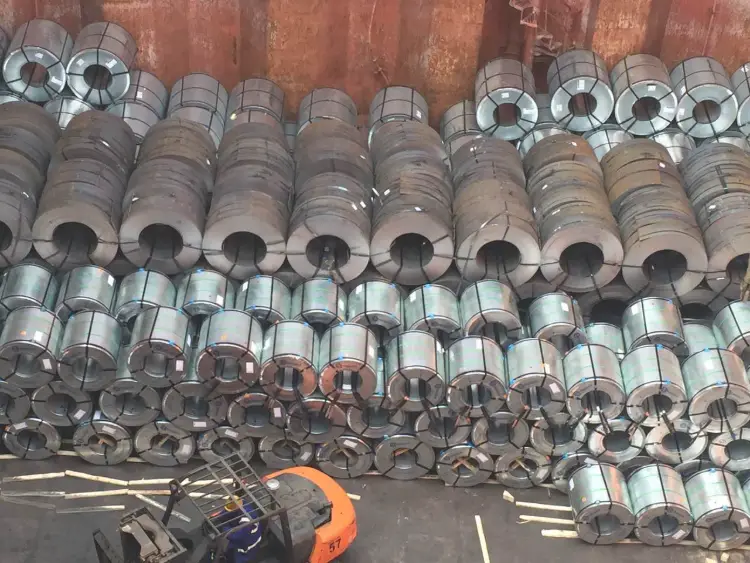
GL F40 Shipbuilding Steel Coil
GL F40 Shipbuilding Steel Coil - High-Strength Ship Plate for Arctic Class Vessels
Detailed material data for GL F40 shipbuilding steel coil: chemical composition, mechanical properties, physical performance, international equivalents, and application guide according to GL-Rules.
Hot Rolling, TMCP (Thermo-Mechanical Controlled Process), Normalizing, Quenching and Tempering (if agreed)
- Phone : +8618037372205
- Email : [email protected]
- WhatsApp: Contact via Whtsapp
- WeChat: +8618037372205
GL F40 Shipbuilding Steel Coil Introduction
GL F40 is a high-strength shipbuilding structural steel grade under the former Germanischer Lloyd (GL) classification rules. It belongs to the enhanced strength group with a minimum yield strength of 390 MPa and is designed for critical cold-climate applications, requiring impact toughness at -60 °C. The steel is typically delivered as thermo-mechanically controlled processed (TMCP) or normalized coils and plates. GL F40 offers an excellent combination of high strength, excellent weldability, and low‑temperature toughness, making it suitable for hull structures of ice‑class vessels, offshore platforms, and other marine engineering components. Compared to lower strength grades like A, D, or AH36, GL F40 allows weight reduction while maintaining safety and fatigue resistance. The grade is now covered by the unified DNV GL rules and fully equivalent to other IACS member classification grades FH40.
GL F40 Shipbuilding Steel Coil Chemical Composition
The chemical composition is defined according to GL Rules for hull structural steel. Limits shown are maximum values unless a range is indicated. The steel is fully killed and fine‑grain treated with aluminum. Microalloying elements (Nb, V, Ti) are added singly or in combination to ensure strength and toughness. Carbon Equivalent (CEV) is controlled to guarantee weldability; typical CEV ≤ 0.40% for thickness ≤ 50 mm.
| Element | Value (≤, except range) | Remarks |
|---|---|---|
| C | ≤ 0.16 | Thickness ≤ 50 mm |
| Si | 0.10 – 0.50 | |
| Mn | 0.90 – 1.70 | |
| P | ≤ 0.025 | |
| S | ≤ 0.025 | |
| Als (acid soluble Al) | ≥ 0.015 | Fine‑grain practice |
| Nb | ≤ 0.05 | Optional microalloy |
| V | ≤ 0.10 | Optional microalloy |
| Ti | ≤ 0.02 | Optional microalloy |
| Cu | ≤ 0.35 | |
| Cr | ≤ 0.20 | |
| Ni | ≤ 0.40 | |
| Mo | ≤ 0.08 | |
| CEV | ≤ 0.40 (typical) | C + Mn/6 + (Cr+Mo+V)/5 + (Ni+Cu)/15 |
GL F40 Shipbuilding Steel Coil Physical Properties
The following values are representative of high‑strength low‑alloy (HSLA) structural steels similar to GL F40. They are provided for engineering calculations and are not part of the classification rule requirements. Thermal conductivity and specific heat depend on temperature; room‑temperature values are given as a baseline. The electrical resistivity is for direct current at ambient temperature and can vary slightly with alloy content and heat treatment.
| Property | Typical Value | Unit | Test Condition / Remarks |
|---|---|---|---|
| Density (ρ) | 7.85 × 10³ | kg/m³ | Room temperature |
| Modulus of elasticity (E) | 205 | GPa | Room temperature, static |
| Shear modulus (G) | 80 | GPa | Room temperature |
| Poisson's ratio (ν) | 0.30 | – | Elastic range |
| Thermal expansion (α) | 12.5 × 10⁻⁶ | K⁻¹ | 20–100 °C |
| Thermal conductivity (λ) | 51.9 | W/(m·K) | At 100 °C |
| Specific heat capacity (cp) | 486 | J/(kg·K) | Room temperature |
| Electrical resistivity (ρₑ) | 0.21 × 10⁻⁶ | Ω·m | Ambient temperature |
GL F40 Shipbuilding Steel Coil Mechanical Properties
Mechanical properties are determined on test pieces taken in the transverse direction and are valid for thicknesses up to 100 mm. Impact test specimens are taken in the longitudinal direction unless otherwise agreed. Charpy V‑notch tests are performed at −60 °C for grade F40. The minimum energy for a standard (10×10 mm) specimen is 34 J for longitudinal and 24 J for transverse orientation. Bending test through 180° with mandrel diameter d = 3a applies for thickness ≤ 25 mm; for larger thicknesses the mandrel diameter is increased.
| Property | Required Value | Unit | Test Condition / Thickness |
|---|---|---|---|
| Yield strength (ReH) | ≥ 390 | MPa | t ≤ 100 mm, transverse |
| Tensile strength (Rm) | 510 – 650 | MPa | t ≤ 100 mm, transverse |
| Elongation (A5) | ≥ 20 | % | t ≤ 50 mm, transverse |
| Elongation (A5) | ≥ 19 | % | 50 < t ≤ 100 mm, transverse |
| Charpy impact (KV2) | ≥ 34 (L) / ≥ 24 (T) | J | −60 °C, 10×10 mm specimen |
| Bend test (180°) | d = 3a | – | t ≤ 25 mm, no cracks |
| Bend test (180°) | d = 4a | – | 25 < t ≤ 50 mm |
| Bend test (180°) | d = 5a | – | 50 < t ≤ 100 mm |
GL F40 Shipbuilding Steel Coil Fully Equivalent Material Standards and Replaceable Grades
| Country / Region | Standard / Classification Society | Designation | Remarks |
|---|---|---|---|
| International | DNV GL | FH40 | Unified DNV GL rule, identical concept |
| USA | ABS | FH40 | American Bureau of Shipping |
| UK | LR | FH40 | Lloyd's Register |
| France | BV | FH40 | Bureau Veritas |
| Japan | NK (ClassNK) | FH40 | Nippon Kaiji Kyokai |
| Italy | RINA | FH40 | Registro Italiano Navale |
| China | CCS | FH40 | China Classification Society |
| Korea | KR | FH40 | Korean Register |
GL F40 Shipbuilding Steel Coil Application Introduction
GL F40 steel is specifically designed for welded ship structures operating under low ambient temperatures and high dynamic loads. The grade is widely used in the following areas:
Product Applications: Hull shell plates and stiffeners, Strength decks and bottom plating, Watertight bulkheads and tank boundaries, Ice‑strengthened regions (ice belt, bow), Heavy sub‑structures and primary structural members
Processed into products: Ship frames and longitudinal girders, Transverse web frames and brackets, Keel and stem/stern plates, Cargo hold side‑shell inserts, Offshore platform legs and bracings, Hatch coamings and corner reinforcements
Application industries: Commercial shipbuilding (container ships, bulk carriers, tankers), Naval ship construction (ice‑class vessels, patrol boats), Offshore oil and gas (jack‑up rigs, semisubmersibles, FPSO modules), Marine equipment manufacturing (crane pedestals, helicopter decks), Bridge engineering (arctic regions)
GL F40 Shipbuilding Steel Coil Similar or Substitute Material Recommendations
| Country / Region | Standard | Designation | Remarks |
|---|---|---|---|
| International | IACS | EH40 | Minimum −40 °C impact; less suitable for extreme cold |
| Europe | EN 10025-4 | S420ML/S420MLO | 420 MPa yield; similar toughness class but offshore steel |
| USA | ASTM A131 / API 2H-50 | EH40 / 2H Grade 50 | Marine and offshore structural grades with comparable strength |
| ASME | ASME SA-537 Cl.2 | SA-537 Cl.2 | Pressure vessel steel with good toughness but not ship-specific |
| Russia | GOST R 52927-2015 | F40 | Similar strength; check low‑temperature notch toughness |
Notes:
Welding and Fabrication: GL F40 exhibits good weldability with low‑hydrogen processes under suitable preheat (when required). The fine‑grain structure and low carbon equivalent minimize susceptibility to cold cracking. Post‑weld heat treatment is normally not required for thicknesses up to 100 mm in TMCP condition. Availability: Coils and cut‑to‑length plates are available in thicknesses from 6 mm to 100 mm. Custom dimensions can be supplied upon agreement. Certification: Typical delivery includes 3.1 or 3.2 inspection certificates according to EN 10204.
- Share



