
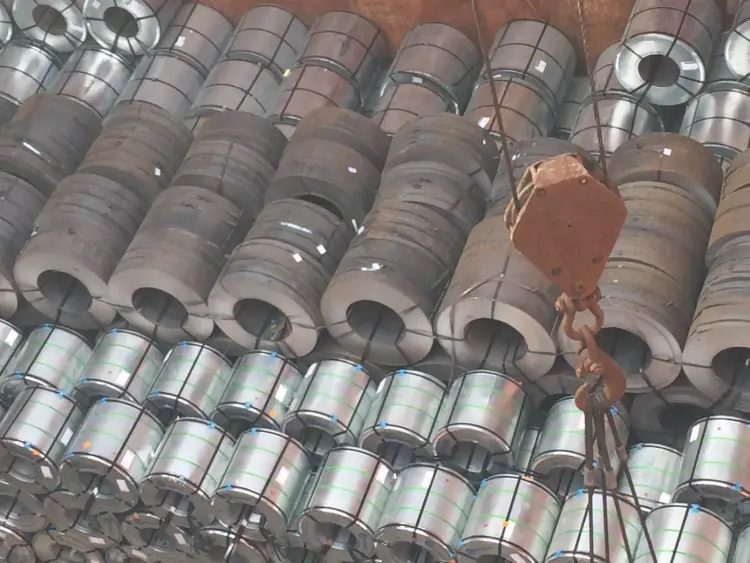
GL E40 Shipbuilding Steel Coil
GL E40 Shipbuilding Steel Coil: High-Strength Marine-Grade Material for Cold Climates
Explore the properties, composition, and equivalents of GL E40 shipbuilding steel coil, a high-strength grade designed for hull structures and offshore applications with guaranteed toughness at -40°C.
Normalized rolling (N), thermomechanical controlled rolling (TMCP), or equivalent processes as agreed with the classification society.
- Phone : +8618037372205
- Email : [email protected]
- WhatsApp: Contact via Whtsapp
- WeChat: +8618037372205
GL E40 Shipbuilding Steel Coil Introduction
GL E40 is a high-strength hull structural steel governed by the rules of Germanischer Lloyd (GL, now DNV GL/DNV).
It is designed for critical shipbuilding and offshore applications where high strength, excellent weldability, and superior low-temperature toughness are essential.
Key features:
- Minimum yield strength of 390 MPa (up to 50 mm thickness).
- Charpy V-notch impact testing at -40°C ensures reliable performance in cold marine environments.
- Supplied in normalized or thermomechanically rolled (TMCP) condition, enabling good formability and reduced preheat requirements for welding.
- Conforms to International Association of Classification Societies (IACS) Unified Requirement UR W11, ensuring global acceptance.
The steel is typically delivered as coils, plates, or profiles, and is widely used in ship hulls, decks, bulkheads, and offshore platform structures.
GL E40 Shipbuilding Steel Coil Chemical Composition
The composition conforms to IACS UR W11 for grade E40, with microalloying elements (Nb, V, Ti) to achieve strength and toughness. Heat analysis limits are typically applied.
For product analyses, slight deviations are permitted according to the applicable standard. Unless otherwise agreed, the sum of Nb + V + Ti ≤ 0.12%.
| Chemical Element | Standard Value | Remarks |
|---|---|---|
| Carbon (C) | ≤0.16 | Heat analysis |
| Silicon (Si) | 0.10 – 0.50 | Heat analysis |
| Manganese (Mn) | 0.90 – 1.60 | Heat analysis |
| Phosphorus (P) | ≤0.025 | Heat analysis |
| Sulphur (S) | ≤0.025 | Heat analysis |
| Aluminium (Al, acid-soluble) | ≥0.015 | Total Al or acid-soluble as agreed |
| Niobium (Nb) | 0.02 – 0.05 | Heat analysis |
| Vanadium (V) | 0.05 – 0.10 | Heat analysis |
| Titanium (Ti) | ≤0.02 | Heat analysis |
| Copper (Cu) | ≤0.35 | Heat analysis |
| Chromium (Cr) | ≤0.20 | Heat analysis |
| Nickel (Ni) | ≤0.40 | Heat analysis |
| Molybdenum (Mo) | ≤0.08 | Heat analysis |
| Nitrogen (N) | ≤0.012 | If sufficient aluminium or other strong nitride formers are present, higher N may be accepted |
GL E40 Shipbuilding Steel Coil Thermal and Electrical Physical Properties
These values are typical for carbon-manganese structural steels and are not directly specified in the GL material rules. They serve as general design references.
The properties are largely independent of the delivery condition and apply at ambient temperature unless stated otherwise.
| Property | Typical Value | Unit | Test Condition |
|---|---|---|---|
| Density (ρ) | 7850 | kg/m³ | 20 °C |
| Elastic modulus (E) | 205 – 210 | GPa | 20 °C |
| Shear modulus (G) | ~ 80 | GPa | 20 °C (derived) |
| Poisson's ratio (ν) | 0.29 – 0.30 | — | Elastic range, 20 °C |
| Thermal expansion coefficient (α) | 11.5 – 12.0 | ×10⁻⁶ /K | 20 – 100 °C |
| Thermal conductivity (λ) | 42 – 50 | W/(m·K) | 20 °C |
| Specific heat capacity (cp) | 460 – 480 | J/(kg·K) | 20 °C |
| Electrical resistivity (ρ_e) | 0.25 – 0.30 | μΩ·m | 20 °C |
GL E40 Shipbuilding Steel Coil Mechanical Properties
The mechanical properties apply to the as-delivered condition (N, TMCP).
Values for yield and elongation are thickness-dependent.
Impact test is performed at -40°C on Charpy V-notch specimens. Transverse test values are lower than longitudinal. Minimum single impact energy values are also specified (e.g., no individual value shall be less than 70% of the average).
| Property | Required Value | Unit | Test Condition |
|---|---|---|---|
| Yield strength (ReH) | ≥ 390 | MPa | t ≤ 50 mm; transverse or longitudinal as per standard |
| Yield strength (ReH) | ≥ 370 | MPa | 50 < t ≤ 70 mm |
| Yield strength (ReH) | ≥ 350 | MPa | 70 < t ≤ 100 mm |
| Tensile strength (Rm) | 510 – 650 | MPa | t ≤ 100 mm |
| Elongation (A5) | ≥ 20 | % | t ≤ 50 mm, longitudinal, gauge length 5.65√So |
| Elongation (A5) | ≥ 19 | % | 50 < t ≤ 70 mm, longitudinal |
| Elongation (A5) | ≥ 18 | % | 70 < t ≤ 100 mm, longitudinal |
| Charpy impact energy (KV) – longitudinal | ≥ 41 | J | at -40°C, average of 3 tests, t ≤ 50 mm |
| Charpy impact energy (KV) – longitudinal | ≥ 41 | J | at -40°C, average of 3 tests, 50 < t ≤ 70 mm |
| Charpy impact energy (KV) – longitudinal | ≥ 41 | J | at -40°C, average of 3 tests, 70 < t ≤ 100 mm |
| Charpy impact energy (KV) – transverse | ≥ 27 | J | at -40°C, average of 3 tests (when required) |
GL E40 Shipbuilding Steel Coil Fully Equivalent Material Standards and Replaceable Grades
| Country/Region | Standard | Grade | Remarks |
|---|---|---|---|
| International (IACS) | IACS UR W11 | E40 | Base unified requirement for all classification societies |
| USA | ABS Rules | EH40 | American Bureau of Shipping, grade EH40 |
| Norway/Germany | DNV Rules | E40 | DNV GL (now DNV) high-strength grade E40 |
| UK | LR Rules | EH40 | Lloyd's Register, grade EH40 |
| France | BV Rules | E40 | Bureau Veritas, grade E40 |
| China | CCS Rules | E40 | China Classification Society, grade E40 |
| Japan | NK Rules | KE40 | Nippon Kaiji Kyokai, grade KE40 |
| South Korea | KR Rules | RE40 | Korean Register, grade RE40 |
| Italy | RINA Rules | E40 | Registro Italiano Navale, grade E40 |
| Russia | RS Rules | E40 | Russian Maritime Register of Shipping, grade E40 |
GL E40 Shipbuilding Steel Coil Application Introduction
GL E40 steel coil is engineered for demanding marine and offshore environments where high strength, low-temperature toughness, and reliable weldability are paramount.
Its balanced microalloyed composition enables efficient fabrication into heavy structural components with reduced risk of brittle fracture.
Principal applications include:
- Primary hull structures of ships and vessels.
- Deck plating, bottom shells, and side shells.
- Bulkheads, girders, and transverse web frames.
- Jacket legs, bracings, and module support structures for offshore platforms.
- Structural elements in port cranes and heavy-lift equipment.
Product Applications: Hot-rolled steel coils and cut-to-length plates for ship hulls, Wide flats and bulb flats for stiffeners, Structural profiles (H-beams, channels) made from E40 grade, Welded structural sections and built-up girders
Processed into products: Ship shell plates (bottom, side, deck), Bulkhead panels and watertight doors, Transverse webs and longitudinal stiffeners, Brackets and connection details, Offshore platform nodal joints and can sections, Heavy lifting beams and crane booms
Application industries: Shipbuilding (commercial, naval, and special-purpose vessels), Offshore oil & gas (jackets, topsides, FPSOs), Marine engineering and port infrastructure, Heavy civil construction (when shipbuilding-grade plates are specified)
GL E40 Shipbuilding Steel Coil Similar / Alternative Material Recommendations
| Country/Region | Standard | Grade | Remarks |
|---|---|---|---|
| Europe | EN 10225 | S420G1+M / S420G2+M | Offshore structural steels with minimum yield 420 MPa; higher strength but similar weldability and toughness. S420G2+M offers more stringent through-thickness properties. |
| USA | ASTM A131 / ASTM A131M | EH40 | Structural steel for ships, similar chemistry and mechanical properties, Charpy at -40°C. |
| Japan | JIS G 3106 | SM490YB / SM490YC | Rolled steels for welded structures, min yield 365–460 MPa depending on thickness; SM490YB with impact test at -40°C may be comparable. |
| International | API 2H / 2W | Grade 50 / 50W | Steel for offshore platforms with yield ~345–414 MPa; for non-critical substitutions where toughness at -40°C is specified. |
Notes:
The properties listed are based on IACS UR W11 (Rev.14 May 2022) and aligned GL rules for grade E40.
Additional requirements for through-thickness properties (Z-grade), specific welding consumables, and CTOD testing may apply for critical offshore applications.
Coil material may require flattening for plate applications; the manufacturer's certificate (3.1 or 3.2 as per EN 10204) confirms all required tests.
- Share



