
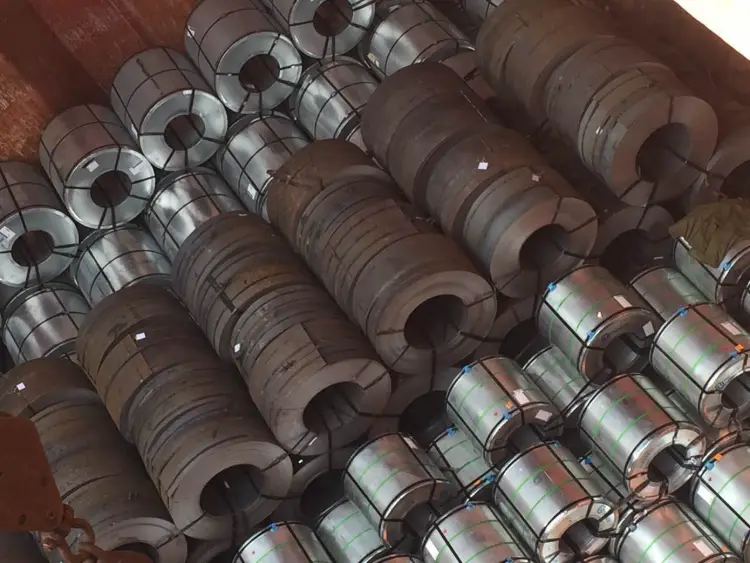
GL D40 Shipbuilding Steel Coil
GL D40 Shipbuilding Steel Coil: Complete Material Data, Equivalents & Applications
Explore the full technical profile of GL D40 shipbuilding steel coil: chemical composition, mechanical properties, thermal and electrical physical properties, global equivalents, and application guidance for marine and offshore structures.
Hot rolling, controlled rolling, normalizing rolling, thermo-mechanical control process (TMCP)
- Phone : +8618037372205
- Email : [email protected]
- WhatsApp: Contact via Whtsapp
- WeChat: +8618037372205
GL D40 Shipbuilding Steel Coil Introduction
GL D40 is a high-strength shipbuilding structural steel grade specified by Germanischer Lloyd (now part of DNV GL/DNV) for marine and offshore applications. It offers a minimum yield strength of 400 MPa and excellent weldability combined with guaranteed low-temperature toughness. This grade is produced as hot-rolled coils and plates, typically delivered in thermo-mechanically controlled processed (TMCP) or normalized condition. Key features:
- High strength-to-weight ratio for lightweight ship design.
- Good notch toughness at -20 °C (D-class), suited for hull structures in moderate cold environments.
- Excellent formability and weldability using standard shipyard procedures.
- Low carbon equivalent (CEV) to avoid cold cracking.
GL D40 Shipbuilding Steel Coil Chemical Composition
Typical ladle analysis according to GL rules for Grade D40 with thickness usually ≤ 50 mm. All values are maximum unless a range is shown. Residual elements are strictly controlled. The carbon equivalent CEV = C + Mn/6 + (Cr + Mo + V)/5 + (Ni + Cu)/15 is limited to ≤ 0.40% (for thickness ≤ 50 mm) to ensure weldability.
| Element | Standard Value (wt%) | Remarks |
|---|---|---|
| Carbon (C) | ≤ 0.18 | Ladle analysis |
| Silicon (Si) | ≤ 0.50 | |
| Manganese (Mn) | 0.90 - 1.60 | For thickness ≤ 50 mm |
| Phosphorus (P) | ≤ 0.035 | |
| Sulfur (S) | ≤ 0.035 | |
| Aluminium total (Al) | ≥ 0.015 | Metallic aluminium; usually fine grain practice |
| Niobium (Nb) | ≤ 0.05 | |
| Vanadium (V) | ≤ 0.10 | |
| Titanium (Ti) | ≤ 0.02 | |
| Copper (Cu) | ≤ 0.35 | |
| Chromium (Cr) | ≤ 0.20 | |
| Nickel (Ni) | ≤ 0.40 | |
| Molybdenum (Mo) | ≤ 0.08 | |
| Nitrogen (N) | ≤ 0.009 | If not fixed by sufficient aluminium or other grain refiners |
| Carbon Equivalent (CEV) | ≤ 0.40 | Product analysis limit; based on formula in standard |
GL D40 Shipbuilding Steel Coil Thermal and Electrical Physical Properties
Physical property data for D40 steel at room temperature (20 °C unless otherwise noted). These values are typical for carbon-manganese structural steels and are provided for design calculations. The properties may vary slightly depending on exact composition and heat treatment condition. Thermal conductivity and specific heat are given for room temperature; values change with temperature. Electrical resistivity is typical for low-alloy steel.
| Property | Typical Value | Unit | Test Condition / Remarks |
|---|---|---|---|
| Density (ρ) | 7.85 | g/cm³ | At 20 °C |
| Elastic modulus (E) | 210 | GPa | At 20 °C |
| Shear modulus (G) | 81 | GPa | At 20 °C (calculated from E and ν) |
| Poisson's ratio (ν) | 0.3 | - | At 20 °C |
| Thermal expansion coefficient (α) | 12.0 | ×10⁻⁶ /K | Between 20 °C and 100 °C |
| Thermal conductivity (λ) | 50 | W/(m·K) | At 20 °C |
| Specific heat capacity (cp) | 480 | J/(kg·K) | At 20 °C |
| Electrical resistivity (ρe) | 0.20 | μΩ·m | At 20 °C |
GL D40 Shipbuilding Steel Coil Mechanical Properties
Tensile and impact test requirements for GL D40 steel coils/plates. Test pieces are transverse unless otherwise agreed. Properties apply to product thickness ≤ 50 mm. For thicker products, slightly reduced minimum yield strength may be specified. Impact tests are performed at -20 °C for the D quality grade, using Charpy V-notch specimens (standard 10x10 mm). Values shown are minimum required unless indicated as a range.
| Property | Value | Unit | Test Condition |
|---|---|---|---|
| Yield strength (ReH) | ≥ 400 | MPa | Transverse, thickness t ≤ 50 mm |
| Tensile strength (Rm) | 510 - 650 | MPa | Transverse |
| Elongation after fracture (A5) | ≥ 22 | % | Gauge length 5.65√S0, transverse |
| Charpy impact energy (KV2, -20 °C) | ≥ 27 (average), ≥ 20 (individual) | J | Longitudinal, standard 10x10 mm specimen |
| Bend test (bending angle 180°) | No cracks or fissures | - | Bend diameter = 3 × thickness (t ≤ 50 mm) |
GL D40 Shipbuilding Steel Coil Fully Equivalent Material Standards & Grade Replacements
| Country / Region | Standard / Society | Designation | Remarks |
|---|---|---|---|
| DNV (Norway) | DNV Rules Pt.2 Ch.1 | D40 | Identical mechanical and toughness requirements; D40 is a recognised grade |
| BV (France) | BV Rules Part B | D40 | Same yield, tensile, and impact requirements |
| LR (UK) | LR Rules Part 3 Ch.1 | D40 | Also called LR Grade D40 |
| ABS (USA) | ABS Rules Part 2 | D40 | Identical strength level and D quality |
| CCS (China) | CCS Rules Part 1 Ch.3 | D40 | Same designation; widely used in Asian shipyards |
| KR (Korea) | KR Rules Pt.2 Ch.4 | D40 | Equivalent requirements |
| NK (Japan) | NK Rules Part K | KD40 | NK uses KD for hull structural steel; KD40 equals D40 |
| RINA (Italy) | RINA Rules Part D | D40 | Fully compliant |
| RS (Russia) | RS Rules Part XIII | D40 | Recognised under Russian Maritime Register |
GL D40 Shipbuilding Steel Coil Application Introduction
GL D40 steel coil is primarily used in the construction of ship hulls and marine structures. Its high strength and good toughness in the thickness range up to 50 mm make it suitable for weight-critical designs and areas subjected to moderate to high service stresses. Typical applications include:
Product Applications: Bulk carriers, Oil tankers, Container ships, Ro-Ro vessels, Offshore platform topsides and jackets, Floating production storage and offloading (FPSO) units, Living quarters modules
Processed into products: Hull exterior plating (bottom, side, deck), Longitudinal stiffeners and stringers, Transverse web frames, Bulkhead panels, Hatch coamings and covers, Pedestal crane bases, Reinforced plates around anchor windlass and mooring equipment
Application industries: Shipbuilding and marine engineering, Offshore oil & gas platform construction, Port machinery and heavy floating cranes, Naval vessel construction (auxiliary structures), Barge and river-sea shipbuilding
GL D40 Shipbuilding Steel Coil Similar / Comparable Material Grades
| Country / Region | Standard / Specification | Designation | Remarks |
|---|---|---|---|
| Europe | EN 10225-1:2009 | S400G1+M | Thermomechanical rolled; yield 400 MPa, tensile 510-630 MPa; Charpy at -20 °C, KV ≥ 50 J. Requires verification for ship class approval. |
| Europe | EN 10225-1:2009 | S400G2+M | Better through-thickness properties; otherwise similar to S400G1+M. Not a direct ship classification substitute but often used in offshore structures. |
| Japan | JIS G 3106 | SM490YA | Yield ≥ 365 MPa, tensile 490-610 MPa; Charpy at 0 °C (not -20 °C). Lower toughness grade; thickness limitations may apply for ship use. |
| USA | ASTM A131 / A131M | DH40 | Shipbuilding steel; similar yield and tensile range; Charpy at -20 °C. Note ASTM DH40 may have slight composition differences. Check with classification society. |
Notes:
D40 coils must be clearly marked with the manufacturer's name, grade, heat number, and the classification society's stamp. Welding procedures must be qualified according to the relevant ship classification society. Preheating is generally not required if CEV ≤ 0.40 and combined thickness precautions are observed, but good welding practice (e.g., hydrogen control, proper interpass temperature) is essential. The material can be cold formed, but strain ageing effects should be considered; a minimum bend radius of 3t is recommended for 90° bends transverse to the rolling direction. For thicknesses above 50 mm, through-thickness properties may be specified (Z-quality) upon agreement. Surface condition: descaled and oiled or as-rolled, depending on order agreement.
- Share



