
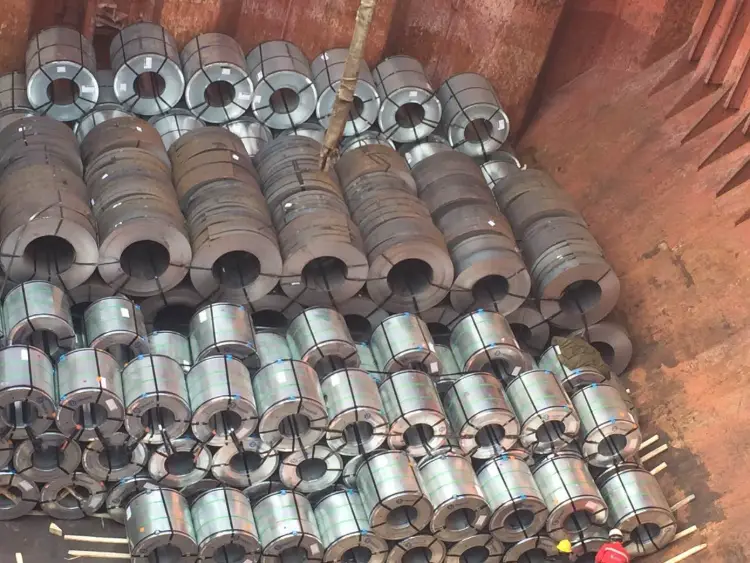
GL A40 Shipbuilding Steel Coil
GL A40 Shipbuilding Steel Coil - Data Sheet, Properties & Equivalent Grades
Complete technical data for GL A40 shipbuilding steel coil: chemical composition, mechanical and thermal properties, international equivalents and typical applications.
Welding, bending, cutting, cold forming, machining
- Phone : +8618037372205
- Email : [email protected]
- WhatsApp: Contact via Whtsapp
- WeChat: +8618037372205
GL A40 Shipbuilding Steel Coil Introduction
GL A40 is a high-strength hull structural steel grade defined by the Germanischer Lloyd (GL) classification society, now part of DNV GL. It belongs to the A40 (yield strength ≥390 MPa) series and is typically supplied as hot-rolled coil. The 'A' denotes minimum Charpy V‑notch impact energy of 34 J at 0 °C, making it suitable for moderate temperature applications. This steel is widely used in shipbuilding, offshore structures and marine equipment. The main characteristics include good weldability, excellent strength-to-weight ratio and reliable toughness. The material is delivered in normalized or thermo‑mechanically rolled condition, ensuring uniform mechanical properties.
- Minimum yield strength: 390 MPa (for thickness ≤50 mm)
- Minimum tensile strength: 510–650 MPa
- Impact tested at 0 °C
- Available as coil / strip / plate
GL A40 Shipbuilding Steel Coil Chemical Composition
The chemical composition of GL A40 shipbuilding steel is controlled to ensure high strength, good weldability and sufficient notch toughness. The values below are maximum limits unless a range is given, in accordance with DNV GL rules for grade A40. Microalloying elements such as niobium, vanadium or titanium may be added for grain refinement.
| Element | Standard Value (max, wt%) | Remarks |
|---|---|---|
| Carbon (C) | ≤0.18 | Higher carbon may be allowed for thinner gauges |
| Manganese (Mn) | 0.90 – 1.60 | Depending on product thickness |
| Silicon (Si) | ≤0.50 | - |
| Phosphorus (P) | ≤0.035 | - |
| Sulfur (S) | ≤0.035 | - |
| Aluminum (Al) | ≥0.015 (acid soluble) | For fine grain practice |
| Niobium (Nb) | 0.02 – 0.05 | Optional, for microalloying |
| Vanadium (V) | 0.05 – 0.10 | Optional, for microalloying |
| Titanium (Ti) | ≤0.02 | Optional, for grain refinement |
| Nitrogen (N) | ≤0.009 | If present with Al |
| Copper (Cu) | ≤0.35 | Residual / permitted |
| Chromium (Cr) | ≤0.20 | Residual |
| Nickel (Ni) | ≤0.40 | Residual |
| Molybdenum (Mo) | ≤0.08 | Residual |
GL A40 Shipbuilding Steel Coil Physical Properties
These physical properties are typical for normalized shipbuilding steel similar to GL A40. They are not mandatory requirements but are useful for design, thermal analysis and welding simulation. Actual values can vary slightly depending on exact composition and heat treatment.
| Property | Typical Value | Unit | Condition / Temperature |
|---|---|---|---|
| Density (ρ) | 7.85 | g/cm³ | Room temperature |
| Modulus of elasticity (E) | 206 | GPa | Room temperature |
| Shear modulus (G) | 80 | GPa | Room temperature |
| Poisson ratio (ν) | 0.30 | - | Room temperature |
| Thermal expansion coefficient (α) | 12 × 10⁻⁶ | 1/K | 20 – 100 °C |
| Thermal conductivity (λ) | 50 | W/(m·K) | Room temperature |
| Specific heat capacity (cp) | 460 | J/(kg·K) | Room temperature |
| Electrical resistivity (ρe) | 0.22 × 10⁻⁶ | Ω·m | Room temperature |
GL A40 Shipbuilding Steel Coil Mechanical Properties
Mechanical property requirements for GL A40 steel according to DNV GL rules. Tensile tests are performed in transverse direction. Yield strength and tensile strength may be reduced for thicknesses above 50 mm. Charpy V‑notch impact tests are conducted at 0 °C with minimum average energy of 34 J.
| Property | Standard Requirement | Unit | Test Condition |
|---|---|---|---|
| Yield strength (ReH) t ≤ 50 mm | ≥ 390 | MPa | Transverse tensile, ambient |
| Yield strength (ReH) 51 – 100 mm | ≥ 370 | MPa | Transverse tensile, ambient |
| Tensile strength (Rm) | 510 – 650 | MPa | Transverse tensile, ambient |
| Elongation (A) t ≤ 50 mm | ≥ 20 | % | Gauge length 5.65√So, transverse |
| Elongation (A) 51 – 100 mm | ≥ 19 | % | Gauge length 5.65√So, transverse |
| Charpy impact (KV) at 0 °C | ≥ 34 J (average) | J | Longitudinal, V‑notch |
| Charpy impact (KV) single value | ≥ 24 J | J | Longitudinal, V‑notch, one specimen |
| Bend test (180°) | bend diameter 3t | - | Specimen thickness t |
GL A40 Shipbuilding Steel Coil Fully Equivalent Standards and Replaceable Grades
| Country / Region | Standard / Society | Grade | Remarks |
|---|---|---|---|
| International | DNV GL | A40 | Unified GL A40 after merger |
| USA / International | ABS | AH40 | American Bureau of Shipping, identical strength & toughness |
| UK | LR | AH40 | Lloyd's Register, full equivalence |
| France | BV | AH40 | Bureau Veritas, identical requirements |
| China | CCS | AH40 | China Classification Society, same grade concept |
| Japan | NK | AH40 | Nippon Kaiji Kyokai, equivalent |
| South Korea | KR | AH40 | Korean Register, equivalent |
| Italy | RINA | AH40 | Registro Italiano Navale, equivalent |
| Russia | RS | A40 | Russian Maritime Register, identical notation |
GL A40 Shipbuilding Steel Coil Application Introduction
GL A40 steel coil is intended for structural components in marine and offshore environments. It combines high strength (390 MPa yield) with good low‑temperature toughness and excellent weldability, suitable for both civilian and military vessel construction.
Product Applications: Bulk carriers, tankers, container ships, Frigates, corvettes and naval auxiliaries, Offshore platform decks, legs and modules, Hatch covers, hull keels and bulkheads, Piled foundations and floating docks
Processed into products: Ship shell plating, Longitudinal and transverse frames, Stiffeners and girders, Deck panels and stringers, Offshore module structural steel
Application industries: Shipbuilding and marine engineering, Offshore oil & gas platforms, Port and harbour equipment, Bridges and heavy civil structures in coastal areas, Pressure vessels and storage tanks for low‑temperature service
GL A40 Shipbuilding Steel Coil Similar / Alternative Materials
| Country / Region | Standard / Society | Grade | Remarks |
|---|---|---|---|
| International | DNV GL | DH40 | Higher toughness grade, impact tested at -20 °C |
| International | DNV GL | EH40 | Higher toughness, impact at -40 °C |
| International | DNV GL | AH36 | Lower yield strength (355 MPa) but widely used |
| Europe | EN 10025‑4 | S420M/ML | Thermo‑mechanical rolled structural steel, not ship‑class but similar strength |
Notes:
- Delivery is typically in coil form with pickled & oiled or hot‑rolled surface, as agreed.
- Ultrasonic testing may be specified for critical applications per DNV GL rules.
- Weldability is excellent with standard low‑hydrogen procedures; preheat is generally not required for thicknesses below 30 mm.
- For thickness above 50 mm, normalizing or controlled rolling is often mandatory.
- All mechanical properties are verified in the as‑delivered condition.
- Share



