
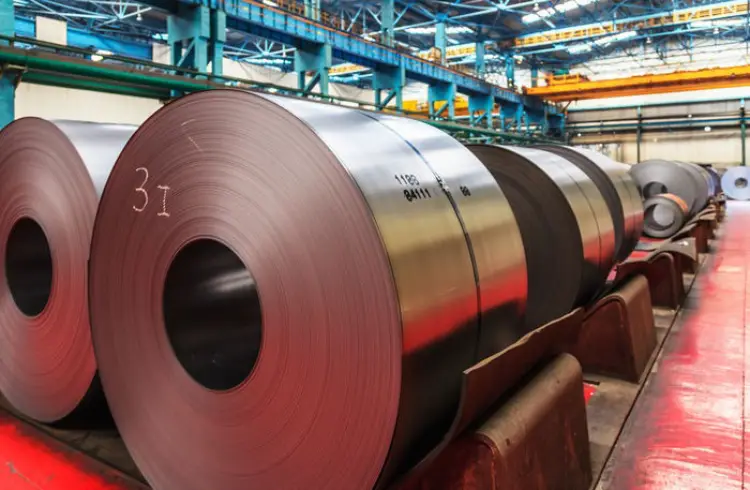
GL F36 (FH36) Shipbuilding Steel Coil
GL F36 (FH36) Shipbuilding Steel Coil - 355 MPa High Strength Hull Steel
Comprehensive material data for GL F36 high strength hull structural steel, 355 MPa yield, low temperature toughness, used in ship and offshore structures.
Cutting, Welding, Forming, Machining, Bending, Straightening
- Phone : +8618037372205
- Email : [email protected]
- WhatsApp: Contact via Whtsapp
- WeChat: +8618037372205
GL F36 Shipbuilding Steel Coil Introduction
GL F36, also designated as FH36 according to IACS unified requirements, is a high-strength hull structural steel approved by Germanischer Lloyd (now part of DNV GL). It offers a minimum yield strength of 355 MPa, excellent weldability, and guaranteed low-temperature impact toughness at -60°C. The steel is supplied in normalized (N) or thermo-mechanically controlled rolled (TMCP) condition, primarily as coils and plates. Its chemical composition is carefully balanced with low carbon and micro-alloying elements such as niobium, vanadium, and titanium to refine grain structures and enhance mechanical properties.
- Meets IACS UR W11 and DNV GL rules
- Ideally suited for critical ship and offshore structural components
- Equivalent to FH36 from all major classification societies
Typical applications include hull envelopes, decks, bulkheads, and longitudinal stiffeners.
GL F36 Shipbuilding Steel Coil Chemical Composition
The chemical composition of GL F36 is controlled in accordance with IACS UR W11 for FH36 steel. Maximum limits and typical ranges are given. Micro-alloying elements like Nb, V, and Ti are added singly or in combination for grain refinement. Carbon equivalent (CEV) is limited to ensure good weldability.
| Element | Specified Value | Unit | Remarks |
|---|---|---|---|
| C | ≤0.18 | % | Ladle analysis |
| Mn | 0.90–1.60 | % | |
| Si | 0.10–0.50 | % | |
| P | ≤0.035 | % | |
| S | ≤0.035 | % | |
| Al (acid soluble) | ≥0.015 | % | Total Al ≥0.020 also acceptable |
| Nb | 0.02–0.05 | % | Grain refining element |
| V | 0.05–0.10 | % | Grain refining element |
| Ti | ≤0.02 | % | May be added |
| Cr | ≤0.20 | % | Residual |
| Ni | ≤0.40 | % | Residual |
| Mo | ≤0.08 | % | Residual |
| Cu | ≤0.35 | % | Residual |
| CEV | ≤0.38 | % | Carbon equivalent, if required |
GL F36 Shipbuilding Steel Coil Thermal and Electrical Physical Properties
The following physical properties are typical for carbon-manganese structural steels like GL F36. They are not specified in the standard but are representative values useful for design calculations and simulation.
| Property | Typical Value | Unit | Condition |
|---|---|---|---|
| Density (ρ) | 7.85 | g/cm³ | Room temperature |
| Modulus of Elasticity (E) | 205–210 | GPa | Typical for steel |
| Shear Modulus (G) | ≈80 | GPa | Typical |
| Poisson's Ratio (ν) | 0.30 | – | Typical |
| Coefficient of Thermal Expansion (α) | 11.5 | 10⁻⁶/K | 20–100°C |
| Thermal Conductivity (λ) | 50 | W/(m·K) | At 20°C |
| Specific Heat Capacity (cp) | 460 | J/(kg·K) | Typical |
| Electrical Resistivity (ρ_e) | 0.20 | μΩ·m | At 20°C |
GL F36 Shipbuilding Steel Coil Mechanical Properties
Mechanical properties for GL F36 comply with IACS UR W11. Tensile testing is performed on longitudinal specimens. Impact toughness is verified at -60°C both longitudinally and transversely. The bend test ensures ductility without cracking.
| Property | Specified Value | Unit | Test Condition |
|---|---|---|---|
| Yield Strength (ReH) | ≥355 | MPa | Plate/coil thickness ≤50 mm |
| Tensile Strength (Rm) | 490–630 | MPa | Plate/coil thickness ≤50 mm |
| Elongation (A) | ≥21 | % | Longitudinal, gauge length 5.65√So, thickness ≤50 mm |
| Bend Test | No cracks, 180° bend, mandrel diameter = 3a | – | t ≤ 25 mm; a = specimen thickness |
| Charpy V-Notch Impact Energy (KV2) | ≥34 | J | Longitudinal, -60°C, t ≤ 50 mm |
| Charpy V-Notch Impact Energy (KV2) | ≥24 | J | Transverse, -60°C, t ≤ 50 mm |
GL F36 Shipbuilding Steel Coil Full Equivalents – Identical FH36 Standards and Grades
| Country / Region | Standard | Grade | Remarks |
|---|---|---|---|
| International (IACS) | IACS UR W11 | FH36 | Unified requirement for all members |
| USA | ABS Rules / ASTM A131 | FH36 | American Bureau of Shipping |
| France | BV Rules | FH36 | Bureau Veritas |
| China | CCS Rules | FH36 | China Classification Society |
| Norway/Germany | DNV GL Rules | FH36 | DNV GL (merged) |
| UK | LR Rules | FH36 | Lloyd's Register |
| Japan | NK Rules | FH36 | Nippon Kaiji Kyokai (ClassNK) |
| Italy | RINA Rules | FH36 | Registro Italiano Navale |
| Korea | KR Rules | FH36 | Korean Register |
GL F36 Shipbuilding Steel Coil Application Introduction
GL F36 is specifically designed for welded structures in shipbuilding and offshore engineering where high strength and excellent notch toughness at sub-zero temperatures are required. It is suitable for both plate and coil supply, enabling efficient prefabrication and automated welding processes.
- Ship hull primary structures
- Ice-class vessel reinforcement
- Columns and decks of offshore platforms
Product Applications: Hull plating, Deck and bottom structural plates, Bulkhead and panel sheets, Longitudinal and transverse stiffeners, Web frames and girders
Processed into products: Shell plating panels, Bottom longitudinal stiffeners, Side shell frames, Deck plate assemblies, Floor and bracket gussets, Transverse web frames
Application industries: Shipbuilding (merchant, naval, ice-class), Offshore oil & gas (jackets, topsides), Marine engineering, Heavy civil marine structures
GL F36 Shipbuilding Steel Coil Similar / Alternative Materials with Comparable Performance
| Country / Region | Standard | Grade | Remarks |
|---|---|---|---|
| EU | EN 10025-3 | S355NL | Normalized fine grain steel, ReH ≥355 MPa, impact -50°C; not ship class certified but mechanically similar |
| EU | EN 10025-4 | S355ML | TMCP steel, same strength level, may replace after engineering approval |
| International | API 2W / 2Y | Grade 50 | Offshore structural steel with similar strength, often used in marine structures |
Notes:
- CEV ≤ 0.38% ensures good weldability. Preheating may be required for thick sections (>30 mm) depending on heat input and humidity.
- Ultrasonic testing is normally performed per classification society rules.
- Surface condition and dimensional tolerances shall follow EN 10029 or equivalent class standards.
- TMCP delivery condition offers superior strength-toughness balance and allows lighter structures compared to normalized rolling.
- Share



