
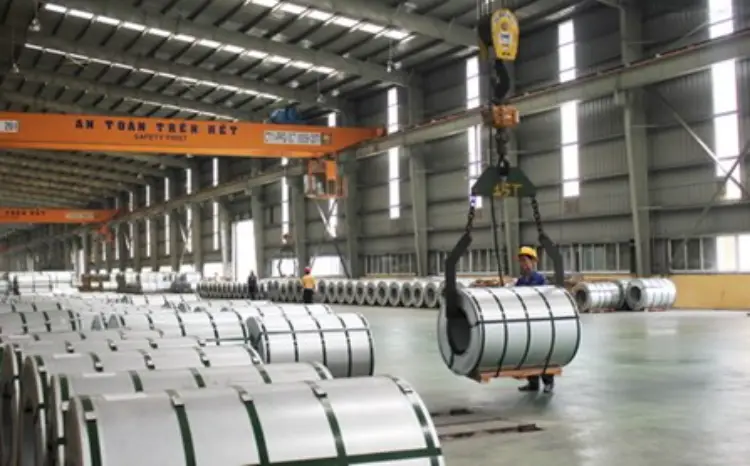
GL E36 Shipbuilding Steel Coil
GL E36 Shipbuilding Steel Coil | High Strength Hull Structural Steel Properties
Comprehensive technical data for GL E36 shipbuilding steel coil: chemical composition, mechanical and thermal properties, international equivalents, and application guidelines. Certified according to Germanischer Lloyd rules.
Hot rolling, controlled rolling, normalizing (N), thermo-mechanical controlled processing (TMCP), quenching and tempering (Q&T)
- Phone : +8618037372205
- Email : [email protected]
- WhatsApp: Contact via Whtsapp
- WeChat: +8618037372205
GL E36 Shipbuilding Steel Coil Introduction
GL E36 is a high strength shipbuilding structural steel approved by Germanischer Lloyd (now part of DNV GL). It features a minimum yield strength of 355 MPa and excellent notch toughness down to -40°C, making it suitable for critical hull structures and offshore components. The steel is produced via controlled rolling, normalizing, or TMCP processes to achieve fine grain size and good weldability. Typical deliveries are in coil, plate, or strip form.
- High strength and good impact toughness at low temperatures
- Excellent weldability with a carbon equivalent typically ≤0.40%
- Complies with GL Rules for Classification and Construction, Part 2, Materials and Welding
- Widely used in ship hulls, decks, bulkheads, and offshore platforms
- Equivalent to DNV E36, ABS EH36, LR EH36, and similar grades under other classification societies
GL E36 Shipbuilding Steel Coil Chemical Composition
The chemical composition of GL E36 steel is tightly controlled to ensure weldability, strength, and low-temperature toughness. Typical requirements follow GL rules with addition of grain-refining elements such as Al, Nb, V, Ti. The carbon equivalent (CEV) is limited to prevent cold cracking.
- Carbon: ≤0.18%
- Manganese: 0.90–1.60%
- CEV: max 0.40% (C+Mn/6+(Cr+Mo+V)/5+(Ni+Cu)/15)
| Element | Standard Value | Remarks |
|---|---|---|
| C | ≤0.18 | |
| Mn | 0.90–1.60 | |
| Si | ≤0.50 | |
| P | ≤0.035 | |
| S | ≤0.035 | |
| Al (acid soluble) | ≥0.015 | Grain refining element, if used |
| Nb | ≤0.05 | |
| V | ≤0.10 | |
| Ti | ≤0.02 | |
| Cu | ≤0.35 | |
| Ni | ≤0.40 | |
| Cr | ≤0.20 | |
| Mo | ≤0.08 | |
| N | ≤0.009 | If not combined with sufficient Al |
| CEV (Carbon Equivalent) | ≤0.40 | Based on IIW formula |
GL E36 Shipbuilding Steel Coil Thermal and Electrical Physical Properties
Physical properties are typical for low-alloy carbon-manganese shipbuilding steel at room temperature. These values are not mandatory in GL rules but are useful for design and thermal analysis.
- Density: ~7.85 g/cm³
- Elastic Modulus: ~205 GPa
- Thermal Conductivity: ~52 W/(m·K) at 20°C
- Specific Heat Capacity: ~460 J/(kg·K)
| Property | Typical Value | Unit | Test Condition |
|---|---|---|---|
| Density (ρ) | 7.85 | g/cm³ | At 20°C |
| Elastic Modulus (E) | 205 | GPa | At 20°C |
| Shear Modulus (G) | 80 | GPa | At 20°C |
| Poisson's Ratio (ν) | 0.3 | - | At 20°C |
| Thermal Expansion Coefficient (α) | 12 × 10⁻⁶ | /K | 20°C to 200°C |
| Thermal Conductivity (λ) | 52 | W/(m·K) | At 20°C |
| Specific Heat Capacity (c) | 460 | J/(kg·K) | At 20°C |
| Electrical Resistivity (ρ_e) | 0.25 × 10⁻⁶ | Ω·m | At 20°C |
GL E36 Shipbuilding Steel Coil Mechanical Properties
Mechanical properties are specified according to GL rules and depend on plate thickness and sampling direction. Typical values are given for thickness ≤ 50 mm unless otherwise noted. Charpy V-notch impact tests are performed at -40°C in transverse direction.
- Yield Strength: ≥355 MPa across common thickness ranges
- Tensile Strength: 490–620 MPa
- Elongation: ≥21% (≤50 mm), ≥19% (70–100 mm)
| Property | Required Value | Unit | Test Condition |
|---|---|---|---|
| Yield Strength (ReH) | ≥355 | MPa | Thickness ≤ 150 mm; transverse |
| Tensile Strength (Rm) | 490–620 | MPa | Thickness ≤ 150 mm; transverse |
| Elongation (A) | ≥21 | % | Thickness ≤ 50 mm; gauge 5.65√So |
| Elongation (A) | ≥20 | % | 50 mm < Thickness ≤ 70 mm |
| Elongation (A) | ≥19 | % | 70 mm < Thickness ≤ 100 mm |
| Charpy Impact (KV) -40°C | ≥34 (avg) / ≥24 (single) | J | Transverse; 10×10 mm; thickness ≤ 50 mm |
| Charpy Impact (KV) -40°C (sub-size) | Scaled per rules | J | For thickness ≤ 50 mm with sub-size specimens |
| Bend Test (180°) | Mandrel = 3×thickness | - | Transverse; thickness ≤ 25 mm |
GL E36 Shipbuilding Steel Coil Fully Equivalent Material Standards and Replaceable Grades
| Country/Region | Standard | Grade | Remarks |
|---|---|---|---|
| International (DNV GL) | DNV GL Rules | E36 | Formerly Germanischer Lloyd, now DNV GL; same -40°C impact |
| USA | ABS Rules | EH36 | American Bureau of Shipping; equivalent toughness class |
| UK | LR Rules | EH36 | Lloyd's Register; identical requirements |
| France | BV Rules | EH36 | Bureau Veritas; same strength and impact |
| China | CCS Rules | E36 | China Classification Society; -40°C impact |
| Japan | NK Rules | E36 | ClassNK; -40°C notch toughness |
| South Korea | KR Rules | EH36 | Korean Register; equivalent shipbuilding steel |
| Italy | RINA Rules | E36 | RINA; equivalent to E36/EH36 |
GL E36 Shipbuilding Steel Coil Application Introduction
GL E36 steel is engineered for demanding marine and offshore environments where high strength, excellent weldability, and low-temperature notch toughness are critical. It is extensively used in hull construction, deck panels, and structural frames.
- Good formability and through-thickness properties
- Suitable for heavy-section welding with appropriate preheat
- Available in coil, plate, and cut-to-length sheet forms for fabrication
Product Applications: Hull plates and shell plating, Decks and bulkheads, Stiffeners and stiffening profiles, Longitudinal and transverse frames, Superstructures, Deckhouses
Processed into products: Keel plates, Frames and webs, Longitudinal stiffeners, Transverse bulkheads, Beams and girders, Hatch coamings, Offshore platform legs and bracing members, Jack-up rig chord structures
Application industries: Shipbuilding, Offshore engineering, Marine construction, Port and harbor infrastructure, Pressure vessels (with additional certification)
GL E36 Shipbuilding Steel Coil Similar / Alternative Material Recommendations
| Country/Region | Standard | Grade | Remarks |
|---|---|---|---|
| Europe | EN 10025-4 | S355NL | Normalized fine-grain steel; yield 355 MPa, impact -50°C; suitable for structural applications |
| Europe | EN 10025-4 | S355ML | TMCP fine-grain steel; similar strength, -50°C impact; used in bridges and offshore |
| USA | ASTM A131 | EH36 | Same as ABS EH36; -40°C, already listed as equivalent |
| USA | ASTM A572 | Grade 50 | Yield 345 MPa; lower strength, Charpy not always guaranteed at -40°C |
| Japan | JIS G 3106 | SM490YA | Yield 365 MPa; impact 0°C typical; less severe toughness requirement |
Notes:
Welding considerations: GL E36 typically has a carbon equivalent ≤0.40%, reducing the risk of cold cracking. Preheating and heat input control are recommended for thicker sections. Further processing: The steel can be cut, formed, and welded using conventional shipyard procedures. Coils are often processed into cut-to-length plates or formed profiles. Certification: Material is certified with GL mark and must carry the registering classification society's stamp unless otherwise agreed. Minimum bend radius: When cold forming, the inner bend radius should be ≥ 3 times the thickness for transverse bends. Thickness range: Typically supplied in thicknesses from 6 mm up to 150 mm. Note on obsolete designation: The GL prefix has been replaced by DNV GL now DNV; for historical references, DNV E36 is the identical current designation.
- Share



