
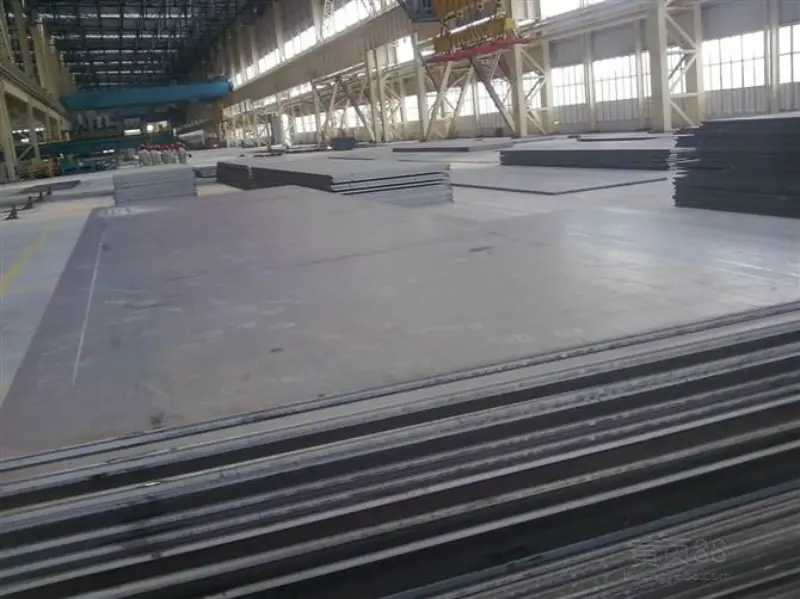
GL D36 Shipbuilding Steel
GL D36 Shipbuilding Steel Coil: High Strength, Excellent Weldability for Marine Structures
Detailed technical data for GL D36 shipbuilding steel coil: chemical composition, mechanical and physical properties, equivalent grades, and application guidance for ship and offshore engineering.
Thermo-mechanical controlled processing (TMCP), normalizing, controlled rolling, or normalizing rolling; suitable for cold forming, welding, and shot blasting
- Phone : +8618037372205
- Email : [email protected]
- WhatsApp: Contact via Whtsapp
- WeChat: +8618037372205
GL D36 Shipbuilding Steel Introduction
GL D36 is a high-strength normalized or thermo-mechanically controlled processed (TMCP) shipbuilding steel grade certified by Germanischer Lloyd (now DNV GL).
Key characteristics:
- Minimum yield strength of 355 MPa, providing excellent structural load-bearing capacity
- Good toughness at low temperatures down to -20°C, ensuring safe operation in cold marine environments
- Excellent weldability and formability, suitable for automated panel line production
- Complies with IACS UR W11 and GL Rules for Classification and Construction
The steel is predominantly supplied as hot-rolled coils or cut-to-length plates in thicknesses ranging from 6 mm to 50 mm, with controlled rolling and normalizing as common delivery conditions. Typical applications include primary hull structures, decks, bulkheads, stiffeners, and offshore platform components. Its balanced chemistry with microalloying elements (Nb, V, Ti) refines the grain structure, enhancing both strength and toughness while maintaining carbon equivalent low enough for straightforward fabrication.
GL D36 Shipbuilding Steel Chemical Composition , Heat Analysis
The chemical composition conforms to GL Rules and IACS UR W11. The table shows the limits for ladle analysis. Microalloying elements like Nb, V, and Ti may be added singly or in combination to achieve the required strength and toughness. The carbon equivalent (CEV) is typically controlled below 0.38% to ensure good weldability.
| Chemical Element | Standard Value (max unless range) | Remarks |
|---|---|---|
| Carbon (C) | ≤0.18 | Ladle analysis |
| Manganese (Mn) | 0.90 – 1.60 | Depending on thickness and carbon equivalent |
| Silicon (Si) | ≤0.50 | Deoxidation element |
| Phosphorus (P) | ≤0.035 | Strict control for toughness |
| Sulfur (S) | ≤0.035 | Strict control for ductility |
| Aluminium (Al, total) | ≥0.015 | Sufficient for full deoxidation (acid-soluble Al ≥0.015) |
| Niobium (Nb) | 0.02 – 0.05 | Grain refinement and precipitation strengthening |
| Vanadium (V) | 0.05 – 0.10 | Precipitation hardening |
| Titanium (Ti) | ≤0.02 | Grain refinement, also for N fixation |
| Copper (Cu) | ≤0.35 | Residual element, may improve atmospheric corrosion resistance |
| Chromium (Cr) | ≤0.20 | Residual/tramp element |
| Nickel (Ni) | ≤0.40 | Residual element |
| Molybdenum (Mo) | ≤0.08 | Residual element |
| Nitrogen (N) | ≤0.012 | If not fixed by Ti/Al |
| Carbon Equivalent (CEV) | ≤0.38 (typical) | Based on IIW formula: C + Mn/6 + (Cr+Mo+V)/5 + (Ni+Cu)/15 |
GL D36 Shipbuilding Steel Thermal and Electrical Physical Properties
The following physical properties are based on typical data for carbon‑manganese‑microalloyed shipbuilding steels and serve as engineering reference values. They are influenced by the exact composition and heat treatment but vary only slightly within the D36 grade.
| Property | Typical Value | Unit | Test Condition / Remarks |
|---|---|---|---|
| Density (ρ) | 7.85 | g/cm³ | At 20 °C |
| Modulus of Elasticity (E) | 205 | GPa | Tension / compression, at 20 °C |
| Shear Modulus (G) | 79.3 | GPa | Derived from E and Poisson's ratio, at 20 °C |
| Poisson's Ratio (ν) | 0.30 | – | Within elastic range |
| Thermal Expansion Coefficient (α) | 11.5 | 10⁻⁶ /K | For the temperature range 20 – 100 °C |
| Thermal Expansion Coefficient (α) | 12.5 | 10⁻⁶ /K | For 20 – 200 °C |
| Thermal Expansion Coefficient (α) | 13.5 | 10⁻⁶ /K | For 20 – 300 °C |
| Thermal Conductivity (λ) | 50 | W/(m·K) | At 20 °C, typical for low-alloy steel |
| Specific Heat Capacity | 470 | J/(kg·K) | At 20 °C |
| Electrical Resistivity (ρ_e) | 0.21 | μΩ·m | At 20 °C |
GL D36 Shipbuilding Steel Mechanical Properties
The mechanical properties are determined in accordance with GL Rules and IACS UR W11 using transverse test pieces unless longitudinal is stated for impact. The values apply to material in the delivered condition (normalized or TMCP). Multiple rows represent different thickness ranges or test conditions.
| Property | Requirement (min unless range) | Unit | Test Condition / Remarks |
|---|---|---|---|
| Yield Strength (ReH) | ≥355 | MPa | Thickness ≤ 50 mm, transverse |
| Yield Strength (ReH) | ≥355 | MPa | Thickness > 50 mm to 70 mm, transverse |
| Yield Strength (ReH) | ≥345 | MPa | Thickness > 70 mm to 100 mm, transverse (accord. to GL practice) |
| Tensile Strength (Rm) | 490 – 630 | MPa | All thicknesses, transverse |
| Elongation (A) | ≥21 | % | Gauge length 5.65√S₀, thickness ≤ 50 mm, transverse |
| Elongation (A) | ≥20 | % | Thickness > 50 mm to 70 mm, transverse |
| Elongation (A) | ≥20 | % | Thickness > 70 mm to 100 mm, transverse |
| Bend Test (180°) | d = 2a | Bend diameter (d) as a multiple of thickness (a), for thickness ≤ 25 mm, transverse | |
| Bend Test (180°) | d = 3a | Thickness > 25 mm to 35 mm, transverse | |
| Bend Test (180°) | d = 4a | Thickness > 35 mm to 50 mm, transverse | |
| Impact Energy (KV) | ≥34 (longitudinal) | J | Charpy-V, -20 °C, longitudinal specimen |
| Impact Energy (KV) | ≥24 (transverse) | J | Charpy-V, -20 °C, transverse specimen (if required by specification) |
GL D36 Shipbuilding Steel Identical / Fully Equivalent Material Standards and Replaceable Grades
The following table lists classification society grades that are technically interchangeable with GL D36. They share the same chemical composition limits and mechanical requirements as defined by the IACS UR W11 standard.
| Country / Region | Standard / Classification Society | Grade | Remarks |
|---|---|---|---|
| International | IACS UR W11 | D36 | Unified Requirement for normal and high strength hull structural steels |
| USA / International | ABS (American Bureau of Shipping) | Grade D36 | ABS Rules, Part 2, Chapter 1 |
| UK / International | LR (Lloyd's Register) | Grade D36 | LR Rules, Part 2, Chapter 3 |
| Norway / Germany | DNV (Det Norske Veritas) / GL (merged) | NV D36 / GL D36 | DNV Rules Pt.2 Ch.2 / GL Rules Pt.1 Ch.2 |
| France | BV (Bureau Veritas) | Grade D36 | BV Rules, Part B, Chapter 2 |
| China | CCS (China Classification Society) | Grade D36 | CCS Rules Part 2, Chapter 1 |
| Japan | NK (ClassNK) | KA36 / KD36 | Equivalent to KA36 or KD36 depending on impact test temperature |
| Korea | KR (Korean Register) | Grade D36 | KR Rules Pt.2 Ch.2 |
| Italy | RINA (Registro Italiano Navale) | Grade D36 | RINA Rules Pt.B Ch.2 |
| Russia | RMRS (Russian Maritime Register) | Grade D36 | RMRS Rules Part 2, Section 2 |
GL D36 Shipbuilding Steel Application Introduction
GL D36 steel coil is specifically designed for welded structures in the shipbuilding and offshore industry. It is approved by major classification societies and is available in a wide range of dimensions. The steel exhibits excellent cold formability and can be joined with all conventional welding techniques (SMAW, SAW, GMAW, FCAW) without requiring preheating for moderate thicknesses.
Key processing advantages:
- Excellent lamellar tearing resistance due to clean steel practice
- Consistent mechanical properties after normalizing or TMCP, enabling lightweight design
- Good fatigue strength, essential for dynamically loaded marine structures
- Surface quality suitable for direct coating with anti‑corrosion systems
Product Applications: Ship hull plates, side shells, bottom plates, Deck plating and reinforced deck structures, Longitudinal and transverse bulkheads, Web frames, girders, and stiffeners, Hatch coamings and container guides, Offshore platform topsides, legs, and jacket structures, Barge and pontoon structures, Marine crane booms and heavy‑duty structural components
Processed into products: Cut‑to‑shape hull plates for keel, bilge, and sheer strakes, Stiffener profiles (angle bars, T‑bars, bulb flats) roll‑formed from coil, Prefabricated panel sections like deck panels and corrugated bulkheads, Flanged brackets, knees, and gusset plates, Reinforcement pads for mooring equipment, Submerged arc welded (SAW) pipeline fittings when approved for marine use, Machined bearing housings and slewing ring supports for marine cranes
Application industries: Shipbuilding (merchant vessels, naval vessels, cruise ships, ferries), Offshore engineering (jack‑up rigs, FPSOs, semi‑submersibles), Marine equipment and port machinery, Bridge and heavy civil construction (when certified accordingly), Pressure vessels and storage tanks meeting specific ship classification requirements
GL D36 Shipbuilding Steel Similar or Closely Related Steel Grades
The grades listed below are from the same high‑strength hull structural steel family or share a similar strength level but differ in toughness, delivery condition, or thickness capabilities. They may serve as alternative choices depending on specific design requirements.
| Country / Region / Society | Standard / Reference | Grade | Remarks |
|---|---|---|---|
| IACS / Multi-Society | IACS UR W11 | E36 | Higher toughness (impact at -40 °C) with same strength; stricter for cold regions |
| IACS / Multi-Society | IACS UR W11 | D40 | Higher yield strength (min 390 MPa), otherwise similar; for weight reduction |
| IACS / Multi-Society | IACS UR W11 | EH36 | Extra high toughness; suitable for critical low‑temperature applications |
| EN (Europe) | EN 10025-4 | S355ML | Thermo‑mechanically rolled fine‑grain structural steel with similar strength but different certification |
| EN (Europe) | EN 10025-3 | S355N/NL | Normalized/normalized‑rolled fine‑grain steel; often used in pressure vessels and bridges |
| ASTM (USA) | ASTM A131 / A131M | Grade DH36 | Similar chemical and mechanical requirements; widely used in shipbuilding |
| JIS (Japan) | JIS G 3106 | SM490YA / SM490YB | High‑strength welded structural steel; comparable yield strength, but different impact test requirements |
Notes:
Additional requirements may apply depending on the end‑use and the specific project specifications (e.g., through‑thickness properties according to GL guidelines, strain‑ageing resistance, CTOD testing).
When ordering, the relevant GL Rules condition should be fully specified: grade, delivery condition (N, M, NR), dimensional tolerances, and whether the material is intended for cold‑forming or high‑heat‑input welding. The mill test certificate (3.2 per EN 10204 or equivalent) must be provided, confirming compliance with the Classification Society rules.
Welding consumables should be selected to match the mechanical properties of the base material; low‑hydrogen processes are recommended to avoid hydrogen‑induced cracking. For thicknesses above 50 mm, a preheating temperature of 50–100 °C may be necessary depending on the carbon equivalent and welding parameters.
- Share



