
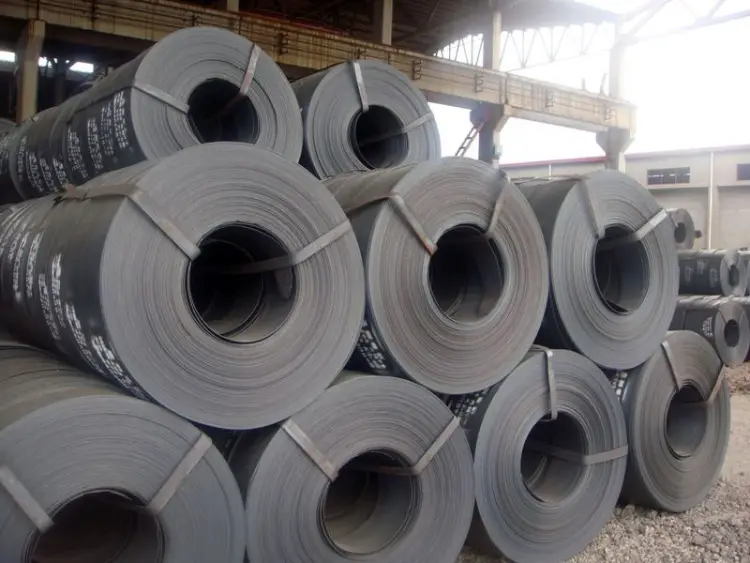
GL AH36 Shipbuilding Steel Coil
GL AH36 Shipbuilding Steel Coil - High Tensile Strength for Marine Structures
Explore GL AH36 shipbuilding steel coil certified by Germanischer Lloyd (GL). It offers minimum 355 MPa yield strength, excellent weldability, and superior notch toughness, ideal for hull structures and offshore platforms.
Hot rolling, controlled rolling (TMCP), normalizing, normalizing rolling, quenching + tempering (upon agreement)
- Phone : +8618037372205
- Email : [email protected]
- WhatsApp: Contact via Whtsapp
- WeChat: +8618037372205
GL AH36 Shipbuilding Steel Coil Introduction
GL AH36 is a high‑tensile shipbuilding steel grade governed by the Germanischer Lloyd (GL) Rules for Materials and Welding. It belongs to the higher‑strength family of hull structural steels (IACS UR W11) and is widely used in marine and offshore construction. Minimum yield strength is 355 MPa, with tensile strength ranging from 490 to 620 MPa. Compared to normal‑strength grades such as GL‑A or GL‑B, AH36 permits lighter structural design without compromising safety. The grade is delivered as coils, plates, or sections, typically in a thermo‑mechanically controlled processed (TMCP) or normalized condition, ensuring fine‑grain microstructure, good formability, and reliable low‑temperature impact toughness. Its chemical composition is tightly controlled to guarantee excellent weldability and resistance to brittle fracture. Through‑thickness properties can be specified for critical joints. The steel meets stringent international requirements, making it interchangeable with equivalent classification society grades such as ABS AH36 or LR AH36. Typical applications include ship hulls, decks, bulkheads, offshore platform components, and structural members exposed to dynamic loads in harsh marine environments.
GL AH36 Shipbuilding Steel Coil Chemical Composition
The chemical composition complies with GL Rules for high‑tensile hull structural steel grade AH36. Values are maximum unless stated as a range. Refining elements (Nb, V, Ti) may be added singly or in combination to achieve fine‑grain structure. When Al is used, the Al/N ratio is controlled to ensure notch toughness. Residual elements (Cr, Ni, Mo, Cu) are kept low to maintain weldability. Product analysis tolerances apply as per the standard.
| Element | Specified Value (max or range) | Remarks |
|---|---|---|
| Carbon (C) | ≤ 0.18 % | Ladle analysis; thickness ≤ 50 mm |
| Manganese (Mn) | 0.90 – 1.60 % | Mandatory range |
| Silicon (Si) | ≤ 0.50 % | |
| Phosphorus (P) | ≤ 0.035 % | |
| Sulfur (S) | ≤ 0.035 % | |
| Aluminium (Al, total) | ≥ 0.015 % | Acid soluble Al; can be replaced by adequate Nb, V, or Ti |
| Niobium (Nb) | ≤ 0.05 % | Grain‑refining element |
| Vanadium (V) | ≤ 0.10 % | |
| Titanium (Ti) | ≤ 0.02 % | |
| Copper (Cu) | ≤ 0.35 % | Residual element |
| Chromium (Cr) | ≤ 0.20 % | Residual element |
| Nickel (Ni) | ≤ 0.40 % | Residual element |
| Molybdenum (Mo) | ≤ 0.08 % | Residual element |
| Nitrogen (N) | ≤ 0.009 % | When Al is present; otherwise ≤ 0.012 % |
GL AH36 Shipbuilding Steel Coil Thermal and Electrical Physical Properties
Physical properties are not part of the GL standard but are typical for carbon‑manganese high‑tensile steel with a ferritic‑pearlitic microstructure. Values are given at room temperature unless a temperature range is noted. These properties are suitable for design calculations where specific data is not available, but exact values may vary slightly with actual heat chemistry and processing route.
| Property | Typical Value | Unit | Test Condition / Temperature |
|---|---|---|---|
| Density (ρ) | 7850 | kg/m³ | 20°C |
| Elastic modulus (E) | 205 | GPa | 20°C, static |
| Shear modulus (G) | 80 | GPa | 20°C, derived |
| Poisson's ratio (ν) | 0.29 | – | 20°C, elastic range |
| Thermal expansion coefficient (α) | 11.7 × 10⁻⁶ | 1/K | 20–100°C |
| Thermal expansion coefficient (α) | 12.2 × 10⁻⁶ | 1/K | 20–200°C |
| Thermal expansion coefficient (α) | 13.1 × 10⁻⁶ | 1/K | 20–400°C |
| Thermal conductivity (λ) | 51 | W/(m·K) | 20°C |
| Thermal conductivity (λ) | 45 | W/(m·K) | 200°C |
| Specific heat capacity (cp) | 486 | J/(kg·K) | 20°C |
| Electrical resistivity (ρₑ) | 0.15 × 10⁻⁶ | Ω·m | 20°C |
GL AH36 Shipbuilding Steel Coil Mechanical Properties
Mechanical properties are derived from GL Rules, IACS UR W11. Tension tests are carried out on transverse specimens according to ISO 6892‑1. Impact tests use Charpy V‑notch specimens taken longitudinal to the rolling direction. For AH36, the impact test temperature is 0°C. Bending test is a 180° bend over a former with diameter 3a (a = specimen thickness) for tensile strength ≥ 490 MPa. Values apply to products with nominal thickness ≤ 50 mm unless otherwise noted.
| Property | Specified Requirement | Unit | Test Condition |
|---|---|---|---|
| Yield strength (ReH) | ≥ 355 | MPa | Transverse tensile test, room temperature |
| Tensile strength (Rm) | 490 – 620 | MPa | Transverse tensile test, room temperature |
| Elongation (A) | ≥ 21 | % | Transverse, gauge length 5.65√So |
| Bend test (180°) | No cracks | – | Bend former diameter = 3a; a = specimen thickness |
| Impact energy (KV₂) – average | ≥ 34 | J | Longitudinal Charpy V‑notch, 0°C |
| Impact energy (KV₂) – individual min | ≥ 24 | J | Longitudinal Charpy V‑notch, 0°C |
GL AH36 Shipbuilding Steel Coil Completely Equivalent Material Standards and Alternative Grade Designations
| Country/Region | Standard / Classification Society | Grade | Remarks |
|---|---|---|---|
| International / Cross‑Society | IACS UR W11 | AH36 | Unified requirement for all IACS members, identical to GL AH36 |
| USA | ABS Rules | AH36 | American Bureau of Shipping |
| UK | Lloyd's Register (LR) Rules | AH36 | LR grade identical in composition and properties |
| Norway / Germany | DNV GL (merged rules) | AH36 | Integrated DNV‑GL rules maintain same requirements |
| France | Bureau Veritas (BV) Rules | AH36 | Equivalent to GL AH36 |
| China | CCS Rules | AH36 | China Classification Society |
| Korea | KR Rules | AH36 | Korean Register |
| Japan | NK (ClassNK) Rules | AH36 | Nippon Kaiji Kyokai |
| Italy | RINA Rules | AH36 | Registro Italiano Navale |
| Russia | RS Rules | AH36 | Russian Maritime Register of Shipping |
| India | IRS Rules | AH36 | Indian Register of Shipping |
GL AH36 Shipbuilding Steel Coil Application Introduction
GL AH36 steel combines high strength, good formability, and guaranteed notch toughness at 0°C, making it a workhorse for modern shipbuilding and offshore engineering. It is suitable for heavy plate components as well as lighter coil‑fed stiffeners. The material performs reliably when fabricated using standard shipyard practices: gas cutting, submerged‑arc welding, flux‑cored arc welding, and cold forming within prescribed limits. Welding consumables should match the strength grade and hydrogen‑controlled processes are recommended. Typical applications range from hull envelopes to intricate structural details subjected to static and dynamic loads.
Product Applications: Bulk vessel hull plates and stiffeners, Container ship main decks and hatch coamings, Tanker side shells and longitudinal bulkheads, Offshore platform module support frames, Jack‑up rig legs and spudcans, Offshore wind monopile and transition piece plates, Ship unloader and crane structural components
Processed into products: Flat and curved hull plate panels (shell expansion), Longitudinal and transverse stiffeners (angles, bulb flats, tees), Brackets, floor plates, and web frames, Deck stringer plates and sheer strakes, Hatch corner reinforcement pads, Rudder horn, stern frame, and rudder stock components (with additional Z‑quality if required), Bollards, fairleads, and mooring foundations, Split rings and stiffening rings for cylindrical structures, Knuckles and knuckle reinforcements in hopper tanks, Crane pedestal base plates and inserts
Application industries: Shipbuilding and repair (commercial vessels, naval auxiliaries), Offshore oil & gas (platforms, FPSOs, jack‑up rig components), Marine renewable energy (offshore wind turbine foundations, tidal structures), Port and harbour engineering (fender systems, heavy‑duty dock structures), Bridge construction (secondary elements exposed to marine atmosphere), Pressure vessel outer shells (where not subject to creep or high temperature)
GL AH36 Shipbuilding Steel Coil Similar or Substitute Material Recommendations
| Country/Region | Standard / Specification | Grade | Remarks |
|---|---|---|---|
| International | IACS UR W11 | AH32 | Lower strength (yield 315 MPa), similar weldability |
| International | IACS UR W11 | DH36 | Same strength, but impact test at -20°C; better low‑temperature toughness |
| International | IACS UR W11 | EH36 | Same strength, impact test at -40°C; for severe cold service |
| International | IACS UR W11 | FH36 | Same strength, impact test at -60°C; highest toughness requirement |
| USA | ASTM A572 / A572M | Grade 50 [345] | Yield 345 MPa, structural steel; not specifically shipbuilding but may serve in some marine structures (non‑classed) |
| EU | EN 10025‑4 | S355M/ML | Thermo‑mechanically rolled structural steel with comparable strength; additional verification for marine service may be needed |
| Japan | JIS G 3106 | SM490A/B/C | Welded structural steel with similar tensile range; require separate certification for shipbuilding |
Notes:
Additional Requirements Available: Through‑thickness properties (Z‑quality) according to GL Rules can be ordered for critical laminated joints (e.g., Z25 or Z35). Impact tests can be requested at temperatures lower than 0°C if the intended service demands it (i.e., DH36 or EH36 levels). Surface protection (shop primer) can be applied to coils or plates prior to delivery. The standard sizes for coil are typically 1.5–25 mm thickness and 900–2100 mm width; heavier gauges are produced as plates. All material must carry a valid GL inspection certificate (3.1 or 3.2 according to EN 10204) issued by the classification society surveyor.
- Share



