
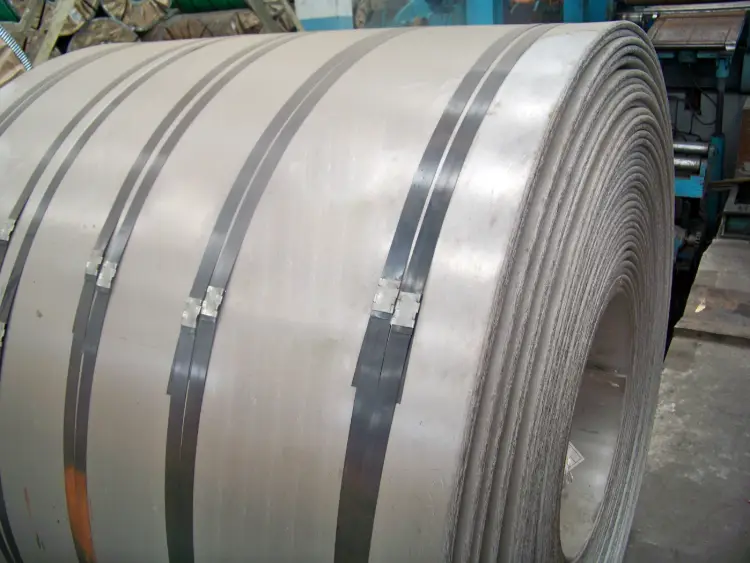
GL F32 Shipbuilding Steel Coil
GL F32 Shipbuilding Steel Coil: High Strength Hull Structural Steel Grade F32 per Germanischer Lloyd Rules
Complete material data for GL F32 shipbuilding steel coil including chemical composition, mechanical and physical properties, international equivalents, and typical applications per official GL and IACS standards.
Normalising rolling, thermomechanical controlled rolling (TMCP), cutting, forming, welding, machining
- Phone : +8618037372205
- Email : [email protected]
- WhatsApp: Contact via Whtsapp
- WeChat: +8618037372205
GL F32 Shipbuilding Steel Coil Introduction
GL F32 is a high-strength hull structural steel grade defined under the rules of Germanischer Lloyd (GL, now part of DNV). It corresponds to the FH32 designation in the IACS UR W11 harmonised standard for normal and high strength hull steels. This fine-grain steel is produced by normalising rolling or thermomechanical controlled processing (TMCP) and offers a minimum yield strength of 315 MPa with excellent toughness at sub-zero temperatures, typically impact tested at -60 °C. The chemical composition is strictly controlled to ensure good weldability, low-temperature ductility, and resistance to brittle fracture, making it suitable for critical structural components in shipbuilding and offshore engineering.
- High strength-to-weight ratio for weight-efficient designs.
- Excellent notch toughness down to -60 °C, meeting F-grade requirements.
- Good weldability with standard shipyard procedures.
- Compliant with IACS UR W11 and major classification society rules.
The material is typically delivered in normalised or TMCP condition as coils or cut-to-length plates, ready for subsequent fabrication.
GL F32 Shipbuilding Steel Coil Chemical Composition
Chemical composition limits according to IACS UR W11 for FH32 high-strength hull structural steel. All values are ladle analysis. Fine-grain practice is mandatory with aluminium content or adequate Nb, V, Ti additions.
- Carbon equivalent (CEV) is typically limited to ensure good weldability.
- Maximum CEV = C + Mn/6 + (Cr+Mo+V)/5 + (Ni+Cu)/15 usually ≤ 0.38% for thicknesses ≤50 mm, adjusted for thicker gauges.
| Chemical Element | Standard Value (max. or range) | Remarks |
|---|---|---|
| C | ≤0.16 % | Maximum |
| Mn | 0.90 – 1.60 % | Range; higher Mn for thicker products |
| Si | ≤0.50 % | Maximum |
| P | ≤0.025 % | Maximum |
| S | ≤0.025 % | Maximum |
| Al (total) | ≥0.015 % | Minimum; for fine-grain practice |
| Nb | ≤0.05 % | Maximum; optional microalloy |
| V | ≤0.10 % | Maximum; optional microalloy |
| Ti | ≤0.02 % | Maximum; optional |
| Cu | ≤0.35 % | Maximum |
| Cr | ≤0.20 % | Maximum |
| Ni | ≤0.40 % | Maximum |
| Mo | ≤0.08 % | Maximum |
| N | ≤0.009 % | Maximum; if Al content sufficient |
GL F32 Shipbuilding Steel Coil Thermal and Electrical Physical Properties
Physical properties are based on typical data for structural carbon-manganese steels. Slight variations may occur depending on specific chemical composition and heat treatment. Values listed are at room temperature unless otherwise noted.
- Thermal conductivity decreases with increasing temperature, specific heat increases up to Curie point.
- Electrical resistivity is sensitive to alloy content; typical values for shipbuilding steel are given.
| Property | Specification Value | Unit | Test Condition |
|---|---|---|---|
| Density (ρ) | 7850 | kg/m³ | 20 °C |
| Modulus of Elasticity (E) | 210 | GPa | 20 °C |
| Shear Modulus (G) | 80.8 | GPa | 20 °C |
| Poisson's Ratio (ν) | 0.3 | — | elastic range |
| Thermal Expansion Coefficient (α) | 12.0 × 10⁻⁶ | 1/K | 20 – 100 °C |
| Thermal Conductivity (λ) | 50 | W/(m·K) | 20 °C |
| Specific Heat Capacity (cp) | 460 | J/(kg·K) | 20 °C |
| Electrical Resistivity (ρe) | 0.22 | μΩ·m | 20 °C |
GL F32 Shipbuilding Steel Coil Mechanical Properties
Mechanical properties for FH32/GL F32 as specified in IACS UR W11 for thicknesses up to 100 mm. Impact test requirements are at -60 °C (F-grade) with longitudinal and transverse minimum values. Bend test is required for structural integrity assessment.
- Yield point ReH is defined as upper yield strength or 0.2% proof stress for grades without distinct yield.
- Elongation measured on proportional gauge length L₀ = 5.65√S₀.
| Property | Specification Value | Unit | Test Condition |
|---|---|---|---|
| Yield Strength (ReH) | ≥315 | MPa | Transverse specimens, thickness t ≤ 100 mm |
| Tensile Strength (Rm) | 440 – 590 | MPa | Transverse specimens, all thicknesses |
| Elongation (A) | ≥22 | % | L₀ = 5.65√S₀, t ≤ 50 mm |
| Elongation (A) | ≥21 | % | L₀ = 5.65√S₀, 50 < t ≤ 100 mm |
| Bend Test (mandrel diameter) | d = 3a | — | 180° bend, t ≤ 25 mm |
| Bend Test (mandrel diameter) | d = 4a | — | 180° bend, t > 25 mm |
| Impact Energy (KV₂) longitudinal | ≥34 | J | -60 °C, t ≤ 50 mm |
| Impact Energy (KV₂) longitudinal | ≥34 | J | -60 °C, 50 < t ≤ 70 mm |
| Impact Energy (KV₂) longitudinal | ≥41 | J | -60 °C, 70 < t ≤ 100 mm |
| Impact Energy (KV₂) transverse | ≥24 | J | -60 °C, t ≤ 50 mm |
| Impact Energy (KV₂) transverse | ≥24 | J | -60 °C, 50 < t ≤ 70 mm |
| Impact Energy (KV₂) transverse | ≥27 | J | -60 °C, 70 < t ≤ 100 mm |
GL F32 Shipbuilding Steel Coil Completely Equivalent Material Standards and Substitutable Grades
| Country / Region | Standard / Rule | Grade | Remarks |
|---|---|---|---|
| International | IACS UR W11 | FH32 | Harmonised rule for all IACS members |
| USA | ABS Rules | FH32 | American Bureau of Shipping |
| UK | LR Rules | FH32 | Lloyd's Register |
| France | BV Rules | FH32 | Bureau Veritas |
| Norway | DNV Rules | FH32 | DNV (currently part of DNV GL) |
| Japan | NK Rules / ClassNK | FH32 | Nippon Kaiji Kyokai |
| South Korea | KR Rules | FH32 | Korean Register |
| Italy | RINA Rules | FH32 | Registro Italiano Navale |
| China | CCS Rules | FH32 | China Classification Society |
| Russia | RS Rules | FH32 | Russian Maritime Register of Shipping |
GL F32 Shipbuilding Steel Coil Application Introduction
GL F32 / FH32 steel is specifically designed for the construction of seagoing vessels and offshore platforms. It provides a reliable balance of strength, toughness, and weldability for critical structural members exposed to low temperatures and dynamic loading. Typical delivery condition is normalised or TMCP, ready for cutting, forming, and welding with standard procedures. Common applications include:
Product Applications: Hull plating and shell plates, Decks, tank tops, and bulkheads, Longitudinals, frames, and stiffeners, Transverse webs and brackets, Rudder horns and shaft brackets, Offshore crane pedestals and foundations
Processed into products: Sheared or flame-cut plate blanks, Rolled or press-bent shell strakes, Welded T-beams and L-profiles, Stiffened panel assemblies, Machined connection pieces and pad eyes, Formed brackets and gussets
Application industries: Shipbuilding (merchant ships, naval vessels, passenger ships), Offshore oil & gas (jackets, modules, flare booms), Marine engineering (docks, lock gates, floating structures), Wind energy offshore foundations (transition pieces, monopile components)
GL F32 Shipbuilding Steel Coil Similar / Alternative Materials with Comparable Performance
These grades offer similar strength levels or can be used in related applications, but may have differences in impact test temperature, certification, or alloy design. Direct substitution on engineering projects should be verified by the responsible inspector.
| Country / Region | Standard / Rule | Grade | Remarks |
|---|---|---|---|
| International | IACS UR W11 | EH32 | Same mechanical properties, impact tested at -40 °C instead of -60 °C; may be acceptable for less demanding low-temperature service. |
| International | IACS UR W11 | FH36 / FH40 | Higher strength grades (min. yield 355/390 MPa), similar toughness at -60 °C; often used for weight reduction when higher loads are expected. |
| EU | EN 10025-4 | S355NL | Normalised fine-grain structural steel, min. yield 355 MPa, impact -50 °C; not ship-specific, but may be considered for marine structural components with appropriate assessment. |
| EU | EN 10025-4 | S420NL | Higher strength variant (min. yield 420 MPa), normalised, impact -50 °C; potential alternative for heavy sections. |
Notes:
Additional Remarks:
- Zinc primer or shop primer is often applied to F32 coils to provide temporary corrosion protection during storage and fabrication.
- For welded structures, preheating may be required for thicknesses above 30 mm to avoid hydrogen-induced cracking; typical preheat temperatures are 50–100 °C.
- Post-weld heat treatment (PWHT) is generally not required but may be applied for thick section stress relief; the steel retains its properties after moderate heating cycles (e.g., 580 °C).
- The CEV is routinely reported on mill test certificates; typical value for F32 is in the range 0.34–0.38%.
- DNV GL's current rules are now published under the joint DNV GL brand; engineering projects should reference the latest applicable version.
- Share



